Triglyceride–glucose index and FIB-4 score in relation to cardiovascular disease risk among people with HIV: a retrospective cohort study
María Luisa Montes, Carmen Busca, Juan Martín-Torres, José Ignacio Bernardino, Francisco Arnaiz de las Revillas, Luz Martín-Carbonero, Jorge Sánchez Villegas, Rafael Micán, David Dalmau, Maria Mar Arcos, María de la Villa López Sánchez, Alejandro de Gea, Sofía Ibarra Ugarte

TL;DR
This study shows that people with HIV who have signs of liver fat and insulin resistance are at higher risk for heart and blood vessel diseases, suggesting these factors should be considered in assessing cardiovascular risk.
Contribution
The study introduces a novel approach by combining hepatic steatosis/insulin resistance and liver fibrosis risk to better predict cardiovascular events in people with HIV.
Findings
The incidence of cardiovascular events was 3.5 per 1,000 person-years in people with HIV.
Individuals with both high hepatic steatosis/insulin resistance and liver fibrosis risk had 10.6 CVEs per 1,000 person-years, significantly higher than those with normal values.
Abnormal HS-IR and fibrosis risk scores were independently linked to cardiovascular events even after adjusting for traditional risk factors.
Abstract
People with HIV (PWH) have a high risk of cardiovascular events (CVEs). We investigated the incidence of CVEs in PWH and the usefulness of combining hepatic steatosis/insulin resistance (HS-IR) and risk of liver fibrosis for the evaluation of cardiovascular risk in PWH. We retrospectively analyzed 7,286 PWH from the prospective CoRIS cohort. We calculated the baseline triglyceride-glucose index (TyG) and FIB-4 index to assess HS-IR and risk of fibrosis, respectively, and evaluated persons with abnormal values for both indices. The primary outcome was the incidence of CVEs, defined as myocardial infarction, coronary disease, stroke, transient ischemic attack, peripheral arterial obstruction, and/or cardiovascular death. The association between HS-IR and risk of fibrosis and incidence of CVEs was assessed using a univariable and multivariable competing risk survival regression analysis.…
Genes, proteins, chemicals, diseases, species, mutations and cell lines named across the full text — each resolved to its canonical identifier and authoritative record.
Click any figure to enlarge with its caption.
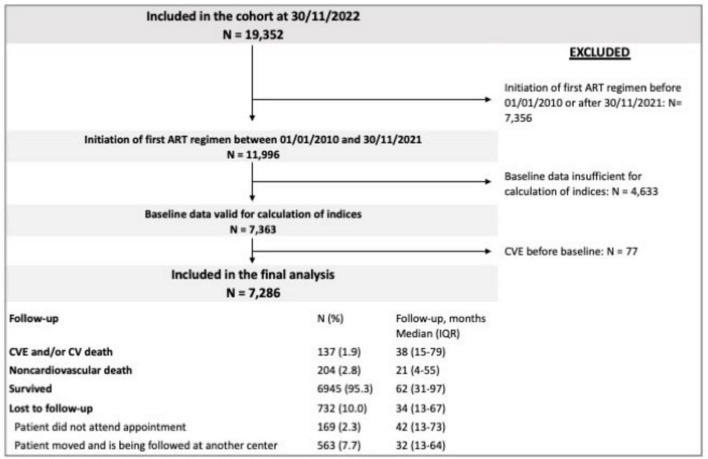 Figure 1
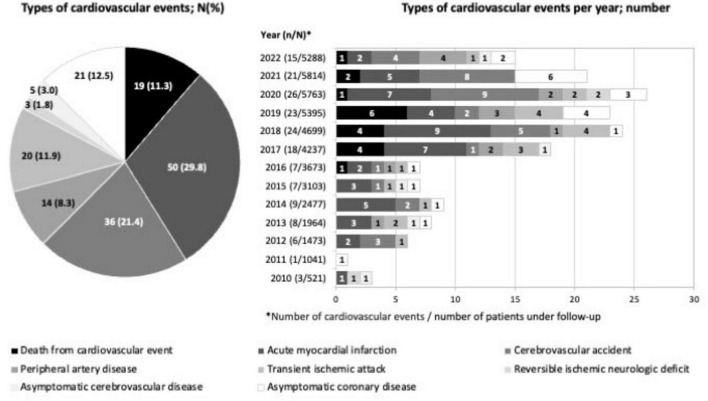 Figure 2
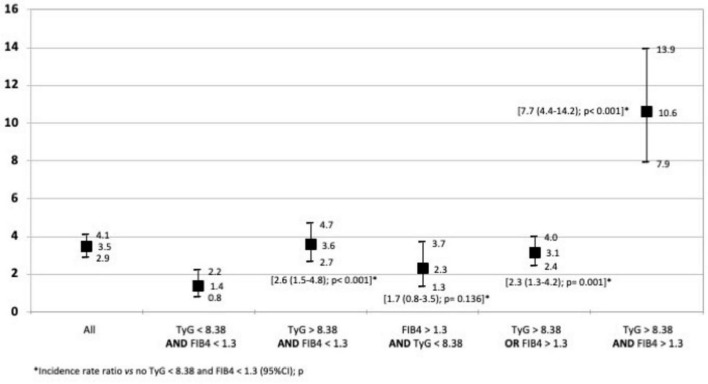 Figure 3
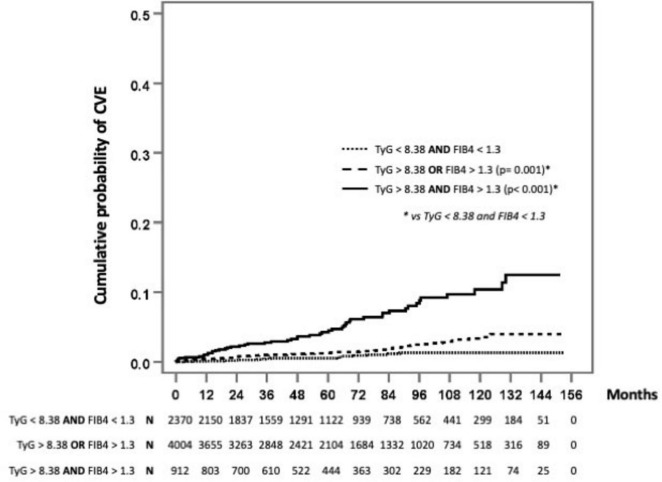 Figure 4
Peer Reviews
No public reviews on file for this paper yet. If you reviewed it on a platform where reviews are public (OpenReview, ICLR, NeurIPS, ICML), you can paste yours below so the community can read it here.
Videos
No videos yet. Explain this paper in a talk, walkthrough, or lecture? Add one.
Taxonomy
TopicsHIV-related health complications and treatments · Diabetes, Cardiovascular Risks, and Lipoproteins · Cardiovascular Function and Risk Factors