Impaired and restored CD8+ T cell responses to a sequentially mutated spike epitope in Omicron variants
Eun Joo Chung, Soyoung Park, Su-Hwan Kim, Ju-yeon Choi, Hye-Sook Jeong, Jae-Hoon Ko, Joon Young Song, Young Jae Lee

TL;DR
The study examines how mutations in the spike protein of Omicron variants affect CD8+ T cell responses and identifies a key epitope involved in immune evasion.
Contribution
The study identifies a specific CD8+ T cell epitope (LYN) that is affected by mutations in Omicron variants and contributes to immune evasion.
Findings
BA.2 mutations more profoundly attenuate LYN-specific cellular immunity compared to BA.1 mutations.
T376A mutation is a major contributor to immune evasion as shown by structural analysis.
Breakthrough infection mitigates the immune evasion effect and the LYN sequence remains conserved in the NB.1.8.1 lineage.
Abstract
In the post-pandemic era, SARS-CoV-2 variants continue to circulate and evolve. T cell-mediated immunity is essential for antiviral defense, but its evasion by emerging variants remains poorly defined. In this study, we screened spike-derived CD8+ T cell epitopes using bioinformatic algorithms and validated them experimentally in COVID-19 vaccine recipients. LYNSASFSTF (LYN), located in the receptor-binding domain (S368–377), was identified as an HLA-A*24:02-restricted epitope harboring mutations observed in Omicron BA.1 (S371L, S373P, and S375F) and BA.2 (S371F, S373P, S375F, and T376A). BA.2 mutations more profoundly attenuated LYN-specific cellular immunity than those from BA.1 with T376A as a major contributor to immune evasion, as supported by structural analysis of altered peptide–HLA interactions. This effect was mitigated by BA.1/BA.2 breakthrough infection and appears unlikely…
Genes, proteins, chemicals, diseases, species, mutations and cell lines named across the full text — each resolved to its canonical identifier and authoritative record.
Click any figure to enlarge with its caption.
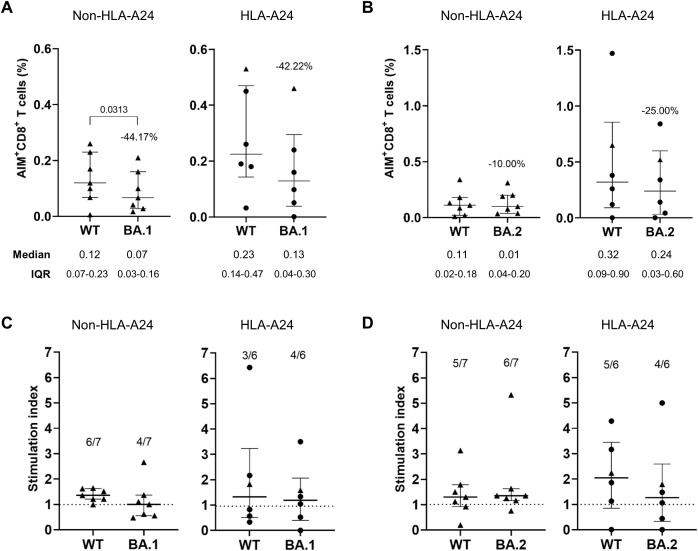 Figure 1
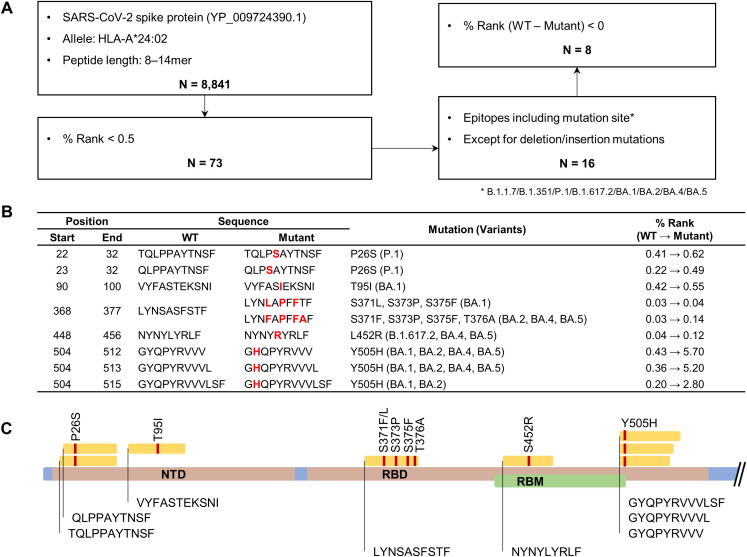 Figure 2
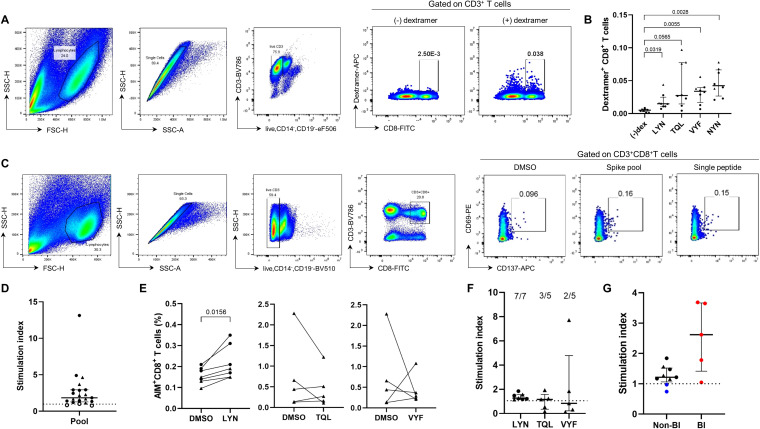 Figure 3
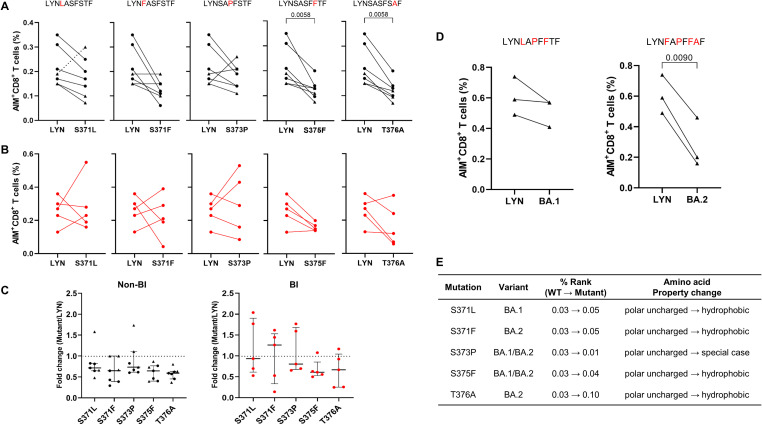 Figure 4
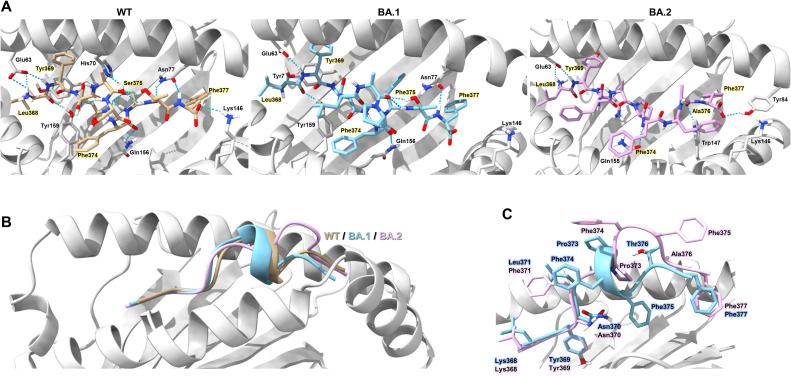 Figure 5
Peer Reviews
No public reviews on file for this paper yet. If you reviewed it on a platform where reviews are public (OpenReview, ICLR, NeurIPS, ICML), you can paste yours below so the community can read it here.
Videos
No videos yet. Explain this paper in a talk, walkthrough, or lecture? Add one.
Taxonomy
Topicsvaccines and immunoinformatics approaches · SARS-CoV-2 and COVID-19 Research · Immunotherapy and Immune Responses