WATCH AFib: smartwatches for detection of atrial fibrillation in secondary prevention of cryptogenic stroke—protocol for a prospective, intraindividual-controlled, multicentre clinical study
Horst Penkert, Johanna Härtl, Alexander Hapfelmeier, Silvia Egert-Schwender, Edith Heimsch, Sabine Friedenberg, Alexander Müller, Franziska Hahn, Eimo Martens, Silke Wunderlich

TL;DR
This study will compare smartwatches and implantable devices for detecting heart rhythm issues in stroke patients to see if smartwatches can help prevent future strokes.
Contribution
The study introduces a novel clinical protocol to evaluate smartwatches as a non-invasive alternative for AFib detection in secondary stroke prevention.
Findings
Smartwatches may offer a non-invasive alternative for prolonged AFib monitoring after cryptogenic stroke.
The study aims to enroll 400 patients to assess smartwatch accuracy compared to implantable event recorders.
AFib detection could improve anticoagulation therapy decisions and reduce stroke recurrence.
Abstract
Detection of atrial fibrillation (AFib) and subsequent anticoagulation therapy reduce the risk of recurrent stroke, while prolonged rhythm monitoring significantly increases AFib detection. Thus, prolonged smartwatch-based ECG monitoring after cryptogenic ischemic stroke or transient ischemic attack (TIA) could lead to a reduction of recurrent stroke by prompting adequate anticoagulation therapy. WATCH AFib investigates the accuracy of smartwatches for AFib detection in patients with cryptogenic TIA or ischemic stroke compared to an implantable event recorder. 40 cases of AFib are required to estimate the sensitivity for AFib detection per patient with a precision of about 10%. As AFib is observed in 9%−16% of cryptogenic strokes, we intend to enroll 400 patients. WATCH AFib is a prospective, intraindividual-controlled, multicentre clinical study in patients with cryptogenic ischemic…
Genes, proteins, chemicals, diseases, species, mutations and cell lines named across the full text — each resolved to its canonical identifier and authoritative record.
Click any figure to enlarge with its caption.
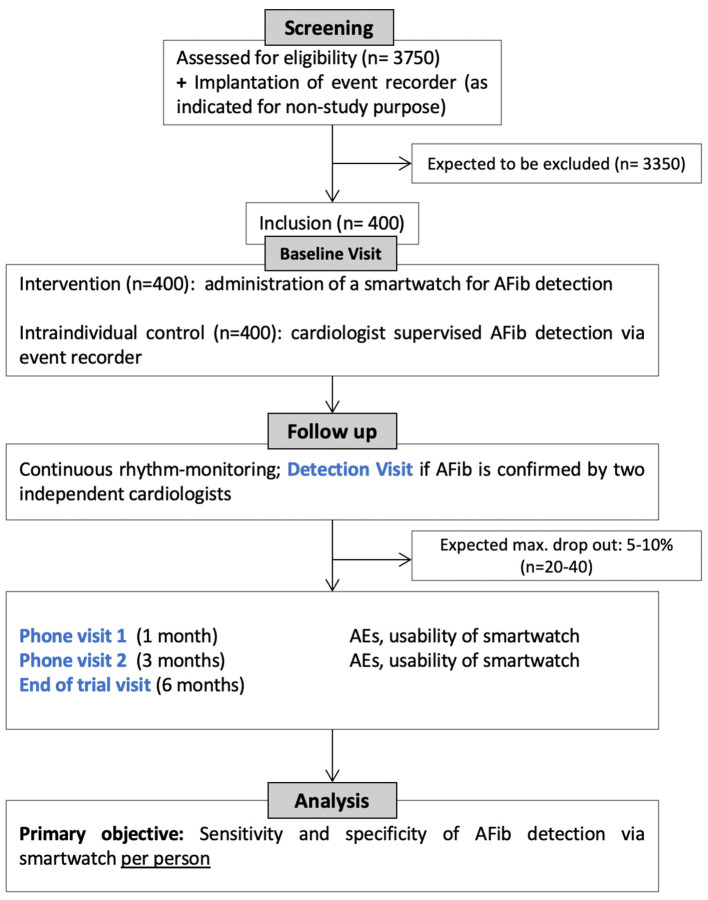 Figure 1
Peer Reviews
No public reviews on file for this paper yet. If you reviewed it on a platform where reviews are public (OpenReview, ICLR, NeurIPS, ICML), you can paste yours below so the community can read it here.
Videos
No videos yet. Explain this paper in a talk, walkthrough, or lecture? Add one.
Taxonomy
TopicsAtrial Fibrillation Management and Outcomes · Acute Ischemic Stroke Management · Cerebrovascular and Carotid Artery Diseases