Case Report: Severe autoimmune hemolytic anemia in an elderly patient caused by warm-reactive IgG and IgA autoantibodies
Wenxia Xia, Jialing Lu, Junjie Hou, Jihao Zhou, Haiqing Lin, Xiaoxuan Lai, Xinyou Zhang, Ruiting Zhang, Peng Ke

TL;DR
A 58-year-old woman with severe anemia caused by two types of autoantibodies was successfully treated with a combination of drugs after a more detailed blood test revealed the issue.
Contribution
Demonstrates the importance of extended DAT testing in diagnosing AIHA caused by multiple autoantibodies and the effectiveness of combination therapy.
Findings
Extended DAT testing identified IgG and IgA autoantibodies in a patient with severe AIHA.
Combination therapy with dexamethasone, rituximab, cyclosporine, and bortezomib improved patient outcomes.
Early intensive treatment is crucial for AIHA caused by multiple autoantibodies.
Abstract
Autoimmune Hemolytic anemia (AIHA) a relatively uncommon form of hemolytic anemia, which is characterized by the presence of autoantibodies directed against erythrocyte surface antigens, most frequently of the IgG isotype. A positive Direct Antiglobulin Test (DAT) is a key diagnostic criterion for AIHA. However, when hemolysis involves multiple autoantibodies, the standard DAT (polyspecific, anti-IgG + C3) may fail to detect certain antibodies, potentially delaying appropriate treatment. We reported one patient with severe AIHA mediated by IgG and IgA autoantibodies was successfully treated with Multi-drug combination regimens. A 58-year-old female was admitted to the hospital presenting with a history of fatigue, jaundice and soy sauce-colored urine for one day. Upon admission, a complete blood count revealed a critically low hemoglobin level of 41 g/L and a life-threatening…
Genes, proteins, chemicals, diseases, species, mutations and cell lines named across the full text — each resolved to its canonical identifier and authoritative record.
Click any figure to enlarge with its caption.
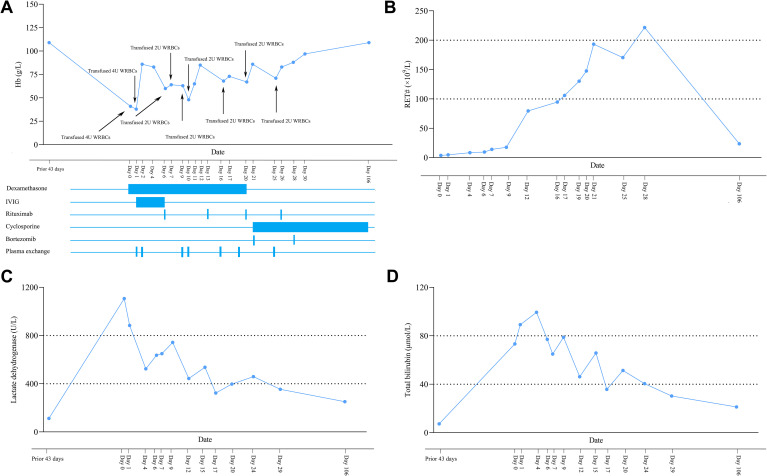 Figure 1
Peer Reviews
No public reviews on file for this paper yet. If you reviewed it on a platform where reviews are public (OpenReview, ICLR, NeurIPS, ICML), you can paste yours below so the community can read it here.
Videos
No videos yet. Explain this paper in a talk, walkthrough, or lecture? Add one.
Taxonomy
TopicsBlood groups and transfusion · Platelet Disorders and Treatments · Blood disorders and treatments