The power of parenting: mitigating conduct problems among adolescents carrying genetic risk
Maia Choi, Genevieve F. Dash, Sally I. Kuo, Fazil Aliev, Holly E. Poore, Sarah J. Brislin, Danielle M. Dick

TL;DR
This study shows that strong parental monitoring can reduce conduct problems in adolescents with a genetic risk for such behaviors.
Contribution
The study demonstrates that parental monitoring moderates the genetic risk for conduct problems in adolescents.
Findings
Parental monitoring significantly reduces the impact of genetic risk on adolescent conduct problems.
Genetic liability for externalizing behaviors is strongly associated with conduct problems when parental monitoring is low.
Family-based interventions can help mitigate conduct problems in genetically at-risk adolescents.
Abstract
Conduct problems (CPs), including aggression, antisocial behavior, and rule-breaking, emerge in childhood and adolescence. Evidence from twin studies shows that CPs are heritable, with approximately 50% of the variance accounted for by genetic influences. Parenting is one prominent and, importantly, modifiable environmental factor in the development of CPs. This study tested whether parental monitoring moderated the associations between genetic liability and CPs in adolescents aged 12–14. We found parental monitoring significantly moderated the association between genetic risk for externalizing and CPs in adolescence. These findings underscore the utility of family-based prevention and intervention efforts, particularly for children at elevated genetic risk.
Genes, proteins, chemicals, diseases, species, mutations and cell lines named across the full text — each resolved to its canonical identifier and authoritative record.
Click any figure to enlarge with its caption.
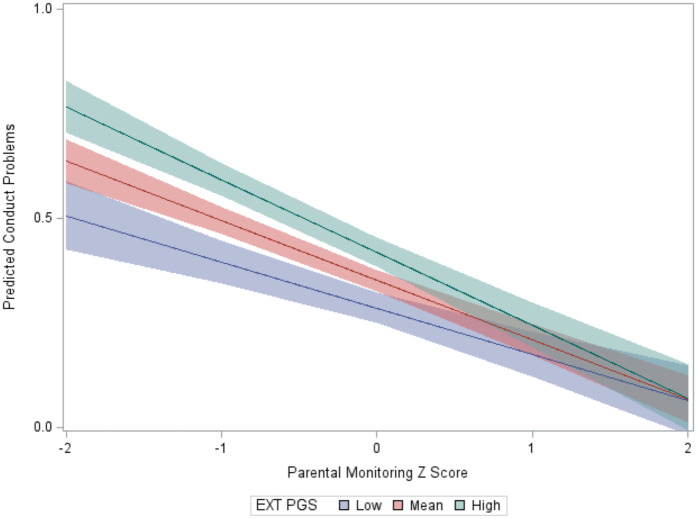 Figure 1
Peer Reviews
No public reviews on file for this paper yet. If you reviewed it on a platform where reviews are public (OpenReview, ICLR, NeurIPS, ICML), you can paste yours below so the community can read it here.
Videos
No videos yet. Explain this paper in a talk, walkthrough, or lecture? Add one.
Taxonomy
TopicsCognitive Abilities and Testing · Child and Adolescent Psychosocial and Emotional Development · Psychopathy, Forensic Psychiatry, Sexual Offending