Higher Controlling Nutritional Status (CONUT) score indicates increased risk of sarcopenia in elderly hospitalized patients: a single institution study in China
Leying Sun, Yilin Yang, Ruiyi Yan, Bingqing Xu, Kaiyu Zhang, Wenyu Zhu, Xiaoyi Lian, Yihui Xu, Lei Liu, Xiuming Gao, Zhengli Guo, Mingqin Zhou

TL;DR
Higher CONUT scores are linked to increased sarcopenia risk in elderly hospitalized patients, suggesting it could be used for screening.
Contribution
This study identifies CONUT score as an independent risk factor for sarcopenia in elderly hospitalized patients.
Findings
High CONUT score is an independent risk factor for sarcopenia (OR:1.814, 95% CI: 1.019–3.255).
Malnutrition is prevalent in sarcopenic patients, with lower albumin and prealbumin levels in high CONUT groups.
Male sex and low iron levels are also associated with sarcopenia.
Abstract
The Controlled Nutritional Status (CONUT) metric has demonstrated effectiveness as a prognostic indicator for acute and chronic diseases in addition to other wasting conditions. However, its association with sarcopenia in elderly hospitalized patients remains insufficiently explored. Our study objectives included the assessment of the potential of CONUT score to predict sarcopenia onset. Our study was a single center retrospective cohort study. Patients from the Department of Geriatrics of the First People’s Hospital of Kunshan were recruited for this study. Multiple indicators related to nutrition and sarcopenia, including CONUT, Prognostic Nutritional Index (PNI), triglyceride–total cholesterol–body weight index (TCBI), Geriatric Nutritional Risk Index (GNRI), and handgrip strength (HGS). Spearman’s and Pearson’s correlation were calculated to assess the associations between…
Genes, proteins, chemicals, diseases, species, mutations and cell lines named across the full text — each resolved to its canonical identifier and authoritative record.
Click any figure to enlarge with its caption.
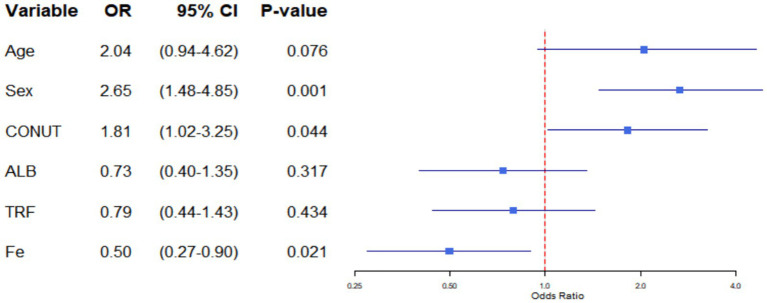 Figure 1
Peer Reviews
No public reviews on file for this paper yet. If you reviewed it on a platform where reviews are public (OpenReview, ICLR, NeurIPS, ICML), you can paste yours below so the community can read it here.
Videos
No videos yet. Explain this paper in a talk, walkthrough, or lecture? Add one.
Taxonomy
TopicsNutrition and Health in Aging · Body Composition Measurement Techniques · Frailty in Older Adults