Case Report: Novel compound heterozygous mutations in PNPLA6 gene associated with Oliver-McFarlane syndrome
Jia Zheng, Zhe Wang, Keqing Li, Lixia Chen, Yayin Luo, Fei Yu, Dan Wang, Guangxiang Yu

TL;DR
A rare case of Oliver-McFarlane syndrome is reported with new genetic mutations in the PNPLA6 gene, helping to understand the condition's cause and diagnosis.
Contribution
Identifies novel compound heterozygous mutations in PNPLA6 gene linked to Oliver-McFarlane syndrome in a Chinese patient.
Findings
Compound heterozygous variants c.3184G>A and c.2704-18C>G in PNPLA6 gene were found in the proband.
c.2704-18C>G variant caused a splice site mutation, leading to a frameshift (p.His902Alafs108).
Findings confirm PNPLA6 gene variation as pathogenic in Oliver-McFarlane syndrome.
Abstract
Oliver-McFarlane syndrome (OMCS) is an extremely rare congenital disorder that presents with hypogonadotropic hypogonadism, long eyelashes and eyebrows, pigmentary retinopathy, peripheral nerve axon neuropathy and other associated features. It is currently known that OMCS is linked to variants in the patatin-like phospholipase domain containing 6 (PNPLA6) gene, but the specific pathogenic mechanism is still unclear. We performed Whole exome sequencing (WES) on the proband and his parents, followed by validation of the findings through Sanger sequencing and Reverse Transcription-Polymerase Chain Reaction (RT-PCR) analysis. Sanger sequencing identified two compound heterozygous variants in the PNPLA6 (NM_006702.5) gene in the proband: c.3184G>A (p.Val1062Met) and c.2704-18C>G. According to the ACMG guidelines, the c.3184G>A variant is classified as likely pathogenic, while the…
Genes, proteins, chemicals, diseases, species, mutations and cell lines named across the full text — each resolved to its canonical identifier and authoritative record.
Click any figure to enlarge with its caption.
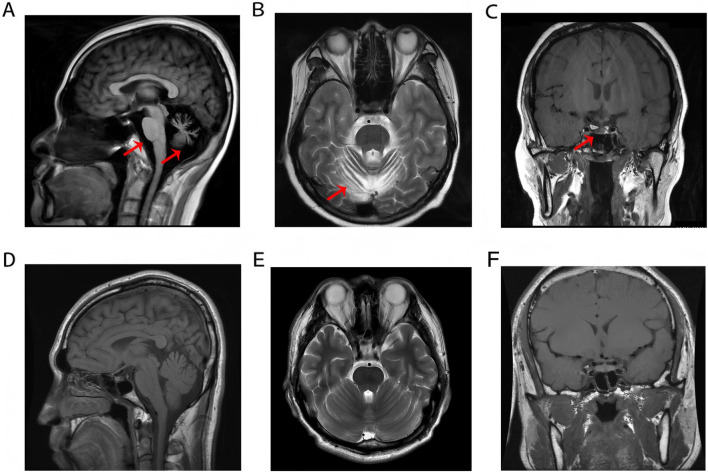 Figure 1
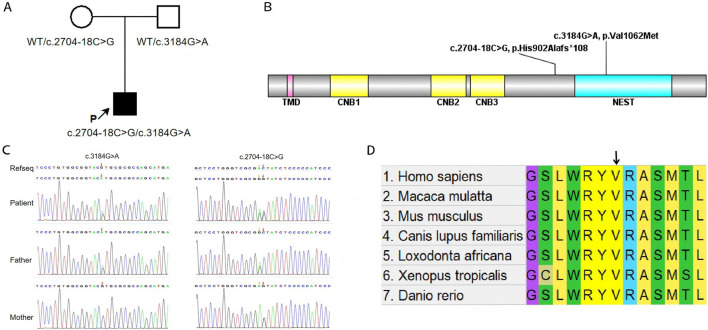 Figure 2
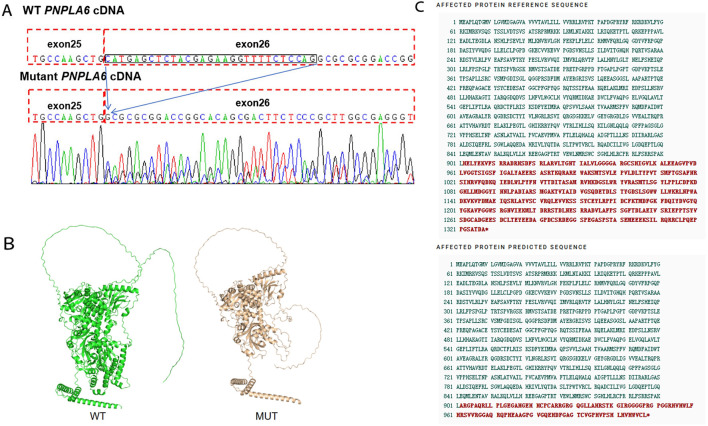 Figure 3
Peer Reviews
No public reviews on file for this paper yet. If you reviewed it on a platform where reviews are public (OpenReview, ICLR, NeurIPS, ICML), you can paste yours below so the community can read it here.
Videos
No videos yet. Explain this paper in a talk, walkthrough, or lecture? Add one.
Taxonomy
TopicsProtein Tyrosine Phosphatases · Genomic variations and chromosomal abnormalities · Proteoglycans and glycosaminoglycans research