Dominant‐Negative Effects of p53 R337 Variants in Li–Fraumeni Syndrome: Impact on Tetramer Formation and Transcriptional Activity
Rui Kamada, Shuya Sakaguchi, Madoka Kanno, Takaaki Ozawa, Natsumi Nakagawa, James G. Omichinski, Kazuyasu Sakaguchi

TL;DR
This study shows how p53 mutations in Li–Fraumeni syndrome reduce the function of normal p53 proteins, leading to cancer risk through unstable protein complexes and reduced gene activity.
Contribution
A novel FRET-based assay was developed to study p53 heterotetramer formation and transcriptional activity in live cells.
Findings
R337C and R337H p53 variants form heterotetramers with wild-type p53 but show significantly reduced transcriptional activity.
The loss of activity is more pronounced for low-affinity response elements like bax compared to high-affinity elements like CDKN1A.
These findings reveal a dominant-negative-like effect of p53 mutations in Li–Fraumeni syndrome.
Abstract
Li–Fraumeni syndrome (LFS) is an inherited cancer predisposition disorder caused by heterozygous TP53 mutations. Among these, missense mutations at Arg337—such as R337C and R337H—are common in LFS patients. Although many studies have characterized individual p53 variants in LFS, the impact of tetramerization domain (TD) mutations on wild‐type (WT) p53 function remains unclear. Herein, a novel FRET‐based assay system that enables the simultaneous detection of heterotetramer formation and p53‐dependent transcriptional activity in live cells is developed. These results show that the heteromultimerization of the R337C variant with WT p53 is only slightly reduced compared to WT homotetramers, yet its transcriptional activity is diminished by over 50%. In contrast, the R337H variant forms heterotetramers at near‐normal levels but exhibits markedly compromised transcriptional activity. These…
Genes, proteins, chemicals, diseases, species, mutations and cell lines named across the full text — each resolved to its canonical identifier and authoritative record.
Click any figure to enlarge with its caption.
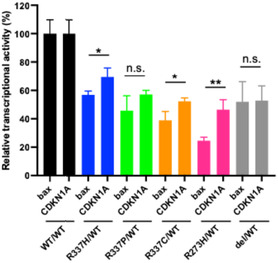 Figure 1
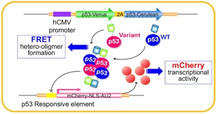 Figure 2
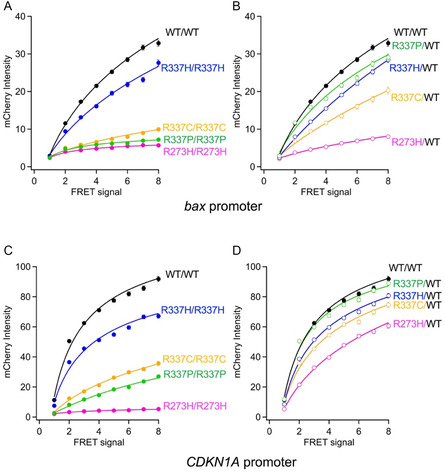 Figure 3
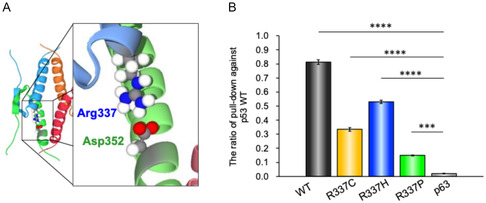 Figure 4
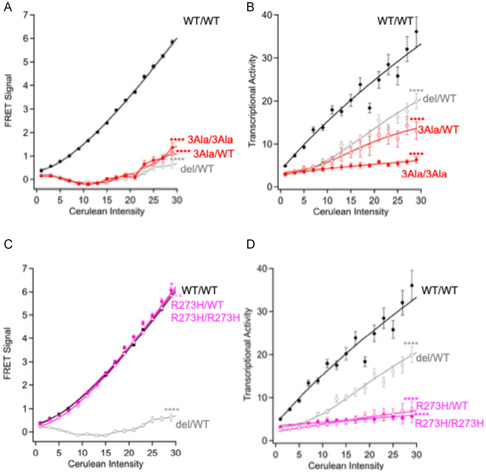 Figure 5
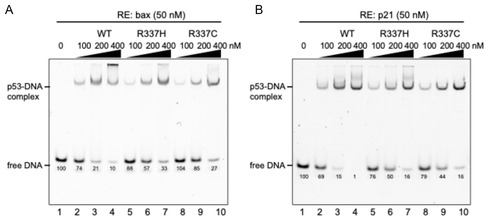 Figure 6
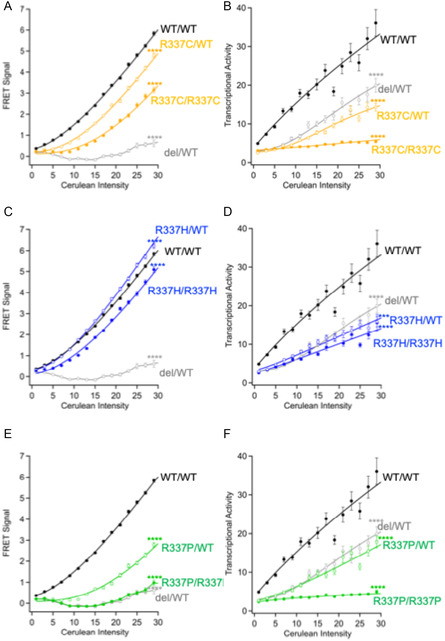 Figure 7
Peer Reviews
No public reviews on file for this paper yet. If you reviewed it on a platform where reviews are public (OpenReview, ICLR, NeurIPS, ICML), you can paste yours below so the community can read it here.
Videos
No videos yet. Explain this paper in a talk, walkthrough, or lecture? Add one.
Taxonomy
TopicsCancer-related Molecular Pathways · HIV Research and Treatment · Epigenetics and DNA Methylation