Exploring the Substrate Flexibility of GrsB Thioesterase Leads to the Structural Reassignment of a Gramicidin S Variant
Sho Konno, Tomoe Mizuguchi, Atsuko Suzuki, Miyu Tanaka, Fumihiro Ishikawa, Akihiro Taguchi, Atsuhiko Taniguchi, Genzoh Tanabe, Yoshio Hayashi

TL;DR
Researchers found that a thioesterase enzyme can process modified building blocks to make a variant of gramicidin S, leading to a structural correction of the variant.
Contribution
The study reveals stereochemical flexibility in GrsB-TE and corrects the structure of a reported GS variant.
Findings
GrsB-TE can cyclize a substrate with L-Ser(Allyl) at position 6 but not at position 1.
The reported GS-variant actually contains D-Ser(Allyl) instead of L-Ser(Allyl).
Structural and functional analyses confirmed the stereochemical flexibility of GrsB-TE.
Abstract
Gramicidin S (GS) is a cyclic decapeptide derived from two pentapeptides. The C‐terminal thioesterase (TE) domain of gramicidin S synthetase B (GrsB) dimerizes precursor pentapeptides and cyclizes the resulting linear decapeptide. Recently, a GS variant (GS‐SA), in which a single D‐Phe is replaced by L‐Ser(Allyl), is reported via precursor‐directed biosynthesis in a native GS producer. To understand how GrsB‐TE processes such modified precursors, its substrate specificity using synthetic linear peptides is investigated. GrsB‐TE cyclizes a substrate containing L‐Ser(Allyl) at position 6 but not at position 1. However, the enzymatically synthesized GS‐SA shows a different high‐performance liquid chromatography retention time than that of the reported GS variant. Further structural and functional analyses, including 1H nuclear magnetic resonance, antimicrobial assays, and circular…
Genes, proteins, chemicals, diseases, species, mutations and cell lines named across the full text — each resolved to its canonical identifier and authoritative record.
Click any figure to enlarge with its caption.
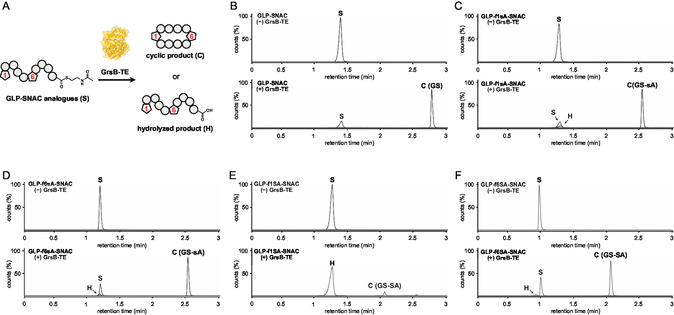 Figure 1
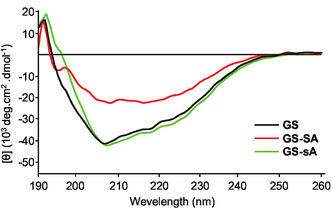 Figure 2
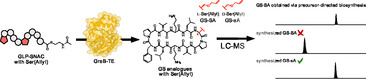 Figure 3
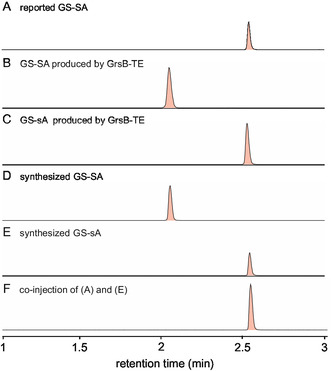 Figure 4
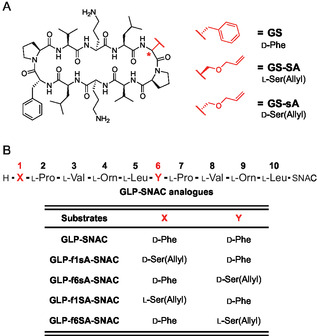 Figure 5
Peer Reviews
No public reviews on file for this paper yet. If you reviewed it on a platform where reviews are public (OpenReview, ICLR, NeurIPS, ICML), you can paste yours below so the community can read it here.
Videos
No videos yet. Explain this paper in a talk, walkthrough, or lecture? Add one.
Taxonomy
TopicsChemical Synthesis and Analysis · Biochemical and Structural Characterization · Carbohydrate Chemistry and Synthesis