A review of the evidence for a protective role of uric acid in Parkinson’s disease
Hanxiang Liu, Gavin P. Reynolds

TL;DR
This paper reviews evidence suggesting that uric acid might protect against Parkinson’s disease by acting as an antioxidant.
Contribution
The paper provides a critical synthesis of clinical, genetic, and experimental evidence for uric acid’s potential protective role in Parkinson’s disease.
Findings
Reduced serum uric acid levels are observed in Parkinson’s disease patients.
Experimental studies suggest uric acid may protect against PD pathogenic mechanisms.
Genetic evidence remains equivocal regarding uric acid’s role in PD.
Abstract
The relationship between the circulating antioxidant uric acid (UA) and Parkinson’s disease (PD) has attracted much interest. This review of the evidence indicating whether UA may have a protective role in the development and/or progression of PD draws on the findings of reduced serum UA in PD, critically assesses the more equivocal genetic results, and discusses experimental observations that UA may provide protection against the pathogenic mechanisms of PD.
Genes, proteins, chemicals, diseases, species, mutations and cell lines named across the full text — each resolved to its canonical identifier and authoritative record.
Click any figure to enlarge with its caption.
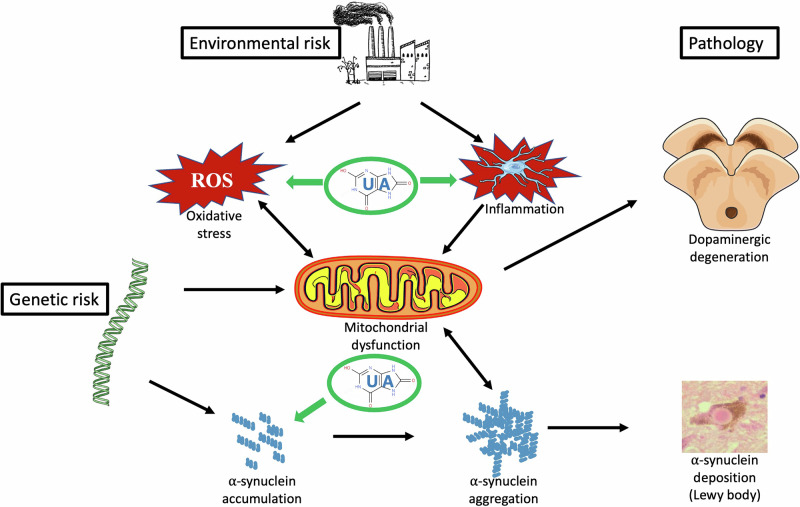 Figure 1
Peer Reviews
No public reviews on file for this paper yet. If you reviewed it on a platform where reviews are public (OpenReview, ICLR, NeurIPS, ICML), you can paste yours below so the community can read it here.
Videos
No videos yet. Explain this paper in a talk, walkthrough, or lecture? Add one.
Taxonomy
TopicsGout, Hyperuricemia, Uric Acid · Parkinson's Disease Mechanisms and Treatments · Inflammasome and immune disorders