Neuropsychological insights into creativity in people with Parkinson’s disease
Sara Zeggio, David Steyrl, Matthew Pelowski, Paul Krack, Sirwan K. L. Darweesh, Julia S. Crone, Bastiaan R. Bloem, Marjan J. Meinders, Blanca T. M. Spee

TL;DR
This study explores how Parkinson’s disease affects creativity, finding that dopamine treatments and lifestyle factors can increase creative activity.
Contribution
The study identifies specific neuropsychological and lifestyle factors that predict changes in creativity among people with Parkinson’s disease.
Findings
Dopamine agonists, extraversion, free time, and a creative lifestyle predict increased creativity in Parkinson’s patients.
Disorganized schizotypy is associated with decreased creativity in Parkinson’s disease.
Machine learning explains 23% of the variance in creativity changes among participants.
Abstract
Creativity, the capacity and motivation to produce novel and personally meaningful ideas or behaviors, can be influenced by Parkinson’s disease (PD). Non-motor neuropsychological symptoms, such as apathy and negative schizotypy have been linked to reduced creativity, while dopaminergic treatments are associated with increased creative engagement. Building on epidemiological findings investigating changes in creativity, we examined possible drivers of increased and decreased creative activity. In a cross-sectional study, 360 participants with PD completed a questionnaire assessing self-reported creativity changes and associated factors, including personality (Big-Five, Multidimensional-Schizotypy-Scale), lifestyle (e.g., creative lifestyle, free time), and clinical (HY-scores, MoCA, dopaminergic treatments). Using machine learning (gradient-boosted decision-trees), we explained 23% of…
Genes, proteins, chemicals, diseases, species, mutations and cell lines named across the full text — each resolved to its canonical identifier and authoritative record.
Click any figure to enlarge with its caption.
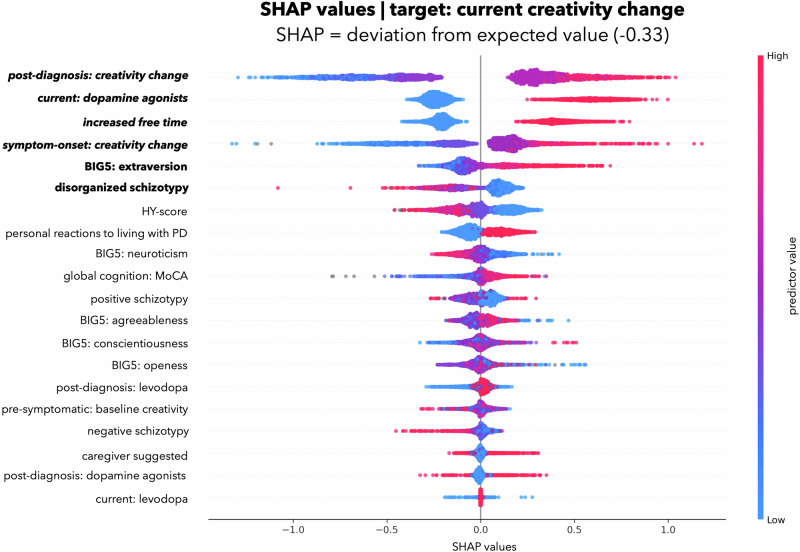 Figure 1
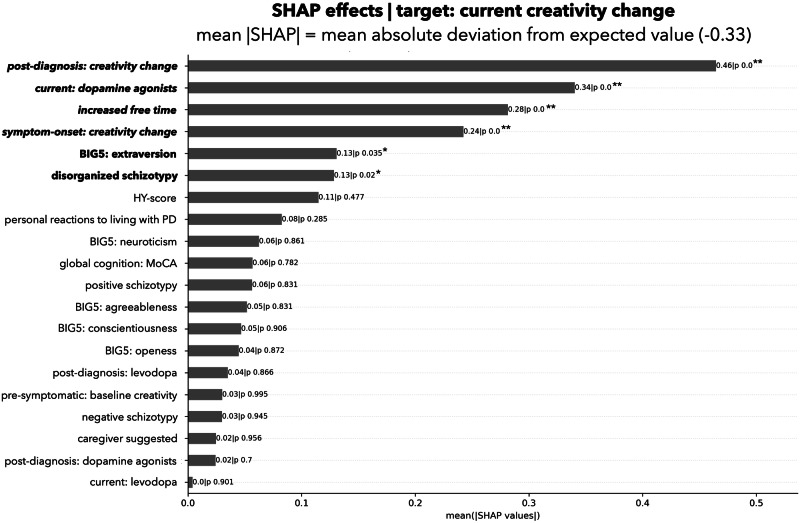 Figure 2
Peer Reviews
No public reviews on file for this paper yet. If you reviewed it on a platform where reviews are public (OpenReview, ICLR, NeurIPS, ICML), you can paste yours below so the community can read it here.
Videos
No videos yet. Explain this paper in a talk, walkthrough, or lecture? Add one.
Taxonomy
TopicsCreativity in Education and Neuroscience · Mind wandering and attention · Action Observation and Synchronization