Optimal structure of signal networks for efficient information aggregation
Bernd Heidergott, Frank den Hollander, Ines Lindner, Azadeh Parvaneh

TL;DR
This paper studies how signal networks can efficiently represent their overall state using just a few key nodes, inspired by systems in neuroscience, medicine, and social science.
Contribution
A mathematical framework is introduced to determine the minimal number of key nodes needed for accurate global network state representation.
Findings
Two or three key nodes are typically sufficient to approximate the overall network state well.
The framework balances sensitivity and robustness in large scale-free and disassortative networks.
Analytical results show how natural systems can aggregate information efficiently using minimal structural components.
Abstract
This paper develops a mathematical framework to study signal networks, in which nodes can be active or inactive, and their activation or deactivation is driven by external signals and the states of the nodes to which they are connected via links. The focus is on determining the optimal number of key nodes (= highly connected and structurally important nodes) required to represent the global activation state of the network accurately. Motivated by neuroscience, medical science, and social science examples, we describe the node dynamics as a continuous-time inhomogeneous Markov process. Under mean-field and homogeneity assumptions, appropriate for large scale-free and disassortative signal networks, we derive differential equations characterising the global activation behaviour and compute the expected hitting time to network triggering. Analytical and numerical results show that two or…
Genes, proteins, chemicals, diseases, species, mutations and cell lines named across the full text — each resolved to its canonical identifier and authoritative record.
Click any figure to enlarge with its caption.
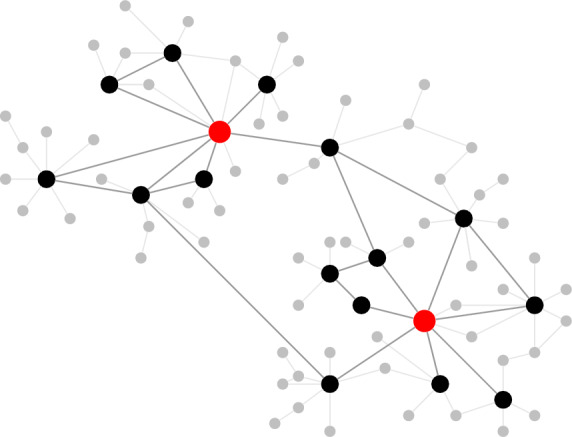 Figure 1
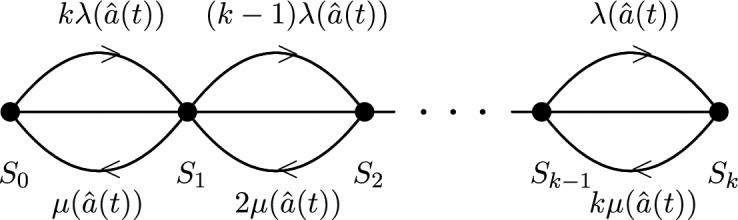 Figure 2
Peer Reviews
No public reviews on file for this paper yet. If you reviewed it on a platform where reviews are public (OpenReview, ICLR, NeurIPS, ICML), you can paste yours below so the community can read it here.
Videos
No videos yet. Explain this paper in a talk, walkthrough, or lecture? Add one.
Taxonomy
TopicsComplex Network Analysis Techniques · Neural dynamics and brain function · Functional Brain Connectivity Studies