Functional analysis of a novel variant in the COL5A1 gene in a Polish patient with the classical type of Ehlers–Danlos syndrome
Anna Junkiert-Czarnecka, Karolina Maciak, Magdalena M. Kacprzak, Agnieszka Łobodzińska, Agnieszka Sobczyńska-Tomaszewska, Aneta Jurkiewicz, Monika Gora, Beata Burzynska, Maria Pilarska-Deltow, Olga Haus

TL;DR
A new genetic variant in the COL5A1 gene was found in a Polish girl with classical Ehlers–Danlos syndrome, leading to a truncated protein and confirming the diagnosis.
Contribution
A novel COL5A1 variant was identified and functionally analyzed, providing insights into its role in classical EDS.
Findings
A novel COL5A1 variant (c.2089-7_2089dupGTACACAG) was identified in a patient with classical EDS.
The variant causes a premature stop codon and a truncated protein missing ~1,000 amino acids.
The variant is de novo and disrupts the triple helical domain of type V collagen.
Abstract
Ehlers–Danlos syndrome (EDS) is a clinically and genetically diverse group of inherited connective tissue disorders. According to the 2017 International Classification, 13 EDS subtypes are associated with pathogenic variants in 19 genes, most of which are involved in collagen synthesis or structure. The most common forms include classical (cEDS) and hypermobile (hEDS) types. Classical EDS is primarily caused by pathogenic variants in the COL5A1 and COL5A2 genes, which encode type V collagen, and less frequently by the c.934C>T variant in COL1A1. This study investigated the molecular basis of cEDS in a 9-year-old girl presenting clinical features consistent with this subtype. Whole-exome sequencing (WES) identified a novel variant in COL5A1: c.2089-7_2089dupGTACACAG. Functional analysis showed that this duplication causes a shift in the exon start site, resulting in a premature stop…
Genes, proteins, chemicals, diseases, species, mutations and cell lines named across the full text — each resolved to its canonical identifier and authoritative record.
Click any figure to enlarge with its caption.
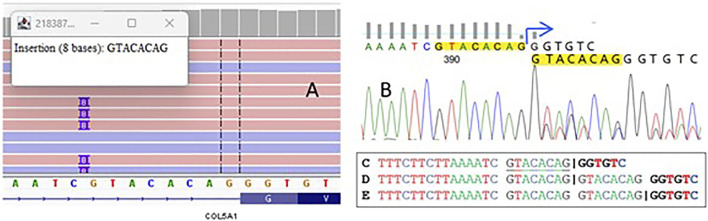 Figure 1
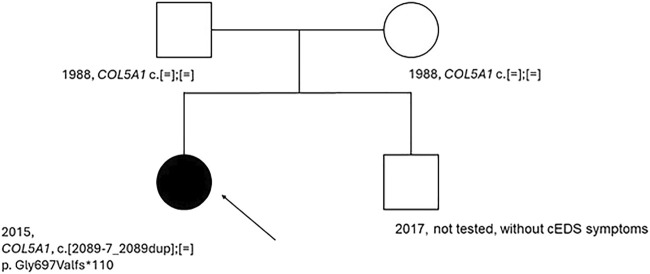 Figure 2
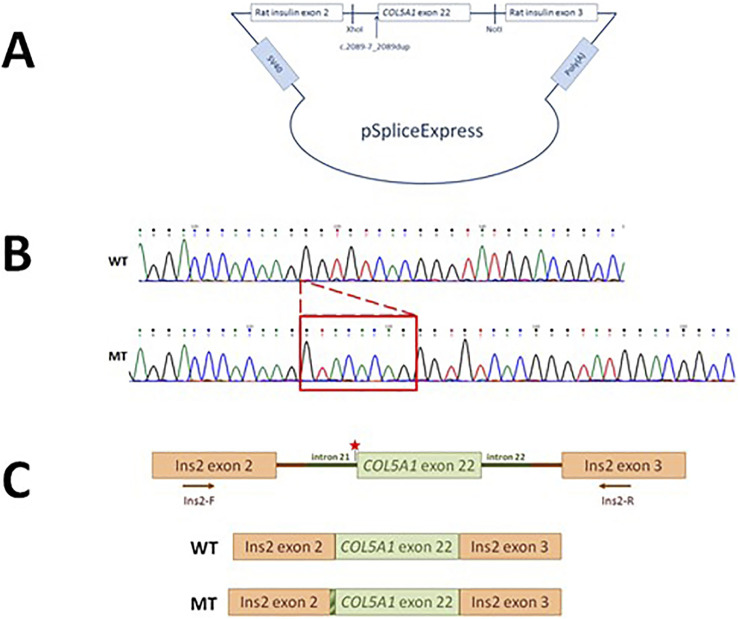 Figure 3
Peer Reviews
No public reviews on file for this paper yet. If you reviewed it on a platform where reviews are public (OpenReview, ICLR, NeurIPS, ICML), you can paste yours below so the community can read it here.
Videos
No videos yet. Explain this paper in a talk, walkthrough, or lecture? Add one.
Taxonomy
TopicsConnective tissue disorders research · Cell Adhesion Molecules Research · Tendon Structure and Treatment