Deceased donor kidney transplantation in candidates with pre-transplant hematological malignancies: a literature review and recipient allocation proposal in Singapore
Emmett Tsz Yeung Wong, Ian Tatt Liew, Hein Than, Aloysius Yew Leng Ho, Chandramouli Nagarajan, Yeow Tee Goh, Charles Thuan Heng Chuah, Michelle Limei Poon, Wee Joo Chng, Melissa Gaik Ming Ooi, Widanalage Sanjay Prasad De Mel, Allen Eng Juh Yeo, Terence Kee, Anantharaman Vathsala

TL;DR
This paper reviews kidney transplant allocation for cancer survivors in Singapore, where donor organs are scarce, and proposes guidelines for fair and efficient allocation.
Contribution
The paper proposes a tailored allocation framework for deceased donor kidney transplants in Singapore, considering local organ scarcity and cancer survivor outcomes.
Findings
Patients with pre-transplant hematological malignancies have higher mortality risks but improved survival with modern therapies.
Allocation of scarce donor kidneys to these patients requires careful evaluation to balance justice and utilitarianism.
The proposed framework is specific to Singapore's context and may not apply universally.
Abstract
Deceased donor kidneys are a scarce national resource, and principles of utilitarianism and justice govern allocation. Kidney transplant recipients with a prior history of cancer show an increased risk of malignancy- and non-malignancy-related mortality compared to their counterparts without a previous history of malignancy. The inferior survival of a recipient with pre-transplant malignancy questions the allocation of a scarce resource to a population at anticipated poorer patient and graft survival. However, patient survival has significantly improved with advances in therapeutics for hematological malignancies, which led to an updated consensus expert opinion by the American Society of Transplantation in 2019. Nevertheless, the candidacy of patients with pre-transplant hematological malignancies in countries with a scarcity of deceased donor kidneys and a prolonged wait time may…
Genes, proteins, chemicals, diseases, species, mutations and cell lines named across the full text — each resolved to its canonical identifier and authoritative record.
Click any figure to enlarge with its caption.
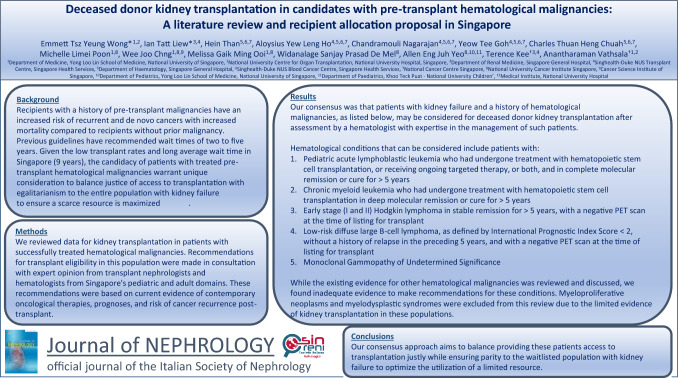 Figure 1
Peer Reviews
No public reviews on file for this paper yet. If you reviewed it on a platform where reviews are public (OpenReview, ICLR, NeurIPS, ICML), you can paste yours below so the community can read it here.
Videos
No videos yet. Explain this paper in a talk, walkthrough, or lecture? Add one.
Taxonomy
TopicsRenal Transplantation Outcomes and Treatments · Polyomavirus and related diseases · Viral-associated cancers and disorders