Lumasiran at birth changes the trajectory of primary hyperoxaluria type 1: same disease, different outcomes in two affected siblings
Licia Peruzzi, Marta Leporati

TL;DR
Treating a newborn with lumasiran immediately after birth prevented severe symptoms of primary hyperoxaluria type 1, unlike in his older brother who developed complications.
Contribution
This is the first report of oxalate and glycolate metabolism in a newborn with primary hyperoxaluria type 1 treated with lumasiran at birth.
Findings
Early treatment with lumasiran and supportive care prevented symptoms of primary hyperoxaluria type 1 in a newborn over 24 months.
Blood oxalate supersaturation was avoided after 30 days of treatment initiation.
No adverse events were observed with the treatment regimen.
Abstract
Lumasiran, an RNA interference therapeutic, demonstrated effectiveness in clinical trials, leading to approval for primary hyperoxaluria type 1 management in all age groups. To date, little is known about its use in newborns. This study assesses, for the first time, the oxalate and glycolate metabolism in a newborn affected by primary hyperoxaluria type 1 treated at birth. His older brother, also affected by primary hyperoxaluria type 1, experienced severe disease progression and significant comorbidities. These challenges informed the decision to initiate immediate treatment for the younger sibling. The child was treated at 6 h of life with lumasiran 6 mg/kg subcutaneously, in combination with pyridoxin 10 mg/kg/day. Lumasiran 6 mg/kg was repeated at 30 and 60 days, then was reduced to 3 mg/kg every month. Intravenous hyperhydration (240 mL/kg/day) was maintained for 16 days, together…
Genes, proteins, chemicals, diseases, species, mutations and cell lines named across the full text — each resolved to its canonical identifier and authoritative record.
Click any figure to enlarge with its caption.
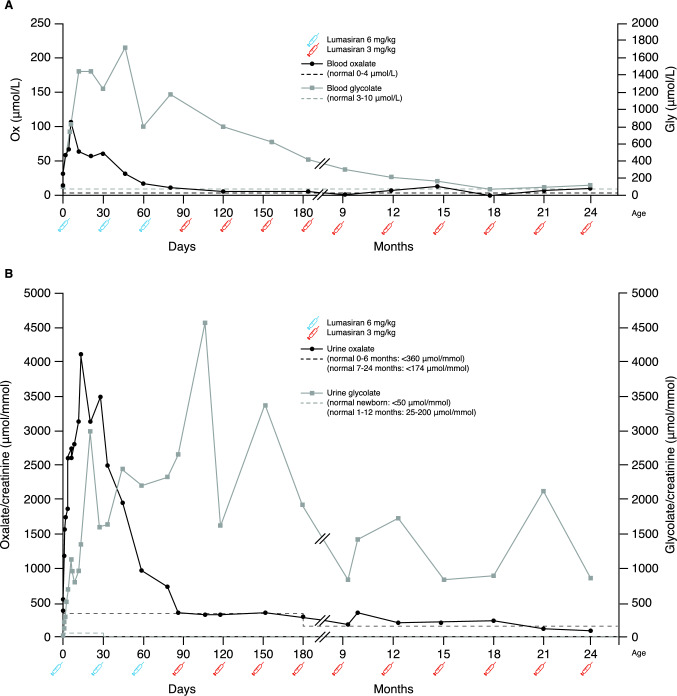 Figure 1
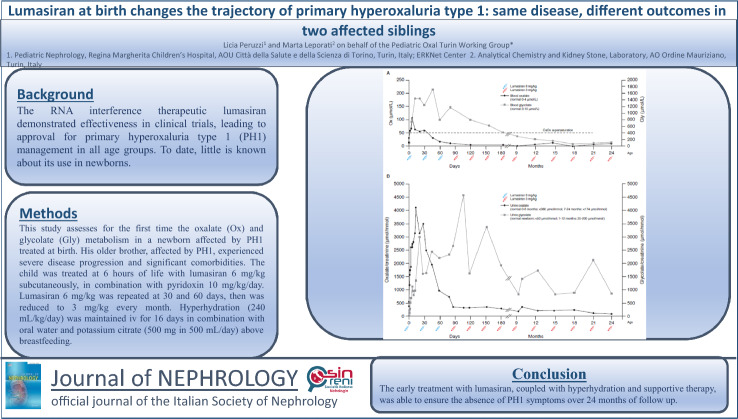 Figure 2
Peer Reviews
No public reviews on file for this paper yet. If you reviewed it on a platform where reviews are public (OpenReview, ICLR, NeurIPS, ICML), you can paste yours below so the community can read it here.
Videos
No videos yet. Explain this paper in a talk, walkthrough, or lecture? Add one.
Taxonomy
TopicsKidney Stones and Urolithiasis Treatments · Biomedical Research and Pathophysiology · Porphyrin Metabolism and Disorders