Post-traumatic epilepsy: bridging pathogenesis, diagnosis, and pharmacotherapeutic strategies
Xiaoyu Yang, Siyang Chen, Haozhou Wang, Tong Sun, Ke Wu

TL;DR
This paper reviews how brain injury can lead to epilepsy, focusing on diagnosis and treatment strategies.
Contribution
The paper provides a comprehensive overview of PTE, integrating pathogenesis, diagnosis, and treatment advances.
Findings
PTE affects 2%–50% of TBI survivors depending on injury severity.
Integrated risk stratification improves prediction of epileptogenesis.
Current diagnosis combines clinical history and multimodal monitoring.
Abstract
Post-traumatic epilepsy (PTE)—affecting 2%–50% of traumatic brain injury (TBI) survivors with severity-dependent incidence—drives secondary neurodegeneration through elevated intracranial pressure (ICP), axonal injury, and neuroinflammatory cascades. While integrated risk stratification (e.g., cortical contusion, acute subdural hematoma on CT; blood-brain barrier disruption via dynamic contrast-enhanced MRI) enhances epileptogenesis prediction, mechanistic understanding of circuit reorganization underlying chronic hyperexcitability remains incomplete. Diagnosis integrates trauma history, seizure semiology, and multimodal monitoring (high-density EEG correlated with [18F] FDG-PET hypometabolism), yet evidence-based prophylaxis is confined to early PTE prevention. In this review, we will describe the progress in incidence, predictors, pathophysiological mechanisms diagnosis, prophylaxis,…
Genes, proteins, chemicals, diseases, species, mutations and cell lines named across the full text — each resolved to its canonical identifier and authoritative record.
Click any figure to enlarge with its caption.
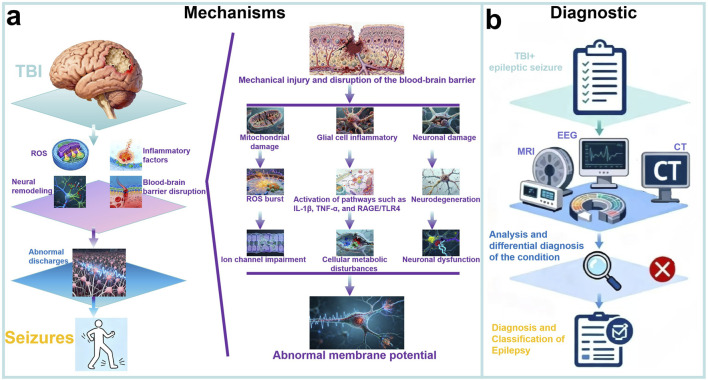 Figure 1
Peer Reviews
No public reviews on file for this paper yet. If you reviewed it on a platform where reviews are public (OpenReview, ICLR, NeurIPS, ICML), you can paste yours below so the community can read it here.
Videos
No videos yet. Explain this paper in a talk, walkthrough, or lecture? Add one.
Taxonomy
TopicsTraumatic Brain Injury and Neurovascular Disturbances · Epilepsy research and treatment · Traumatic Brain Injury Research