Efficient estimation of gadolinium‐based contrast agent concentration using transient‐state keyhole MR‐STAT
Fei Xu, Edwin Versteeg, Hongyan Liu, Miha Fuderer, Oscar van den Heide, Wybe J. M. van der Kemp, Cornelis A. T. van den Berg, Alessandro Sbrizzi

TL;DR
This paper introduces a faster MRI method to estimate contrast agent concentration using a new accelerated protocol, tested in phantoms and synthetic patient data.
Contribution
A novel accelerated MR-STAT protocol that enables efficient and accurate GBCA concentration estimation in clinically feasible scan times.
Findings
The accelerated MR-STAT protocol achieved accurate T1, T2, and GBCA concentration measurements with an undersampling factor of 4.
Estimated GBCA concentrations showed a strong linear relationship with reference values (slope 1.034, intercept 0.009).
Abstract
Fast quantitative MRI (qMRI) techniques have emerged to quantify multiple tissue parameters from a single acquisition in clinically feasible scan times. To integrate fast qMRI techniques into a clinical MRI protocol, one needs to consider imaging after injection of a contrast agent (e.g., dynamic contrast‐enhanced [DCE] imaging). However, fully repeating the multi‐parametric scan after the injection requires lengthy scan times, which are impractical for tracking the contrast agent concentration. This work aimed to develop and validate an accelerated multi‐parametric method capable of estimating the concentration of Gadolinium‐based contrast agents (GBCAs) in a more time‐efficient way. We designed an accelerated 2D Magnetic Resonance Spin TomogrAphy in Time‐domain (MR‐STAT) protocol and tested it on a 3T MRI scanner. This is achieved by combining transient‐state acquisitions with…
Genes, proteins, chemicals, diseases, species, mutations and cell lines named across the full text — each resolved to its canonical identifier and authoritative record.
Click any figure to enlarge with its caption.
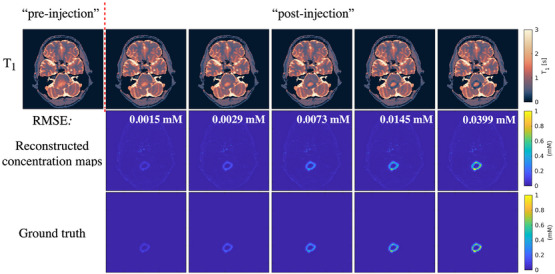 Figure 1
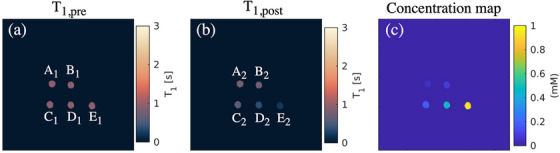 Figure 2
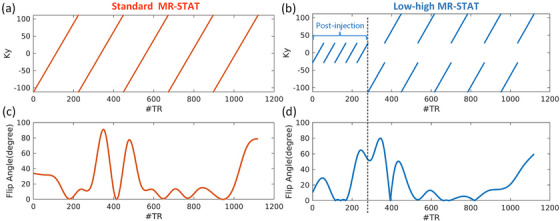 Figure 3
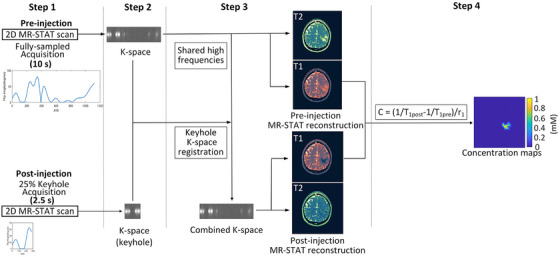 Figure 4
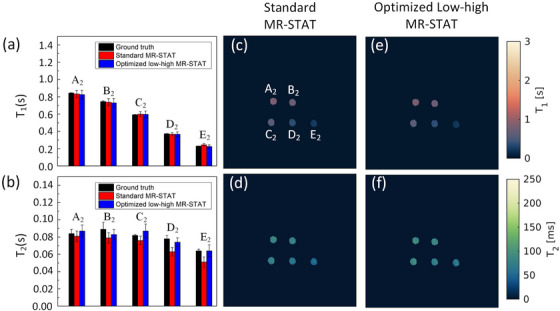 Figure 5
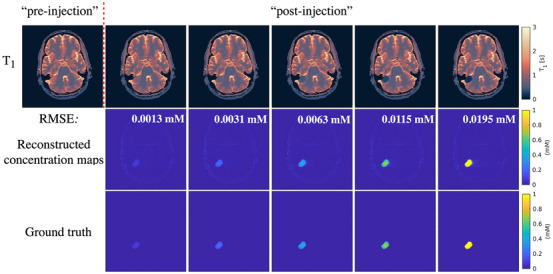 Figure 6
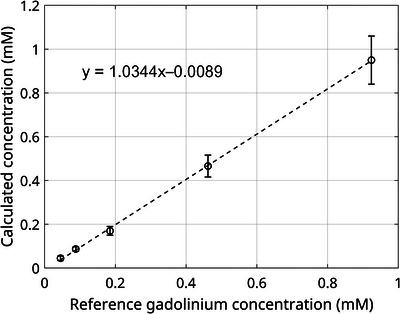 Figure 7
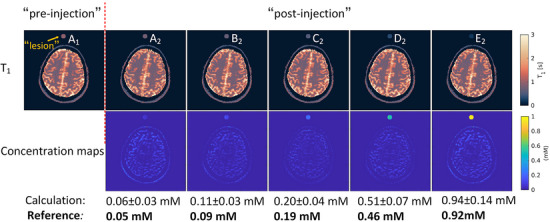 Figure 8
Peer Reviews
No public reviews on file for this paper yet. If you reviewed it on a platform where reviews are public (OpenReview, ICLR, NeurIPS, ICML), you can paste yours below so the community can read it here.
Videos
No videos yet. Explain this paper in a talk, walkthrough, or lecture? Add one.
Taxonomy
TopicsLanthanide and Transition Metal Complexes · Advanced MRI Techniques and Applications · Acute Kidney Injury Research