Mobilising cultural heritage for locally owned adaptation
Kate Donovan, Rowan Jackson, Siona O’Connell, Dulma Karunarathna, Arry Retnowati, Esti Anantasari, YoungHwa Cha, Dominique Niemand, David C. Harvey, Andrew Dugmore

TL;DR
The paper suggests using cultural heritage to create more sustainable and locally suitable climate change adaptations.
Contribution
The novelty lies in integrating cultural heritage into climate adaptation strategies to enhance local relevance and sustainability.
Findings
Engaging with cultural heritage helps create adaptive strategies that reflect local knowledge and values.
Using cultural heritage can lead to more scalable and sustainable climate adaptation solutions.
Risk narratives informed by heritage provide a multi-generational perspective on adaptation.
Abstract
Climate change adaptation planning and implementation has been criticised for following linear steps that can limit local suitability, scalability and sustainability. We argue that meaningful climate change adaptations incorporate a diversity of voices using cultural heritage for situated and multi-generational interventions. Here, we present examples of risk narratives and adaptive strategies developed through engagement with cultural heritage, balancing knowledge of environment with local livelihoods, histories, values and meaning.
Genes, proteins, chemicals, diseases, species, mutations and cell lines named across the full text — each resolved to its canonical identifier and authoritative record.
Click any figure to enlarge with its caption.
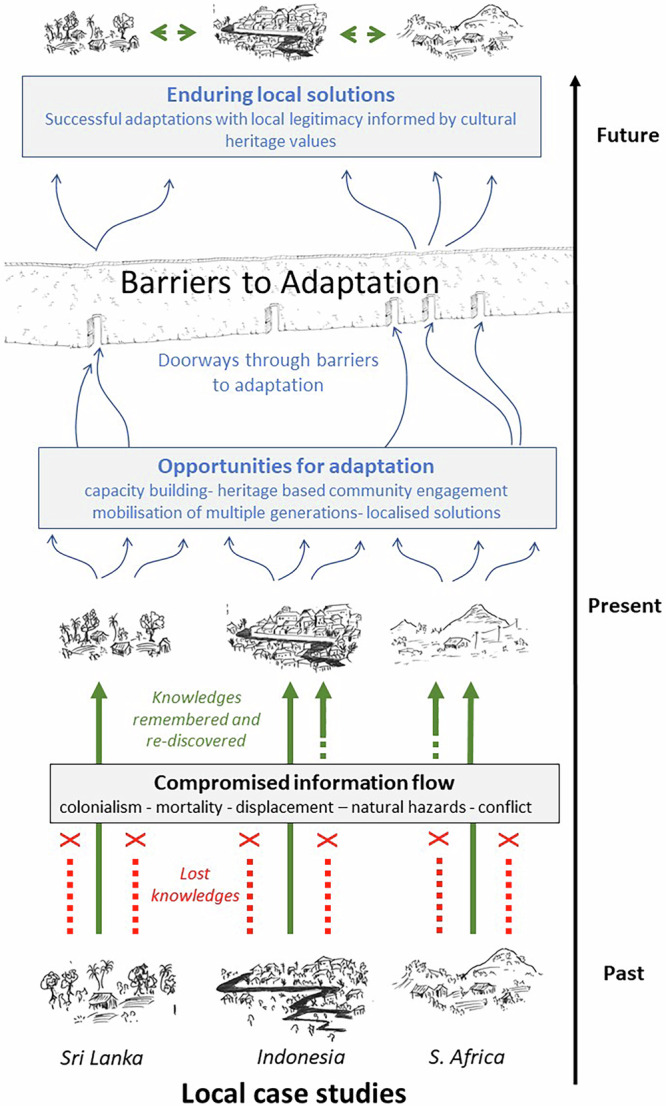 Figure 1
Peer Reviews
No public reviews on file for this paper yet. If you reviewed it on a platform where reviews are public (OpenReview, ICLR, NeurIPS, ICML), you can paste yours below so the community can read it here.
Videos
No videos yet. Explain this paper in a talk, walkthrough, or lecture? Add one.
Taxonomy
TopicsConservation Techniques and Studies · Climate Change, Adaptation, Migration · Cultural Heritage Management and Preservation