Assessing the diagnostic value of qPCR for Trichuris trichiura: sub-analysis of a multi-country clinical trial to determine the efficacy of albendazole compared to an albendazole-ivermectin fixed dose combination
Pedro E. Fleitas, Michel Bengtson, Augusto Messa, Brian Bartilol, Woyneshet Gelaye, Stella Kepha, Javier Gandasegui, Áuria de Jesus, Valdemiro Novela, Inácio Mandomando, Charles Mwandawiro, Wendemagegn Enbiale, Alejandro Krolewiecki, Jose Muñoz, Martin Rono, Lisette van Lieshout

TL;DR
This study compares qPCR and Kato-Katz methods to evaluate the effectiveness of a drug combination for treating Trichuris trichiura infections in a multi-country trial.
Contribution
The study demonstrates that qPCR complements traditional methods and enhances drug efficacy evaluation in helminth trials.
Findings
qPCR confirmed superior efficacy of FDC over albendazole, aligning with Kato-Katz results.
Discrepancies in cure rates between qPCR and Kato-Katz were observed, especially for FDC treatments.
Machine learning models accurately predicted baseline infection intensity from qPCR data.
Abstract
Trichuris trichiura remains a major global public health concern, particularly in low-resource settings where standard anthelmintic regimens are limited. This study evaluated the diagnostic performance of real-time PCR (qPCR) compared to the Kato-Katz (KK) method in assessing the efficacy of a fixed-dose combination (FDC) of albendazole and ivermectin versus albendazole for the treatment of T. trichiura. The study was embedded within the ALIVE clinical trial (NCT05124691), a phase 2/3 trial conducted in Kenya, Mozambique, and Ethiopia. Stool samples were collected at baseline and 21 ± 7 days post-treatment, with KK performed on fresh samples and qPCR on ethanol-preserved aliquots. In total 534 participants were selected based on positive KK and qPCR at baseline and complete data post-treatment. The primary endpoint was cure rate (CR) by KK and qPCR; secondary endpoints included egg…
Genes, proteins, chemicals, diseases, species, mutations and cell lines named across the full text — each resolved to its canonical identifier and authoritative record.
Click any figure to enlarge with its caption.
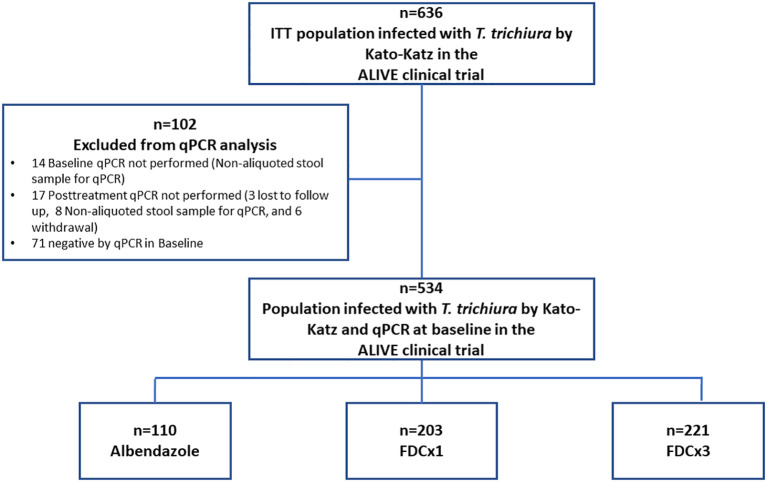 Figure 1
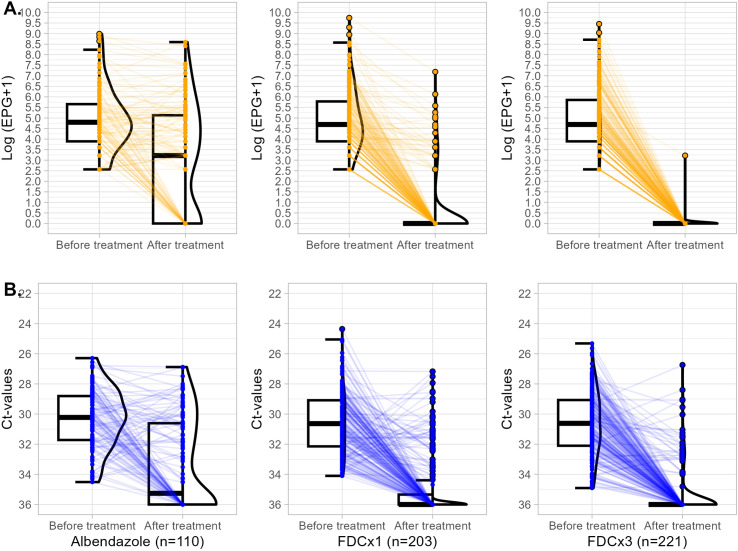 Figure 2
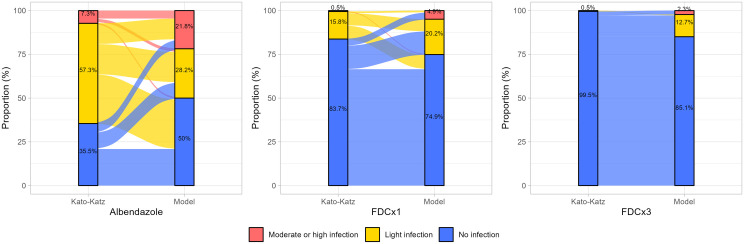 Figure 3
Peer Reviews
No public reviews on file for this paper yet. If you reviewed it on a platform where reviews are public (OpenReview, ICLR, NeurIPS, ICML), you can paste yours below so the community can read it here.
Videos
No videos yet. Explain this paper in a talk, walkthrough, or lecture? Add one.
Taxonomy
TopicsParasites and Host Interactions · Helminth infection and control · Parasitic Diseases Research and Treatment