Percutaneous Management of Cabrol Graft Chronic Total Occlusion: Case Report
Teodora Donisan, Conor M. Lane, Christopher J. Francois, Guy Reeder, Malakh Shrestha, Rajiv Gulati, Abhiram Prasad

TL;DR
A 54-year-old man with a blocked Cabrol graft was successfully treated using a minimally invasive procedure, showing this approach is possible.
Contribution
This is the first reported case of percutaneous coronary intervention for a Cabrol graft chronic total occlusion.
Findings
Percutaneous coronary intervention successfully recanalized a Cabrol graft chronic total occlusion.
Advanced CTO techniques and imaging were essential for successful treatment.
Symptoms improved after the procedure, demonstrating clinical benefit.
Abstract
Cabrol Dacron grafts are used to reimplant coronary arteries during aortic root replacement for complex aortic pathologies. Graft complications, particularly chronic total occlusions (CTO), are challenging. We present a 54-year-old man with a right coronary artery Cabrol graft CTO, treated successfully with percutaneous coronary intervention. Preprocedural imaging confirmed graft stump and right coronary artery collateral anatomy. Using advanced CTO techniques, the graft was recanalized, and symptoms improved. This is the first report of a Cabrol graft CTO percutaneous coronary intervention, demonstrating its feasibility and highlighting the importance of adjunctive imaging and need for hybrid antegrade CTO techniques.
Genes, proteins, chemicals, diseases, species, mutations and cell lines named across the full text — each resolved to its canonical identifier and authoritative record.
Click any figure to enlarge with its caption.
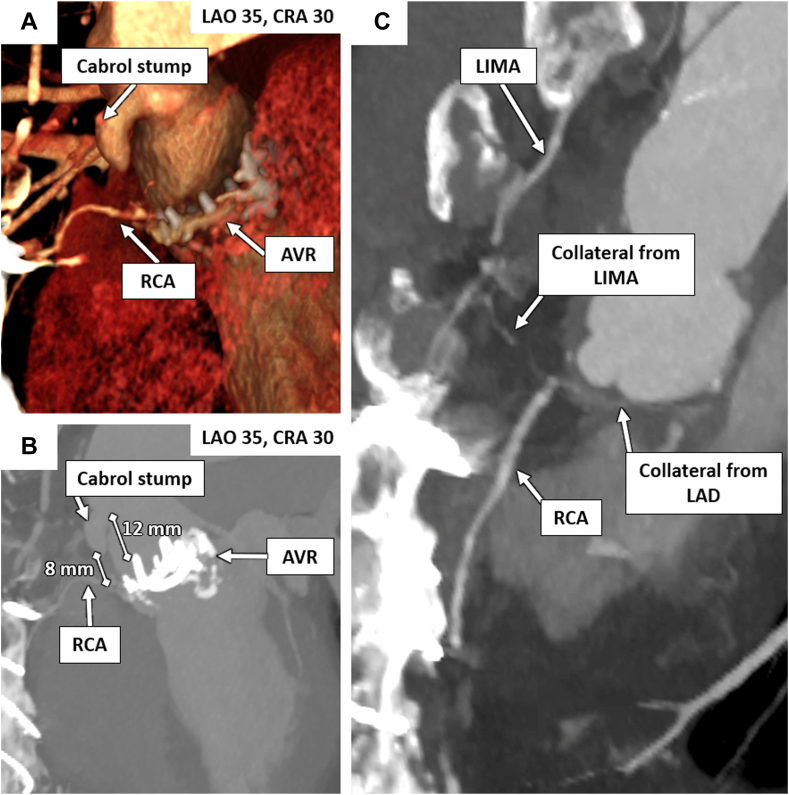 Figure 1
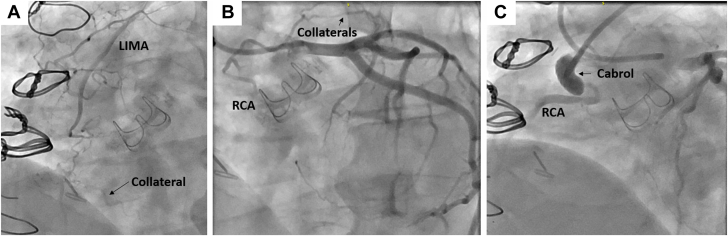 Figure 2
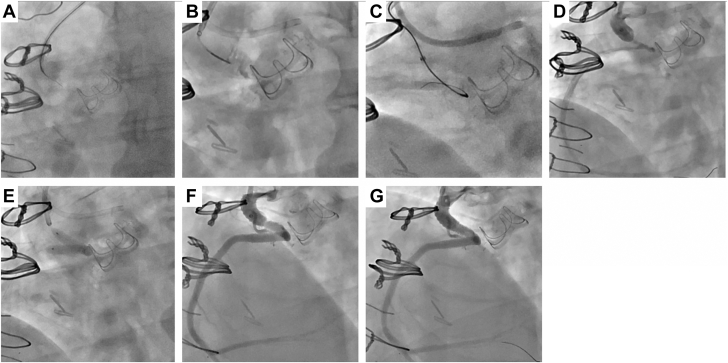 Figure 3
Peer Reviews
No public reviews on file for this paper yet. If you reviewed it on a platform where reviews are public (OpenReview, ICLR, NeurIPS, ICML), you can paste yours below so the community can read it here.
Videos
No videos yet. Explain this paper in a talk, walkthrough, or lecture? Add one.
Taxonomy
TopicsReconstructive Facial Surgery Techniques · Reconstructive Surgery and Microvascular Techniques · Ear Surgery and Otitis Media