Deep learning-based quantification of epicardial adipose tissue volume from non-contrast computed tomography images: a multi-centre study
Shuang Leng, Nicholas Cheng, Eddy Tan, Lohendran Baskaran, Lynette Teo, Min Sen Yew, Kee Yuan Ngiam, Weimin Huang, Ping Chai, Ching Ching Ong, Ching Hui Sia, Malay Singh, Yan Ting Loong, Nur A S Raffiee, Xiaomeng Wang, John Allen, Swee Yaw Tan, Mark Chan, Hwee Kuan Lee

TL;DR
This study developed an AI system to accurately measure heart fat from CT scans, showing it works well across different ethnic groups and helps predict heart disease risk.
Contribution
A deep learning model for automated EAT volume quantification from NCCT scans with strong performance across diverse populations.
Findings
AI-predicted EAT volumes showed excellent agreement with expert annotations (r = 0.975).
AI-derived EAT volume was independently associated with obstructive CAD (odds ratio 1.11).
Model performance remained strong in non-Asian individuals (r = 0.970).
Abstract
Epicardial adipose tissue (EAT), located within the pericardial sac, has emerged as a biomarker for coronary artery disease (CAD) progression. This study aimed to develop and validate a deep learning-based system for automated EAT volume quantification using non-contrast computed tomography (NCCT) scans from a large, multi-centre, pan-Asian cohort. A total of 1243 NCCT patient scans from three centres were used to train and internally validate a deep learning model based on 3D UNet++ architecture for pericardium segmentation, followed by intensity thresholding to derive EAT volume. Epicardial adipose tissue quantification required ∼30 s per scan. The final model was evaluated on an external testing cohort of 160 patients, including 90 non-Asian individuals. In this cohort, AI-predicted EAT volumes showed excellent agreement with expert annotations (r = 0.975; P < 0.0001). The…
Genes, proteins, chemicals, diseases, species, mutations and cell lines named across the full text — each resolved to its canonical identifier and authoritative record.
Click any figure to enlarge with its caption.
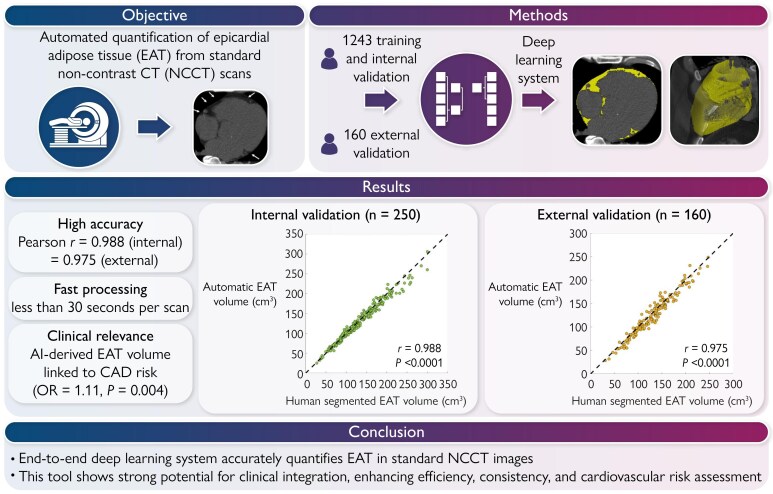 Figure 1
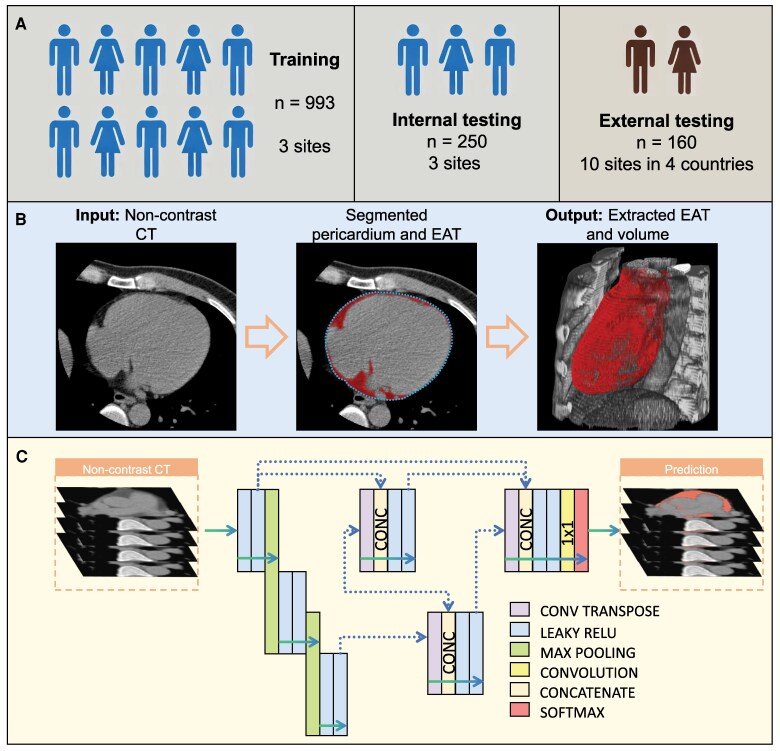 Figure 2
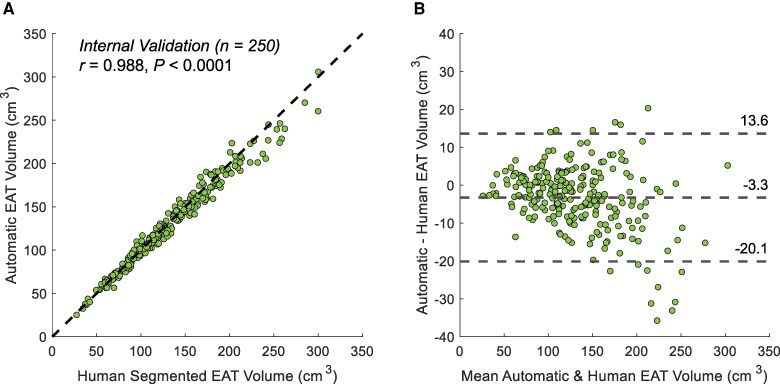 Figure 3
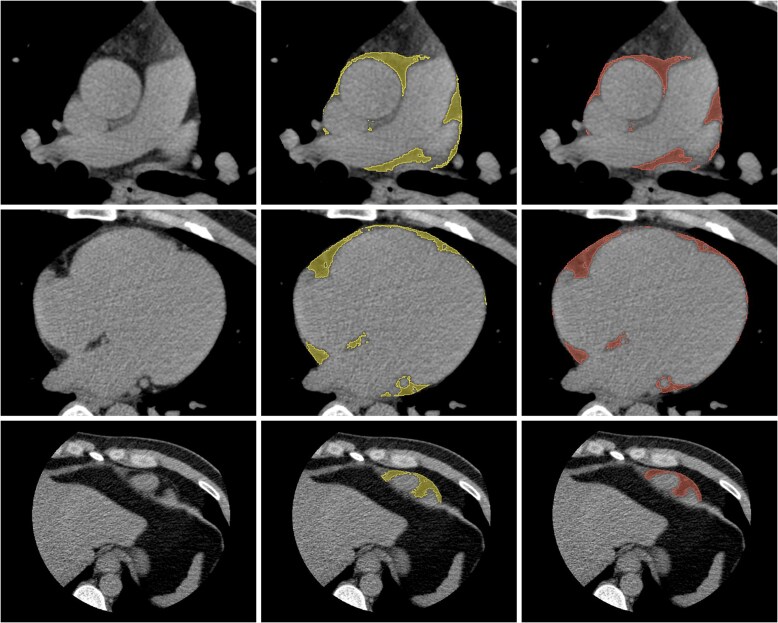 Figure 4
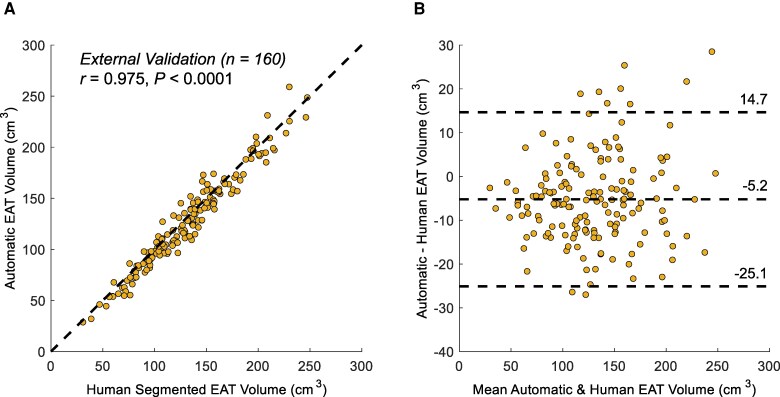 Figure 5
 Figure 6
Peer Reviews
No public reviews on file for this paper yet. If you reviewed it on a platform where reviews are public (OpenReview, ICLR, NeurIPS, ICML), you can paste yours below so the community can read it here.
Videos
No videos yet. Explain this paper in a talk, walkthrough, or lecture? Add one.
Taxonomy
TopicsCardiovascular Disease and Adiposity