The development of a data dictionary with clinical variables for artificial intelligence-driven tools in research on abdominal aortic aneurysms and peripheral arterial disease
Lotte Rijken, Sabrina L M Zwetsloot, Catelijne Muller, Marlies P Schijven, Vincent Jongkind, Kak Khee Yeung, Igor Koncar, Igor Koncar, Ivan Tomic, Marina Dias-Neto, Katarzyna D Bera, Riikka Tulamo, Maarit Venermo, Mirjami Laivuori, Christian-Alexander Behrendt

TL;DR
This study created structured data dictionaries for AI research on abdominal aortic aneurysms and peripheral arterial disease to improve risk prediction and ensure ethical data use.
Contribution
The paper introduces two expert-validated data dictionaries for AI-driven research on arterial vascular diseases, ensuring ethical and high-quality data input.
Findings
The aneurysm data dictionary includes 312 variables, while the peripheral arterial disease dictionary includes 325 variables.
A modified Delphi approach with 16 clinical experts was used to achieve consensus on the data dictionaries.
Ethical and legal experts were involved throughout the process to ensure compliance with AI guidelines.
Abstract
Patients with abdominal aortic aneurysms and peripheral arterial disease (arterial vascular diseases) carry a high disease burden and are likely to experience cardiovascular events. Novel strategies using artificial intelligence could identify which patients with arterial vascular diseases are at high risk of cardiovascular disease progression. Structured data dictionaries are needed to ensure high-quality, unbiased, and ethically sound data input for artificial intelligence models. The aim of this study was to obtain expert consensus-based data dictionaries that adhere to applicable ethical guidelines to support research on arterial vascular diseases. The data dictionaries were created through a modified Delphi approach to achieve consensus among key opinion leaders in the cardiovascular field. First, data requirements were defined and variable longlists were created per disease…
Genes, proteins, chemicals, diseases, species, mutations and cell lines named across the full text — each resolved to its canonical identifier and authoritative record.
Click any figure to enlarge with its caption.
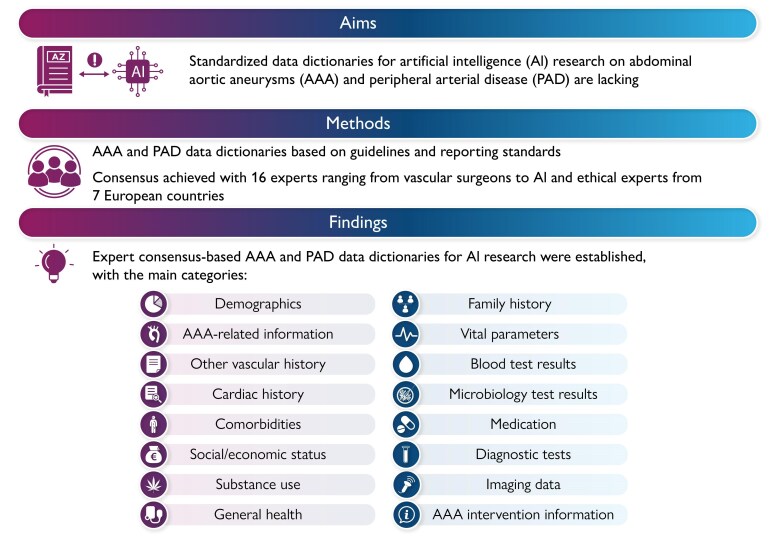 Figure 1
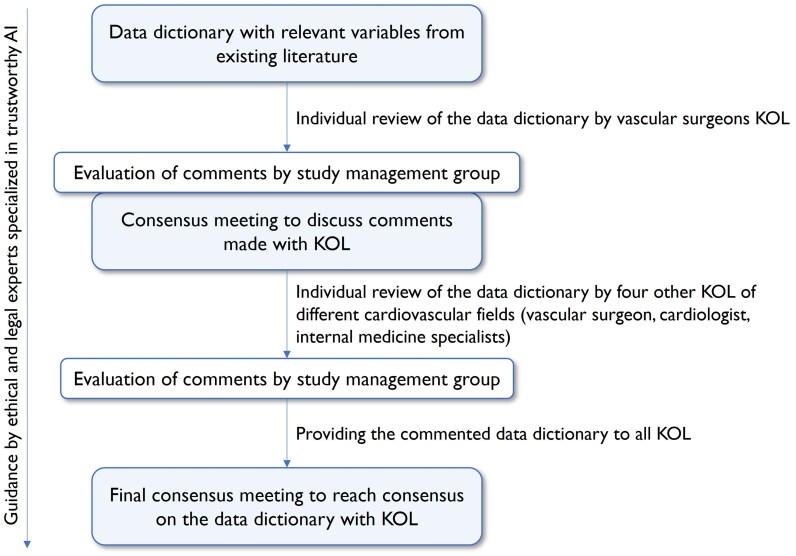 Figure 2
 Figure 3
 Figure 4
Peer Reviews
No public reviews on file for this paper yet. If you reviewed it on a platform where reviews are public (OpenReview, ICLR, NeurIPS, ICML), you can paste yours below so the community can read it here.
Videos
No videos yet. Explain this paper in a talk, walkthrough, or lecture? Add one.
Taxonomy
TopicsArtificial Intelligence in Healthcare