Using machine learning for detection of Parkinson’s disease and mild cognitive impairment
Anthaea-Grace Patricia Dennis, Sarah L. Martin, Robert Chen, Philip Gerretsen, Antonio P. Strafella, Gyan Prakash Modi, Gyan Prakash Modi, Gyan Prakash Modi

TL;DR
This paper explores using machine learning to better detect Parkinson’s disease and cognitive decline by combining brain scans and fluid biomarkers.
Contribution
The novelty is combining neuroimaging and biofluid biomarkers with machine learning to improve detection accuracy.
Findings
Combining DaT-SPECT imaging with phosphorylated-tau-181 improved accuracy in detecting mild cognitive impairment in Parkinson’s patients.
Machine learning models using DaT-SPECT alone performed better for Parkinson’s disease detection than biofluid biomarkers alone.
Support vector machine and random forest models showed similar performance in classification tasks.
Abstract
Parkinson’s disease is a movement disorder featuring motor symptoms and cognitive decline, which can manifest as mild cognitive impairment. The incidence of mild cognitive impairment increases with disease progression, and Parkinson’s disease can cause significant disability, therefore, identification of Parkinson’s disease and mild cognitive impairment in Parkinson’s disease is imperative. Neuroimaging and biofluid biomarkers have been studied separately, however, research suggests that combining biomarkers may improve detection. We aimed to investigate using machine learning whether a combination of neuroimaging and biofluid biomarkers would result in more effective identification of Parkinson’s disease and mild cognitive impairment. Utilizing the Parkinson’s Progression Markers Initiative dataset, we applied two different machine learning approaches, support vector machine and…
Genes, proteins, chemicals, diseases, species, mutations and cell lines named across the full text — each resolved to its canonical identifier and authoritative record.
Click any figure to enlarge with its caption.
 Figure 1
 Figure 2
 Figure 3
 Figure 4
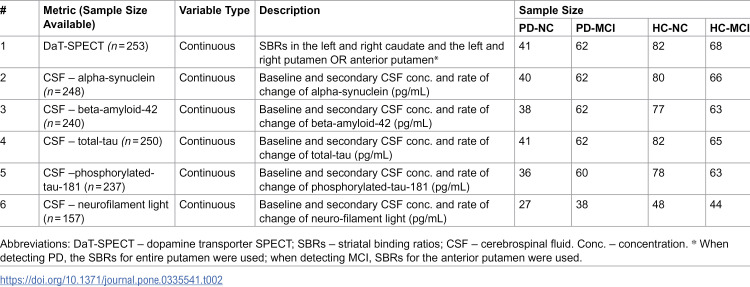 Figure 5
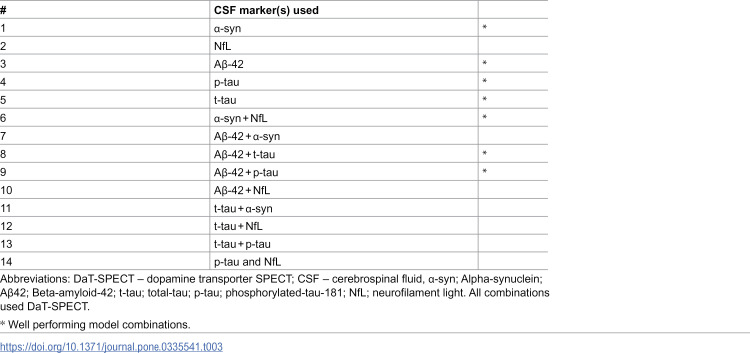 Figure 6
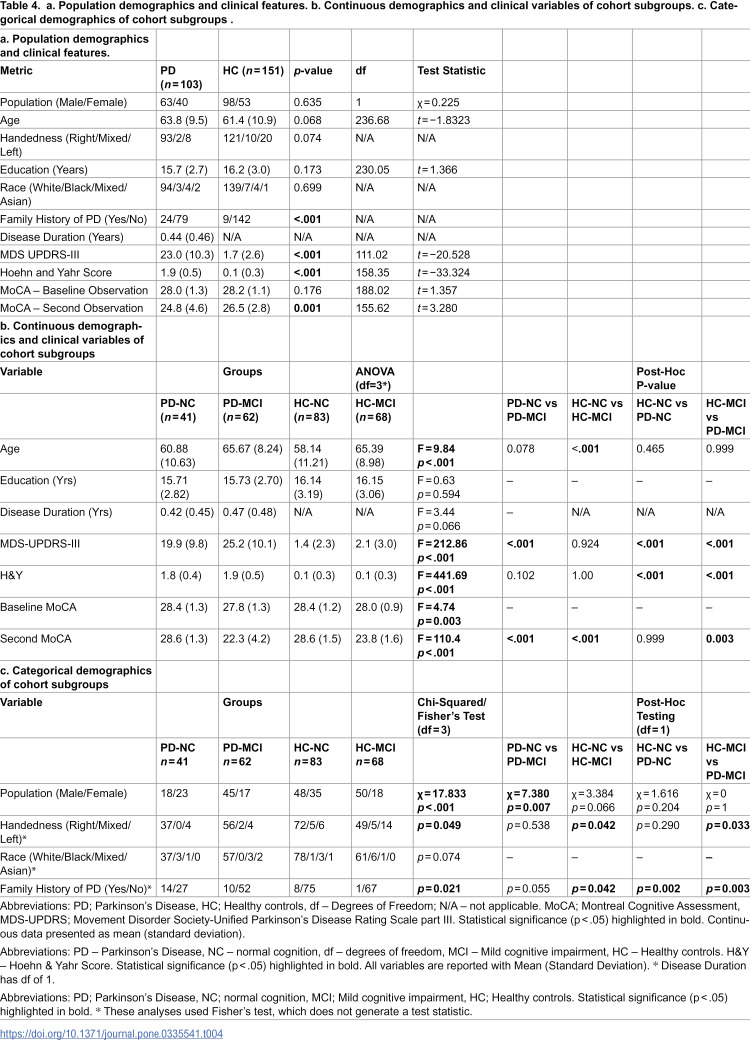 Figure 7
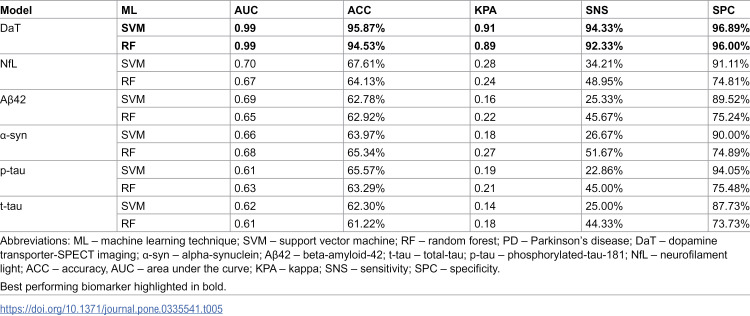 Figure 8
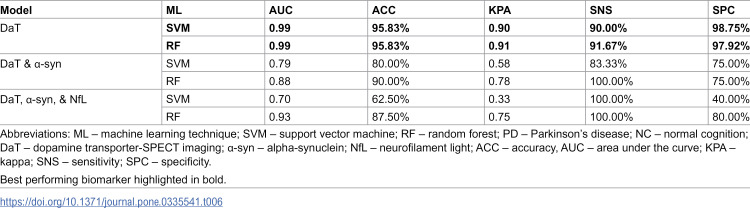 Figure 9
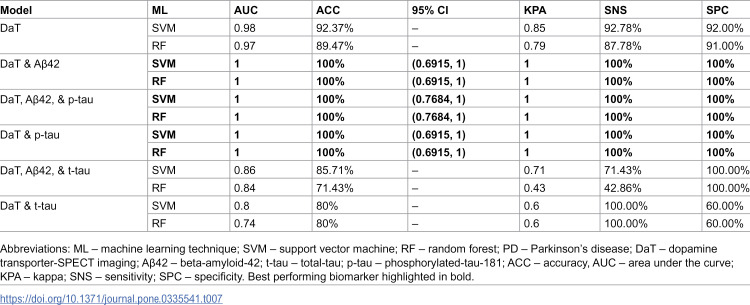 Figure 10
Peer Reviews
No public reviews on file for this paper yet. If you reviewed it on a platform where reviews are public (OpenReview, ICLR, NeurIPS, ICML), you can paste yours below so the community can read it here.
Videos
No videos yet. Explain this paper in a talk, walkthrough, or lecture? Add one.
Taxonomy
TopicsParkinson's Disease Mechanisms and Treatments · Neurological disorders and treatments · Voice and Speech Disorders