Effect of fascial closure using barbed sutures on incisional hernias in midline laparotomy for gynecological diseases: A multicenter randomized controlled trial (KGOG 4001)
Yong Jae Lee, Nam Kyeong Kim, Kidong Kim, Chel Hun Choi, Keun Ho Lee, Jong-Min Lee, Kwang Beom Lee, Dong Hoon Suh, Sunghoon Kim, Min Kyu Kim, Seok Ju Seong, Myong Cheol Lim, Marco Clementi, Marco Clementi, Marco Clementi

TL;DR
This study compared barbed and non-barbed sutures for closing abdominal incisions in gynecological surgeries and found no significant difference in hernia rates.
Contribution
A multicenter trial evaluating barbed sutures for reducing incisional hernias in gynecological laparotomies.
Findings
No significant difference in 1-year hernia rates between barbed and non-barbed sutures.
No significant difference in 2-year hernia rates between the two suture types.
No significant differences in wound complications or postoperative pain between groups.
Abstract
To identify the effect of fascial closure using barbed sutures on the incidence of incisional hernia in patients undergoing elective midline laparotomy for gynecological diseases. In this multicenter, non-blind randomized controlled trial conducted from February to December 2021, patients with a BMI < 35 kg/m2 and aged >18 years, scheduled for midline laparotomy, were randomly assigned to receive either barbed (experimental) or non-barbed sutures (control) for fascial closure. The primary outcome was the cumulative incidence rate of incisional hernia up to 1-year post-surgery. Secondary outcomes included incisional hernia up to 2-years post-surgery, wound complications, and postoperative pain assessed by Brief Pain Inventory-Korean scores, and Numeric Rating Scale. Out of 174 patients (experimental, 86; control, 88), 36 were excluded due to dropout or loss to follow-up, leaving 138…
Genes, proteins, chemicals, diseases, species, mutations and cell lines named across the full text — each resolved to its canonical identifier and authoritative record.
Click any figure to enlarge with its caption.
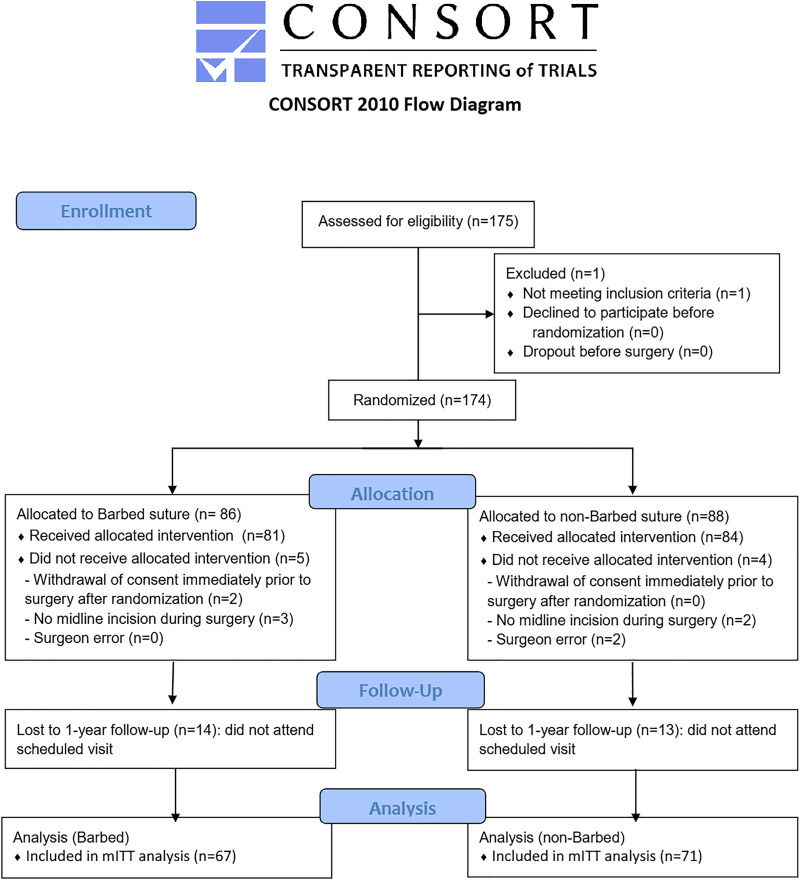 Figure 1
 Figure 2
 Figure 3
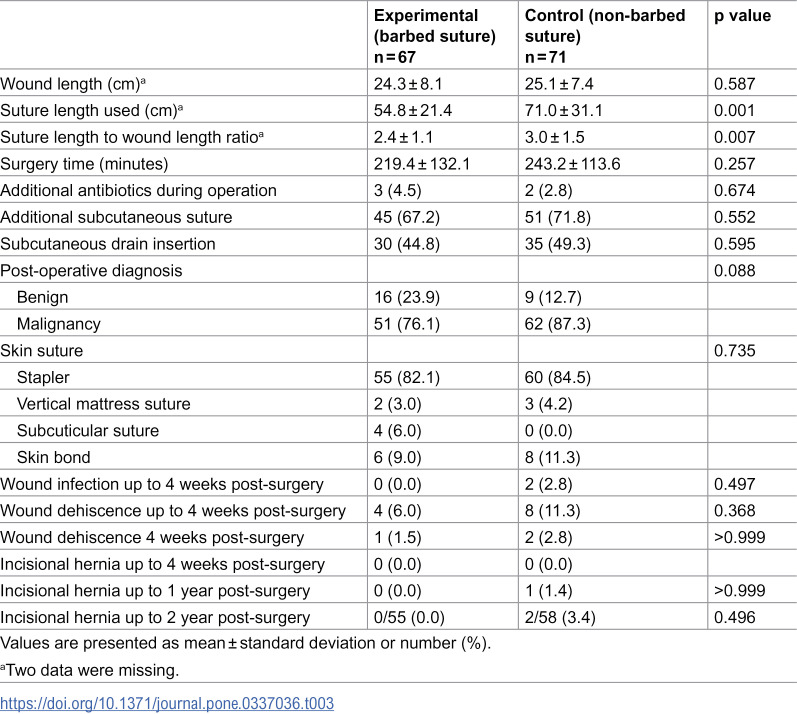 Figure 4
Peer Reviews
No public reviews on file for this paper yet. If you reviewed it on a platform where reviews are public (OpenReview, ICLR, NeurIPS, ICML), you can paste yours below so the community can read it here.
Videos
No videos yet. Explain this paper in a talk, walkthrough, or lecture? Add one.
Taxonomy
TopicsHernia repair and management · Minimally Invasive Surgical Techniques · Intestinal and Peritoneal Adhesions