High‐Intensity Interval Training and Moderate‐Intensity Continuous Training on Ventricular‐Arterial Coupling (VAC) in Young Women With Obesity
Caroline Ferraz Simões, Rogério Toshiro Passos Okawa, João Carlos Locatelli, Gustavo Henrique de Oliveira, Higor Barbosa Reck, Lucimere Bohn, Jorge Mota, Wendell Arthur Lopes

TL;DR
This study found that both high-intensity interval training and moderate-intensity continuous training improve heart-artery coordination in young women with obesity.
Contribution
The study compares the effects of HIIT and MICT on two specific measures of ventricular-arterial coupling in young women with obesity.
Findings
Both HIIT and MICT significantly improved the PWV/GLS ratio in young obese women.
Only HIIT significantly reduced the Ea/Ees ratio, indicating more comprehensive improvements in VAC.
PWV/GLS showed a strong correlation with changes in the Ea/Ees ratio following HIIT.
Abstract
To investigate the effects of an 8‐weeks of high‐intensity interval training (HIIT) or moderate‐intensity continuous training (MICT) program on ventricular‐arterial coupling (VAC) in young women with obesity. Twenty‐four obese women completed an 8‐week supervised aerobic training program (3 sessions/week) assigned to either HIIT (n = 11) or MICT (n = 13). The HIIT protocol involved four 4‐min bouts at 85%–95% of the maximum heart rate (HRmax), while the MICT consisted of continuous walking/running for 41 min at 65%–75% of HRmax. VAC was assessed using two methods: (1) the ratio of pulse wave velocity to global longitudinal strain (PWV/GLS), and (2) the ratio of arterial to ventricular elastance (Ea/Ees). Both HIIT (−0.35 ± 0.01 to −0.31 ± 0.05 m/s%; p = 0.005) and MICT (−0.35 ± 0.01 to −0.30 ± 0.05 m/s%; p = 0.003) significantly improved the PWV/GLS ratio. However, only HIIT led to a…
Genes, proteins, chemicals, diseases, species, mutations and cell lines named across the full text — each resolved to its canonical identifier and authoritative record.
Click any figure to enlarge with its caption.
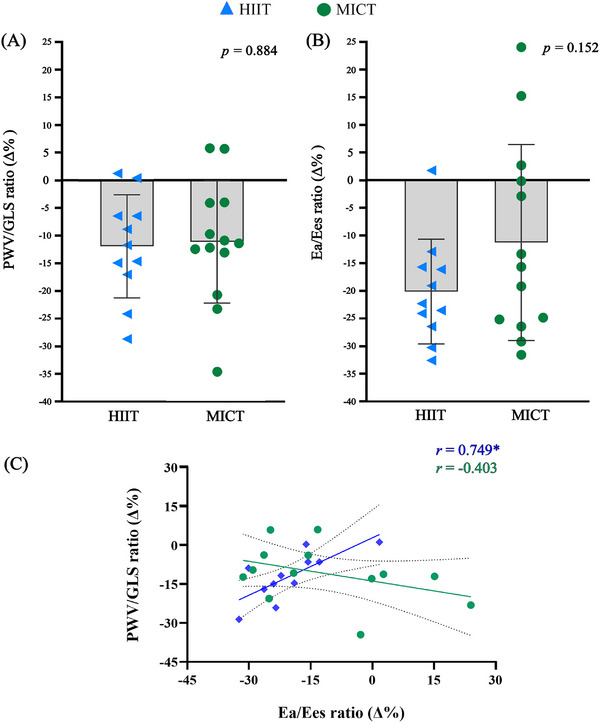 Figure 1
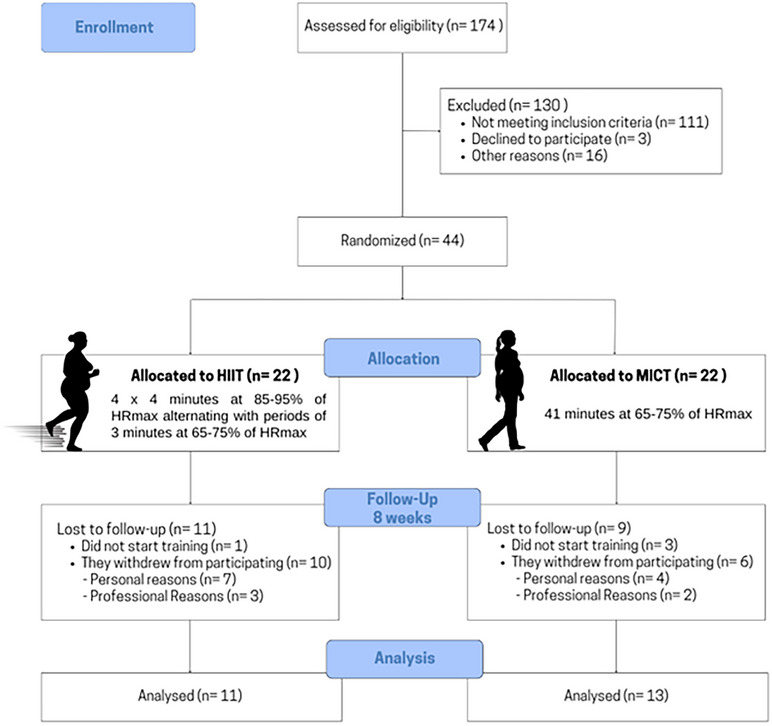 Figure 2
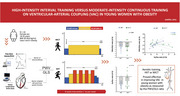 Figure 3
Peer Reviews
No public reviews on file for this paper yet. If you reviewed it on a platform where reviews are public (OpenReview, ICLR, NeurIPS, ICML), you can paste yours below so the community can read it here.
Videos
No videos yet. Explain this paper in a talk, walkthrough, or lecture? Add one.
Taxonomy
TopicsCardiovascular Function and Risk Factors · Cardiovascular Effects of Exercise · Heart Rate Variability and Autonomic Control