Chemical Composition and In Vitro Antibiofilm Action of Varronia curassavica Jacq. (Boraginaceae) Essential Oil: A Promising Natural Agent Against Bacterial Infections
José Thyálisson da Costa Silva, Gabriel Gonçalves Alencar, Nara Juliana Santos Araújo, Lariza Leisla Leandro Nascimento, Saulo Almeida Menezes, Dhenes Ferreira Antunes, Adrielle Rodrigues Costa, Murilo Felipe Felício, Cicero dos Santos Leandro, Luis Pereira de Morais

TL;DR
This study shows that the essential oil from Varronia curassavica is effective against certain bacterial biofilms, making it a potential natural treatment for bacterial infections.
Contribution
The study identifies the chemical composition and antibiofilm activity of Varronia curassavica essential oil against various bacterial strains.
Findings
EOVC effectively inhibited biofilm formation in Staphylococcus aureus and Staphylococcus epidermidis.
EOVC showed biofilm eradication activity against E. faecalis, S. epidermidis, and S. aureus at concentrations similar to gentamicin.
Pseudomonas aeruginosa and S. mutans showed resistance to EOVC, with P. aeruginosa being the most resistant.
Abstract
Antimicrobial resistance is an increasing threat to public health, with alarming estimates of mortality rates. In this context, the clinical properties of Varronia curassavica Jacq. are highlighted due to its biological and pharmacological activities. This study aims to analyze the phytochemical composition of the essential oil from V. curassavica (EOVC) and its antibiofilm activity against Gram‐positive and Gram‐negative strains. The essential oil was extracted from the leaves using hydrodistillation and analyzed by gas chromatography–mass spectrometry (GC–MS), phytochemical analysis of EOVC identified 97.36% of the total composition, predominantly composed of monoterpenes (α‐pinene at 44.46%) and sesquiterpenes (β‐caryophyllene at 21.82%). Antibiofilm tests were performed on five bacterial strains (both Gram‐positive and Gram‐negative) to evaluate the ability to inhibit and eradicate…
Genes, proteins, chemicals, diseases, species, mutations and cell lines named across the full text — each resolved to its canonical identifier and authoritative record.
Click any figure to enlarge with its caption.
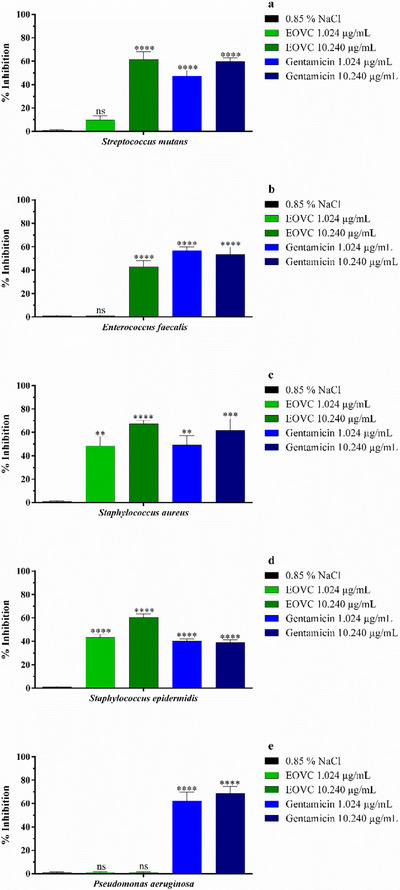 Figure 1
 Figure 2
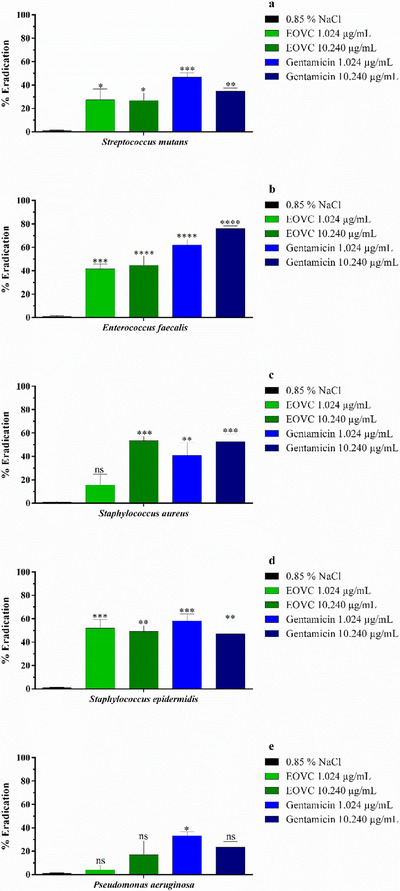 Figure 3
 Figure 4
Peer Reviews
No public reviews on file for this paper yet. If you reviewed it on a platform where reviews are public (OpenReview, ICLR, NeurIPS, ICML), you can paste yours below so the community can read it here.
Videos
No videos yet. Explain this paper in a talk, walkthrough, or lecture? Add one.
Taxonomy
TopicsEssential Oils and Antimicrobial Activity · Ethnobotanical and Medicinal Plants Studies · Antibiotic Resistance in Bacteria