Course of joint range of motion in children with spinal muscular atrophy receiving disease-modifying treatment
I. L. B. Oude Lansink, J. W. Gorter, W. L. van der Pol, D. R. vd Woude, P. J. Scheiberlich, R. P. A. van Eijk, B. Bartels, A. Beelen

TL;DR
This study tracks joint mobility in children with spinal muscular atrophy receiving early treatment, finding a yearly decline in knee extension but stable elbow and wrist mobility.
Contribution
The study provides the first longitudinal analysis of joint range of motion in SMA children treated with disease-modifying therapy.
Findings
Children with SMA showed an average yearly decline of 3° in knee extension mobility.
Elbow and wrist joint range of motion remained stable over the 3-year follow-up.
Knee extension range of motion should be monitored every 6 months to maintain mobility.
Abstract
Progressive decreases in joint range of motion (ROM) is a well-recognized complication in the natural history of spinal muscular atrophy (SMA). How joint ROM evolves in children with SMA receiving disease-modifying treatment (DMT) needs to be documented. To examine the longitudinal course of joint range of motion in young children with SMA receiving disease-modifying therapy. We included children with SMA (with 2 or 3 SMN2 copies) who started treatment within the first 18 months of life in a prospective national tertiary cohort study. Our examination consisted of joint range of motion of the knee, elbow and wrist; the longitudinal course was studied using linear mixed-effects models. We analysed 165 visits of 39 children (median age 22 months (interquartile range [6–45])) with treated SMA over a 3-year follow-up period. The median age at start of treatment was 2 months [0–8]. We…
Genes, proteins, chemicals, diseases, species, mutations and cell lines named across the full text — each resolved to its canonical identifier and authoritative record.
Click any figure to enlarge with its caption.
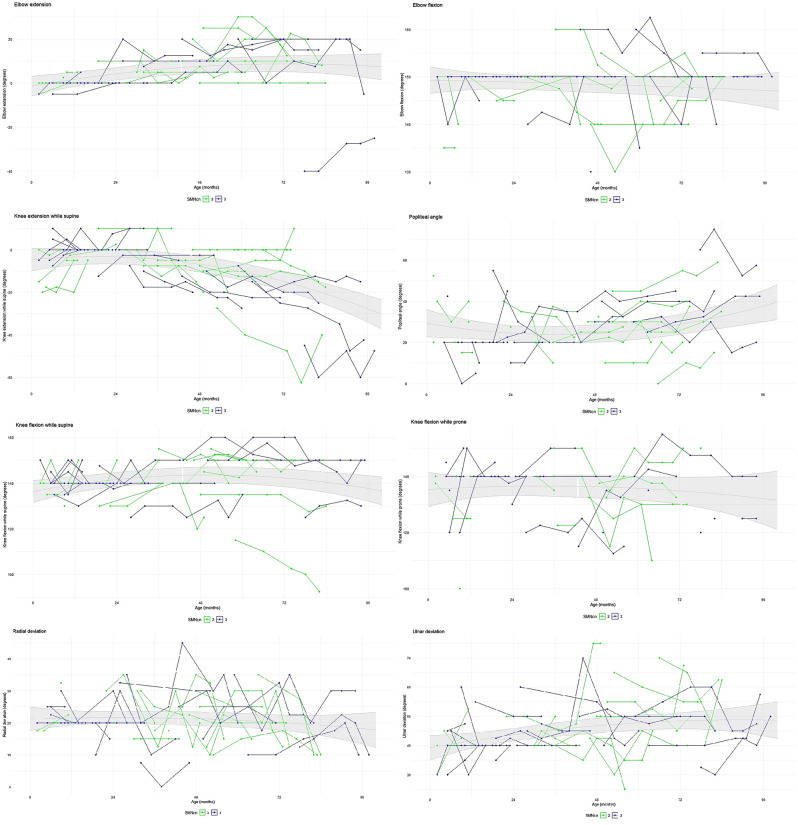 Figure 1
 Figure 2
 Figure 2
Peer Reviews
No public reviews on file for this paper yet. If you reviewed it on a platform where reviews are public (OpenReview, ICLR, NeurIPS, ICML), you can paste yours below so the community can read it here.
Videos
No videos yet. Explain this paper in a talk, walkthrough, or lecture? Add one.
Taxonomy
TopicsNeurogenetic and Muscular Disorders Research · Cerebral Palsy and Movement Disorders · Hereditary Neurological Disorders