Understanding the potential role of Social Prescribing Link Workers in supporting identified needs of people with physical and mental long-term conditions: a qualitative study
Skaiste Linceviciute, Leire Ambrosio, David S. Baldwin, Mari Carmen Portillo

TL;DR
This study explores how Social Prescribing Link Workers can better support people with long-term physical and mental health conditions through qualitative interviews.
Contribution
The study provides new insights into the unmet needs of individuals with P + MH LTCs and the potential but underutilized role of SPLWs in addressing these needs.
Findings
Individuals with P + MH LTCs face complex, shifting health and psychosocial needs.
SPLW support is perceived as potentially beneficial but is inconsistently implemented and often misses opportunities to help.
Integrated health systems with skilled SPLW support are urgently needed to improve outcomes for this population.
Abstract
The Social Prescribing Link Worker (SPLW) approach is a means for supporting individuals and communities with diverse needs, with its reach and impact widely recognised in health and community systems. However, SPLW support for people with long-term physical and mental health conditions (P + MH LTCs) has been variable and there are knowledge gaps such as unheard voices of those with a varied engagement in SPLW support. We undertook a study to better understand the potential relevance of SPLW support for addressing the needs of individuals with P + MH LTCs. Its aim was to explore a range of health and psychosocial needs of people living with P + MH LTCs and to examine perspectives on how the SPLW role supports the complex needs of this group. A qualitative study utilising one-to-one semi-structured interviews with community dwelling adults (aged ≥ 18 years old) living with P + MH LTCs…
Genes, proteins, chemicals, diseases, species, mutations and cell lines named across the full text — each resolved to its canonical identifier and authoritative record.
Click any figure to enlarge with its caption.
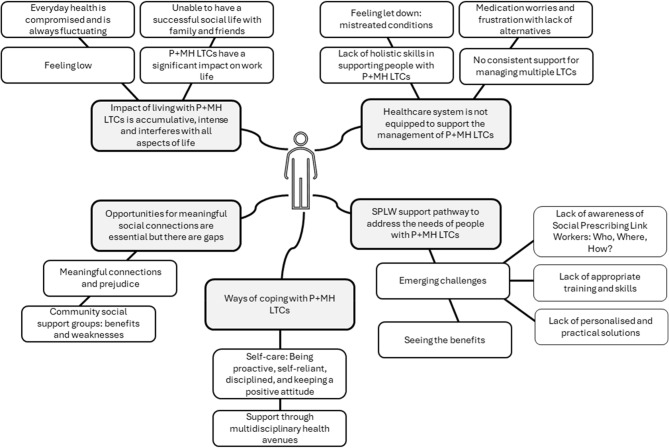 Figure 1
Peer Reviews
No public reviews on file for this paper yet. If you reviewed it on a platform where reviews are public (OpenReview, ICLR, NeurIPS, ICML), you can paste yours below so the community can read it here.
Videos
No videos yet. Explain this paper in a talk, walkthrough, or lecture? Add one.
Taxonomy
TopicsArt Therapy and Mental Health · Occupational Therapy Practice and Research · Mental Health and Patient Involvement