Validation of BMP8A fibrosis score to identify patients with metabolic dysfunction-associated steatohepatitis with advanced liver fibrosis
Stephania C. Isaza, Carlos Ernesto Fernández-García, Diego Rojo, Paula Iruzubieta, Javier Ampuero, Rocío Aller, Raquel Vinuesa Campo, Laura Izquierdo-Sánchez, Esther Fuertes-Yebra, Patricia Marañón, Jesús M. Banales, Laura Pagés, Carolina Jiménez-González

TL;DR
This study validates a new non-invasive test called BFS to accurately identify patients with severe liver fibrosis in a liver disease called MASH.
Contribution
The study introduces and validates the BMP8A Fibrosis Score (BFS) as a more accurate and reliable tool for detecting advanced liver fibrosis in MASH patients.
Findings
BFS outperformed other fibrosis scores like FIB-4, NFS, APRI, and HFS in correctly classifying patients with advanced liver fibrosis.
BFS uses a single cut-off value, reducing the number of patients with indeterminate results compared to other methods.
BFS achieved an AUROC of 0.750 and correctly classified 70.9% of advanced fibrosis cases.
Abstract
Liver fibrosis represents the main risk factor not only for liver-related but also for overall mortality in metabolic dysfunction-associated steatotic liver disease (MASLD) patients, being metabolic dysfunction-associated steatohepatitis (MASH) its more severe clinical form. We recently developed a non-invasive algorithm termed BMP8A Fibrosis Score (BFS) which is able to identify MASH patients with advanced liver fibrosis. The aim of this study was to validate the BFS comparing its diagnostic accuracy with that of other scoring systems developed to assess liver fibrosis in MASH patients. Serum BMP8A was measured in 302 patients with biopsy-proven MASH: 171 with non- or mild fibrosis (F0-F2) and 131 with advanced fibrosis (F3-F4) recruited from seven university hospitals located in different cities in Spain. BFS, Fibrosis-4 (FIB-4) Index, NAFLD Fibrosis Score (NFS), Hepamet Fibrosis…
Genes, proteins, chemicals, diseases, species, mutations and cell lines named across the full text — each resolved to its canonical identifier and authoritative record.
Click any figure to enlarge with its caption.
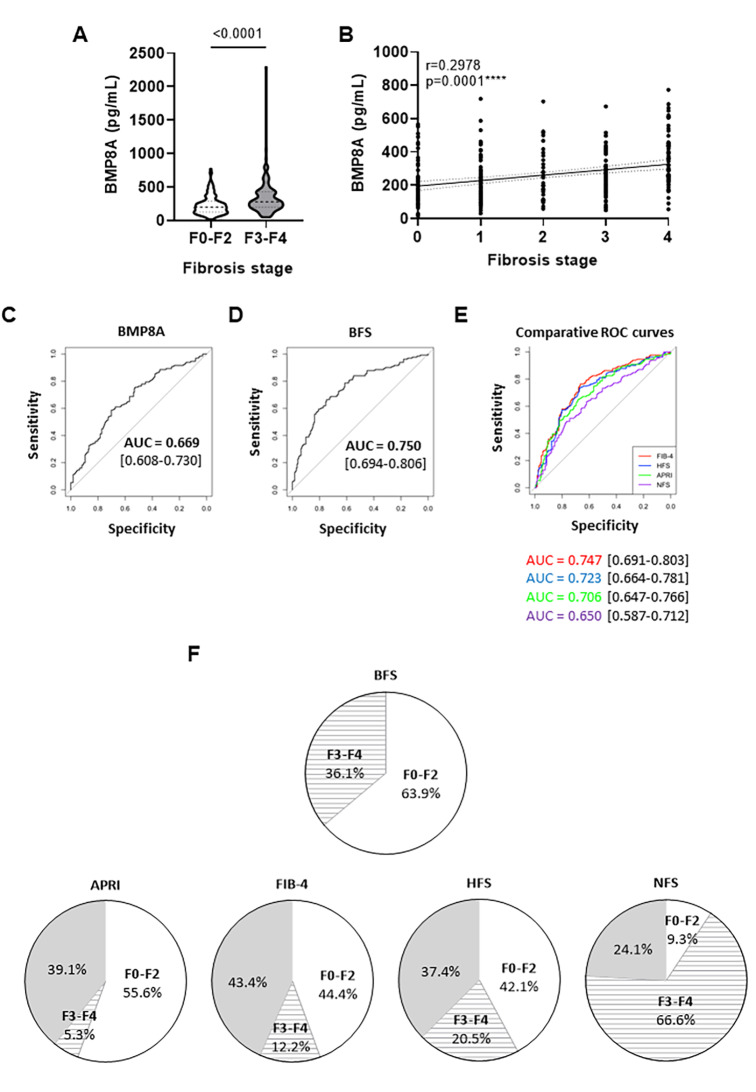 Figure 1
Peer Reviews
No public reviews on file for this paper yet. If you reviewed it on a platform where reviews are public (OpenReview, ICLR, NeurIPS, ICML), you can paste yours below so the community can read it here.
Videos
No videos yet. Explain this paper in a talk, walkthrough, or lecture? Add one.
Taxonomy
TopicsLiver Disease Diagnosis and Treatment · Chronic Kidney Disease and Diabetes · Liver physiology and pathology