Metabolic and population profiles of active subseafloor autotrophs in young oceanic crust at deep-sea hydrothermal vents
Sabrina M. Elkassas, Caroline S. Fortunato, Sharon L. Grim, David A. Butterfield, James F. Holden, Joseph J. Vallino, Christopher K. Algar, Lisa Zeigler Allen, Benjamin T. Larson, Giora Proskurowski, Emily Reddington, Lucy C. Stewart, Begum Topçuoğlu, Julie A. Huber

TL;DR
This study identifies key microbial autotrophs in deep-sea hydrothermal vents and their metabolic strategies for surviving in the subseafloor environment.
Contribution
The study provides new insights into the distribution and metabolic versatility of subseafloor autotrophic microbes using stable isotope probing and metatranscriptomics.
Findings
Hydrogenotrophic sulfur and nitrate reducers from Aquificota and Campylobacterota are consistently active across multiple vent sites.
Hydrogenase transcripts show significant differential expression, indicating diverse hydrogen utilization strategies in these microbes.
Methanothermococcus archaea are less widespread compared to other hydrogenotrophic autotrophs.
Abstract
At deep-sea hydrothermal vents, magmatically driven rock-water reactions in the crust generate gases and other reduced compounds that subseafloor microorganisms use for chemolithoautotrophy. In this study, microbial autotrophs from three diffuse flow hydrothermal vents at Axial Seamount in 2013 and 2014 were isotopically labeled using RNA stable isotope probing, targeting subseafloor autotrophic mesophiles (30°C), thermophiles (55°C), and hyperthermophiles (80°C). We constructed taxonomic and functional profiles of active chemolithoautotrophs, examined population distributions across sites, and linked primary producers to their specific metabolic strategies within the subseafloor community. Dominant autotrophs exhibited hydrogen-dependent dissimilatory metabolisms, such as sulfur and nitrate reduction and methanogenesis, as well as microaerophilic sulfide oxidation even at 80°C,…
Genes, proteins, chemicals, diseases, species, mutations and cell lines named across the full text — each resolved to its canonical identifier and authoritative record.
Click any figure to enlarge with its caption.
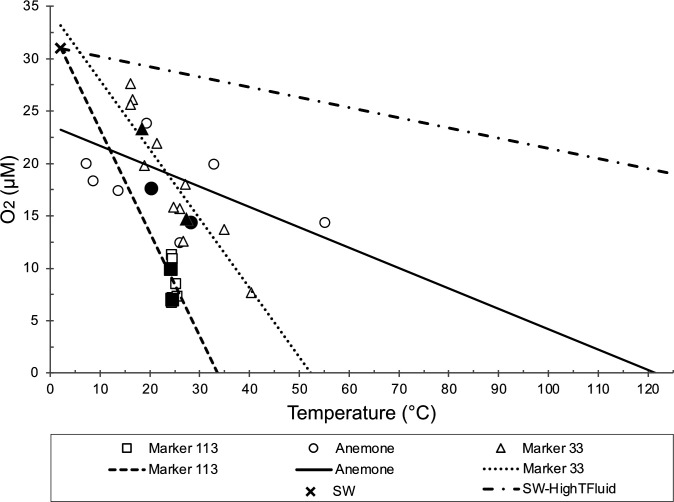 Figure 1
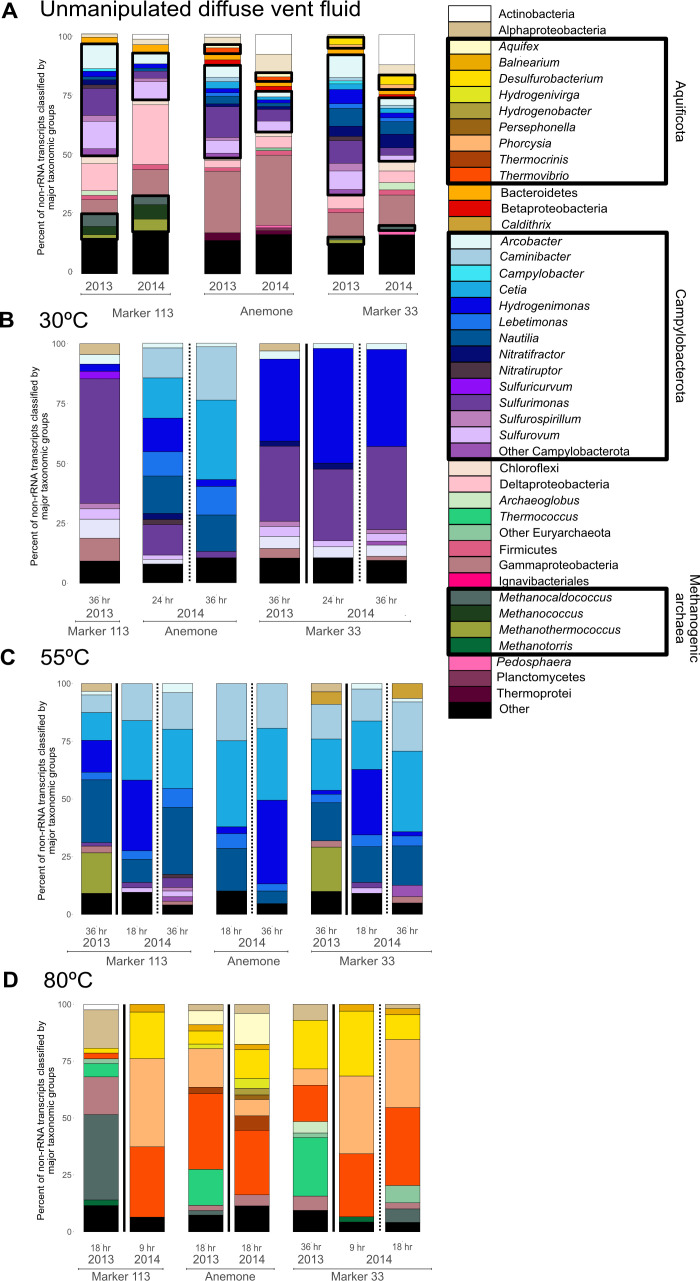 Figure 2
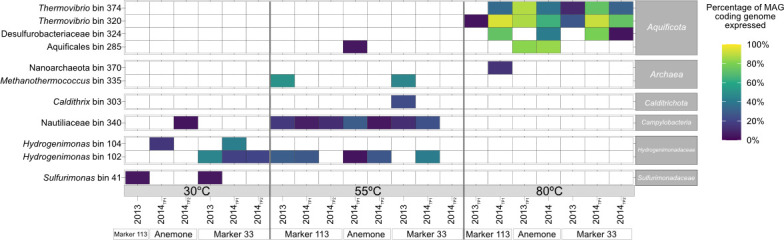 Figure 3
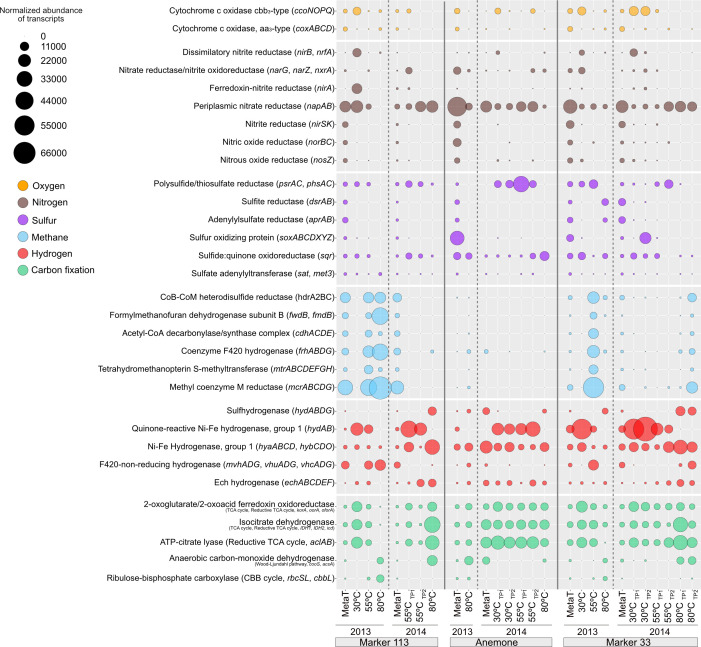 Figure 4
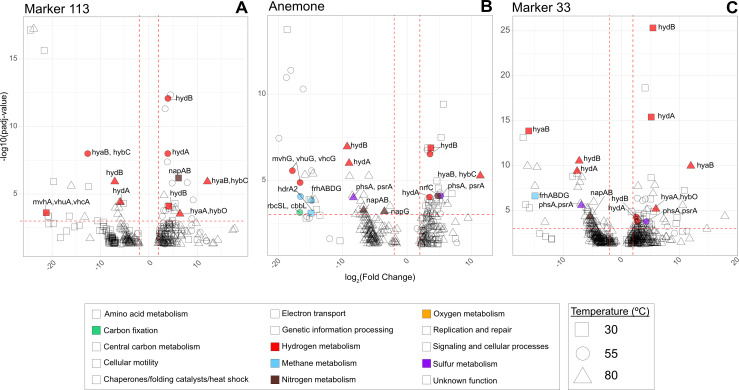 Figure 5
Peer Reviews
No public reviews on file for this paper yet. If you reviewed it on a platform where reviews are public (OpenReview, ICLR, NeurIPS, ICML), you can paste yours below so the community can read it here.
Videos
No videos yet. Explain this paper in a talk, walkthrough, or lecture? Add one.
Taxonomy
TopicsMethane Hydrates and Related Phenomena · Microbial Community Ecology and Physiology · Genomics and Phylogenetic Studies