From biocides to biology: multispecies biofilms as a sustainable, self-regenerating, and effective antifouling strategy
Raphaël Lami

TL;DR
This paper introduces a new antifouling strategy using multispecies biofilms to prevent marine fouling without harmful chemicals.
Contribution
The novelty lies in using ecological steering of biofilms as a sustainable alternative to traditional antifouling methods.
Findings
Multispecies biofilms can act as a physical barrier against macrofouler settlement.
This approach avoids biocides and inert coatings, offering an environmentally safe solution.
Abstract
Finding antifouling strategies that are effective and environmentally safe remains a central challenge for maritime operations and ecosystem protection. Amador et al.’s article in Applied and Environmental Microbiology (91:e01392-25, 2025, https://doi.org/10.1128/aem.01392-25) proposes a bioinspired, applied-microbial-ecology solution: deliberately shaping pioneer biofilm communities, so they form a physical barrier against macrofouler settlement, avoiding biocides and low-adhesion inert coatings. Though focused on the ocean, this paradigm could inform broader anti-biofilm interventions across microbiology, reframing control as ecological steering rather than chemical suppression or materials-based design.
Genes, proteins, chemicals, diseases, species, mutations and cell lines named across the full text — each resolved to its canonical identifier and authoritative record.
Click any figure to enlarge with its caption.
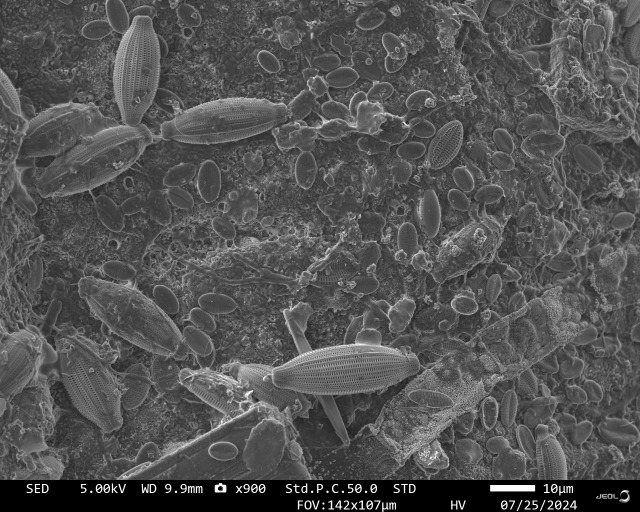 Figure 1
Peer Reviews
No public reviews on file for this paper yet. If you reviewed it on a platform where reviews are public (OpenReview, ICLR, NeurIPS, ICML), you can paste yours below so the community can read it here.
Videos
No videos yet. Explain this paper in a talk, walkthrough, or lecture? Add one.
Taxonomy
TopicsMarine Biology and Environmental Chemistry · Microplastics and Plastic Pollution · Marine Ecology and Invasive Species