Paleogenomics Reveals a Loss of Bovine Lineages in Mid-latitude Asia Over the Last 200,000 Years
Alexandre Gilardet, Jonas Oppenheimer, Mikkel-Holger S Sinding, Edana Lord, J Camilo Chacón-Duque, Gonzalo Oteo-García, Georgios Xenikoudakis, Pavel Kosintsev, John Southon, Sergey K Vasiliev, Michael V Shunkov, Maxim B Kozlikin, Katerina Douka, Beth Shapiro, Peter D Heintzman

TL;DR
Ancient DNA from bovine remains in Siberia reveals a lost lineage related to yaks that once thrived in the Altai mountains for 200,000 years.
Contribution
Discovery of a previously unknown yak-like mitochondrial lineage (yak X) in Pleistocene bovines from the Altai region.
Findings
Bovines with yak-like mitogenomes were common in the Altai mountains alongside bison and aurochs.
The yak X lineage is a sister group to modern yak diversity and persisted for 200,000 years.
The Altai region was a hotspot for bovine diversity, similar to its role in hominin diversity.
Abstract
Bovines have a complex yet poorly understood evolutionary history that is characterized by admixture and diversity loss during the Late Pleistocene. Unraveling this history is challenging in part because deep-time and geographically widespread genetic data are currently limited. In mid-latitude Asia, Denisova Cave, located in the Altai, Siberia, and nearby paleontological sites have yielded a large collection of remains spanning the Middle to Late Pleistocene, many of which are identifiable as bovines via morphology or paleoproteomics. In this study, we screened these bovine bones for ancient DNA and generated mitogenomes, to refine knowledge of Pleistocene bovine diversity in the region. We found that bovines carrying a yak-like mitogenome were common residents of the Altai mountains, along with bison belonging to the clade X mitochondrial lineage and, more rarely, aurochs. The…
Genes, proteins, chemicals, diseases, species, mutations and cell lines named across the full text — each resolved to its canonical identifier and authoritative record.
Click any figure to enlarge with its caption.
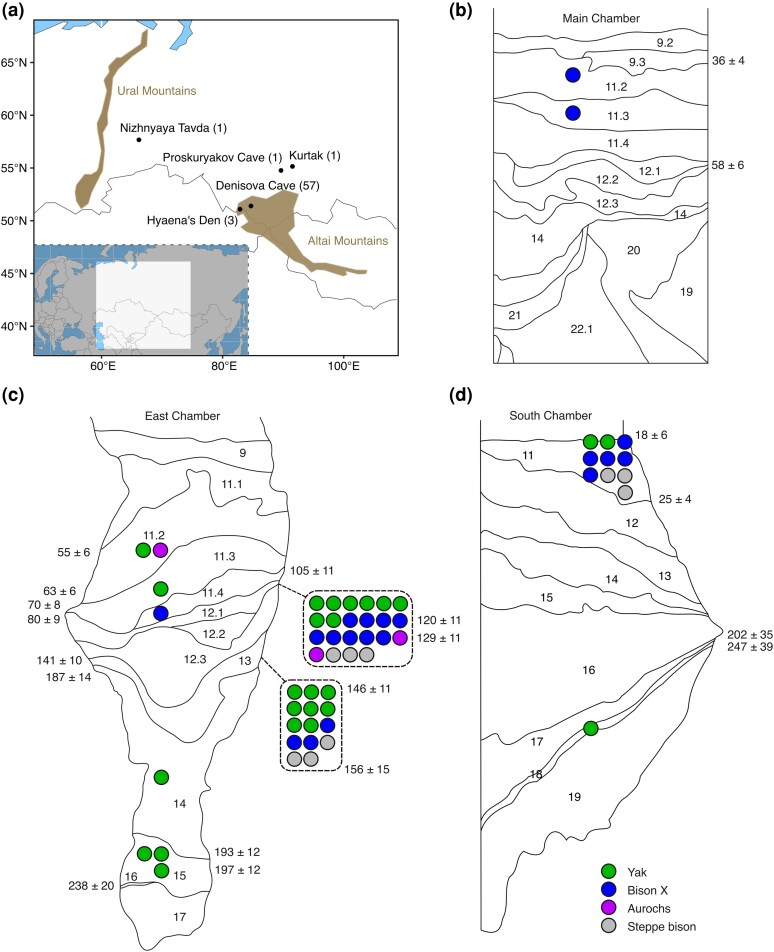 Figure 1
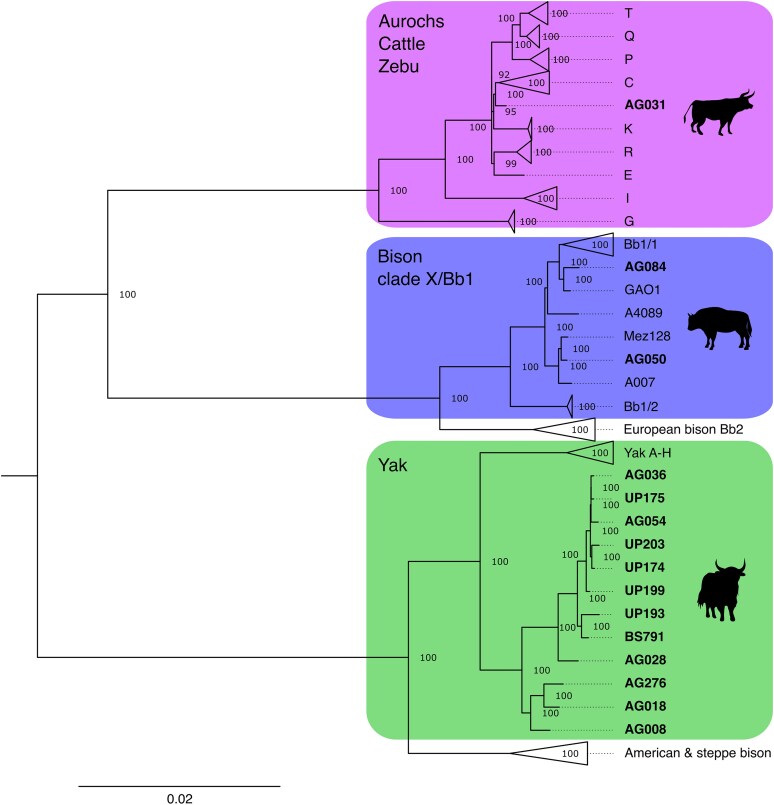 Figure 2
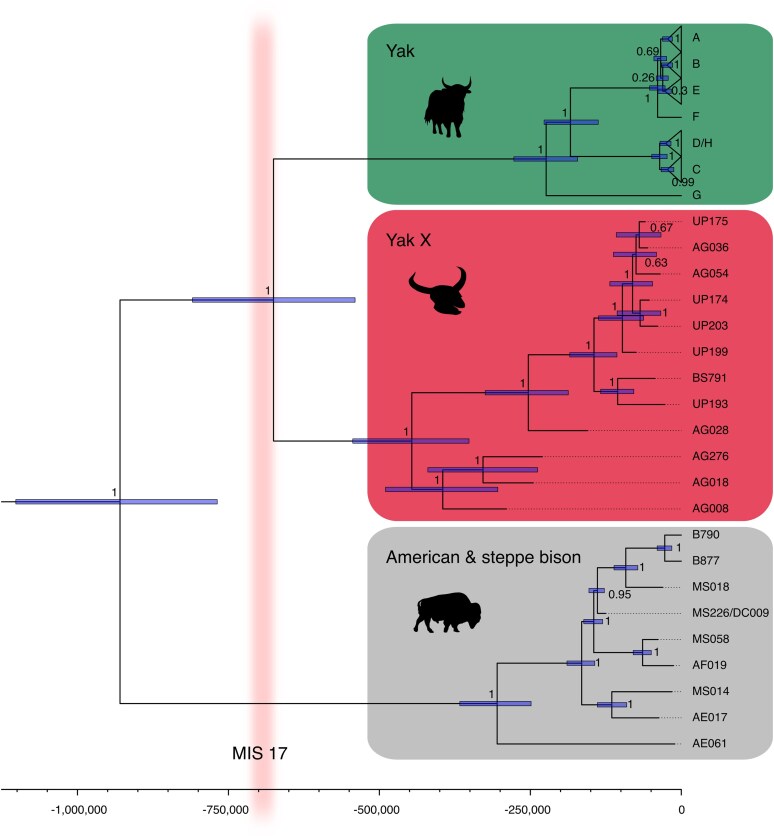 Figure 3
Peer Reviews
No public reviews on file for this paper yet. If you reviewed it on a platform where reviews are public (OpenReview, ICLR, NeurIPS, ICML), you can paste yours below so the community can read it here.
Videos
No videos yet. Explain this paper in a talk, walkthrough, or lecture? Add one.
Taxonomy
TopicsPleistocene-Era Hominins and Archaeology · Forensic and Genetic Research · Evolution and Paleontology Studies