Prevalence and Clinical Impacts of Canine Herpesvirus‐1 (CHV‐1) in Dogs: A Review of Reproductive Effects and Ocular Lesions
Sina Soleimani, Mohammadreza Ghorani, Amir Mohammad Naghshe Javaheri, Mahdiye Shirafkan, Hadi Bakhtiari

TL;DR
This paper reviews the global impact of Canine Herpesvirus-1 on dogs, focusing on its effects on reproduction and eye health, and suggests ways to manage and prevent its spread.
Contribution
The paper provides a comprehensive review of CHV-1's clinical effects and management strategies, emphasizing its global prevalence and transmission.
Findings
CHV-1 causes ocular lesions ranging from mild inflammation to severe corneal conditions in adult dogs.
The virus can lead to reproductive issues such as fetal expulsion and preterm birth.
Prophylactic antimicrobial therapy is recommended for managing ocular disease, but environmental temperature adjustments do not affect disease progression.
Abstract
Canine herpesvirus‐1 (CHV‐1), as a member of the Varicellovirus, subfamily Alphaherpesvirinae and family Herpesviridae, is mainly transmitted at birth but can also spread venereally and transplacentally. In addition, CHV‐1 establishes a latent carrier state in the body and can reactivate due to stress or immunosuppression. CHV‐1 distribution varies worldwide but is believed to have a global distribution. CHV‐1 infection in adult canines can manifest as a spectrum of ocular from eyelid inflammation (blepharitis) and conjunctival inflammation (conjunctivitis) to more severe corneal conditions, including ulcerative and non‐ulcerative keratitis. Moreover, CHV‐1 in adult canines can lead to a range of reproductive effects, from submucosal vascular congestion and bleeding to foetal expulsion and preterm birth of live offspring. Subclinical or mildly symptomatic upper respiratory tract disease…
Genes, proteins, chemicals, diseases, species, mutations and cell lines named across the full text — each resolved to its canonical identifier and authoritative record.
Click any figure to enlarge with its caption.
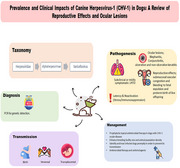 Figure 1
Peer Reviews
No public reviews on file for this paper yet. If you reviewed it on a platform where reviews are public (OpenReview, ICLR, NeurIPS, ICML), you can paste yours below so the community can read it here.
Videos
No videos yet. Explain this paper in a talk, walkthrough, or lecture? Add one.
Taxonomy
TopicsHerpesvirus Infections and Treatments · Veterinary Oncology Research · Cytomegalovirus and herpesvirus research