Crude preparation of a phage-encoded biofilm-dispersing factor expressed in E. coli and its potential application in bacteriological analysis of environmental water samples
Shah Nayeem Faruque, Iftekhar Bin Naser, M. Mozammel Hoque, Fariya Akter, Shah M. Faruque

TL;DR
A phage-encoded biofilm-dispersing factor produced in E. coli can enhance detection of waterborne bacteria like V. cholerae by breaking down biofilms.
Contribution
A phage-encoded biofilm-degrading factor was cloned in E. coli and shown to improve detection of pathogens in water samples.
Findings
The crude extract from recombinant E. coli dispersed biofilms of multiple bacterial species.
Supplementing enrichment medium with the extract increased detection of V. cholerae O1 in water samples.
The biofilm-dispersing activity was heat- and pH-stable but inactivated by proteinase-K.
Abstract
A fundamental technical challenge in detecting pathogenic bacteria in aquatic reservoirs is the inability to accurately estimate biofilm-associated cells in water. Considering the role of biofilms in environmental persistence and waterborne transmission of bacterial pathogens, there is an increasing interest in substances that can effectively degrade bacterial biofilms. The biofilm-dispersing Vibrio cholerae phage JSF7 was analyzed by whole genome sequencing and found to carry a gene predicted to encode an enzyme for degrading complex polysaccharides. The gene was cloned in Escherichia coli DH5α, and crude extract from the recombinant E. coli enhanced the dispersion of diverse bacterial biofilms, including those of E. coli, Shigella dysenteriae, Pseudomonas aeruginosa, and V. cholerae. The crude extract was fully active at a temperature of 37°C and pH of 7.0 but was inactivated by…
Genes, proteins, chemicals, diseases, species, mutations and cell lines named across the full text — each resolved to its canonical identifier and authoritative record.
Click any figure to enlarge with its caption.
 Figure 1
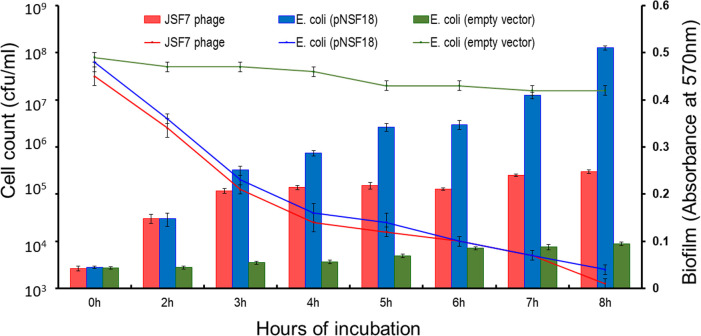 Figure 2
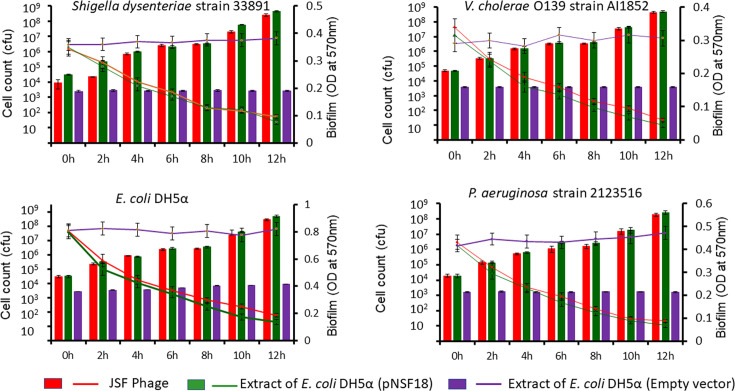 Figure 3
Peer Reviews
No public reviews on file for this paper yet. If you reviewed it on a platform where reviews are public (OpenReview, ICLR, NeurIPS, ICML), you can paste yours below so the community can read it here.
Videos
No videos yet. Explain this paper in a talk, walkthrough, or lecture? Add one.
Taxonomy
TopicsBacteriophages and microbial interactions · Vibrio bacteria research studies · Bacterial biofilms and quorum sensing