A Validated UPLC‐MS/MS Method for Monitoring Temozolomide and Perillyl Alcohol Metabolites in Biological Matrices: Insights From a Preclinical Pharmacokinetic Study
Ariane Krause Padilha Lorenzett, Tatiane Patricia Babinski, Samila Horst Peczek, Ana Paula Tartari, Jeferson Ziebarth, Andressa Zago, Thais Carla Brussulo Pereira, Rubiana Mara Mainardes

TL;DR
This study developed a reliable method to measure the levels of two cancer drugs and their metabolites in the body, showing how they behave in treating brain tumors.
Contribution
A validated UPLC-MS/MS method for quantifying TMZ, AIC, and PA in biological matrices is developed and applied to preclinical pharmacokinetic studies.
Findings
TMZ showed the highest systemic exposure and brain accumulation, supporting its effectiveness in treating brain tumors.
PA was rapidly absorbed but mainly distributed to the liver and kidneys with limited brain penetration.
The method met regulatory validation criteria and can be used for preclinical pharmacokinetic and biodistribution studies.
Abstract
Glioblastoma multiforme (GBM) is among the most aggressive brain tumors, largely due to the restrictive blood–brain barrier (BBB) and limited drug bioavailability. Temozolomide (TMZ), an alkylating agent, and perillyl alcohol (POH), a monoterpene with antitumor properties, have shown promise in GBM therapy. This study developed and validated a UPLC‐MS/MS method for the simultaneous quantification of TMZ, its active metabolite 5‐aminoimidazole‐4‐carboxamide (AIC), and perillic acid (PA), the primary POH metabolite, in rat plasma and tissues. The method met FDA and EMA validation criteria, showing high selectivity, linearity (R 2 > 0.995), accuracy (80%–120%), precision (RSD < 15%), and matrix‐specific stability across plasma, brain, liver, kidney, spleen, and lung. Following single oral doses of TMZ (2 mg/kg) and POH (47 mg/kg), pharmacokinetic analysis revealed that TMZ had the highest…
Genes, proteins, chemicals, diseases, species, mutations and cell lines named across the full text — each resolved to its canonical identifier and authoritative record.
Click any figure to enlarge with its caption.
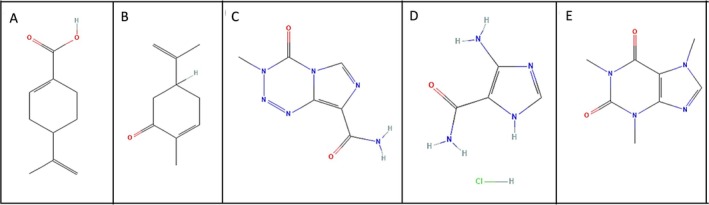 Figure 1
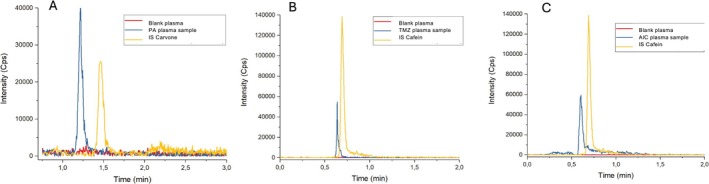 Figure 2
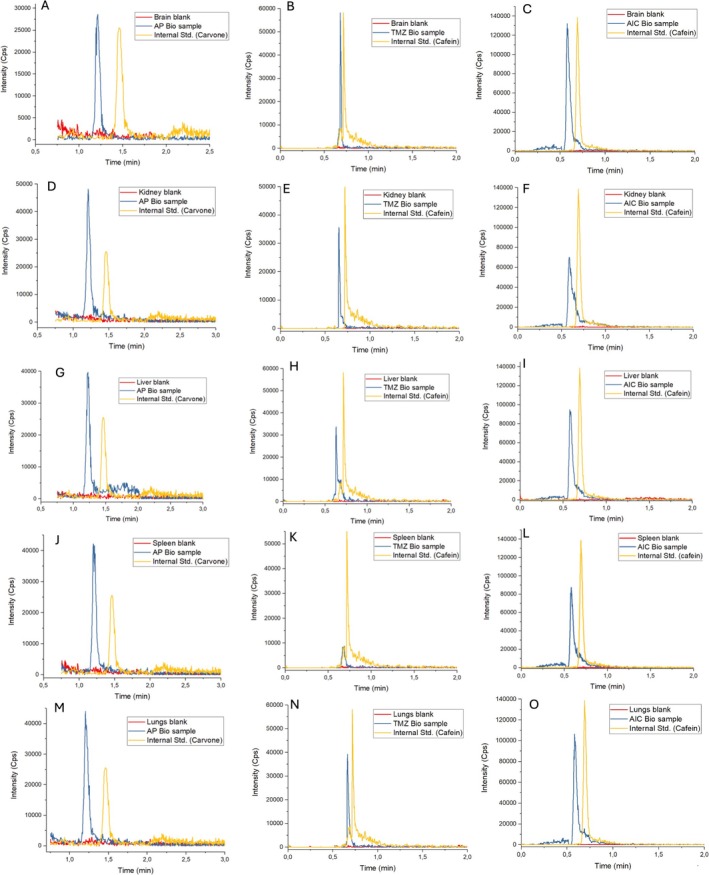 Figure 3
 Figure 4
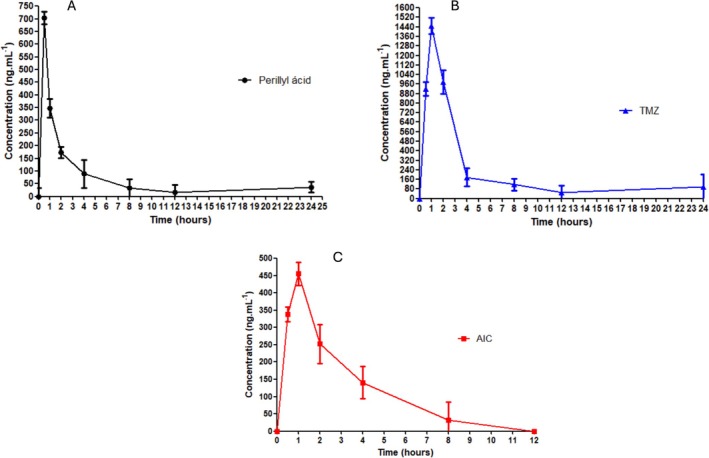 Figure 5
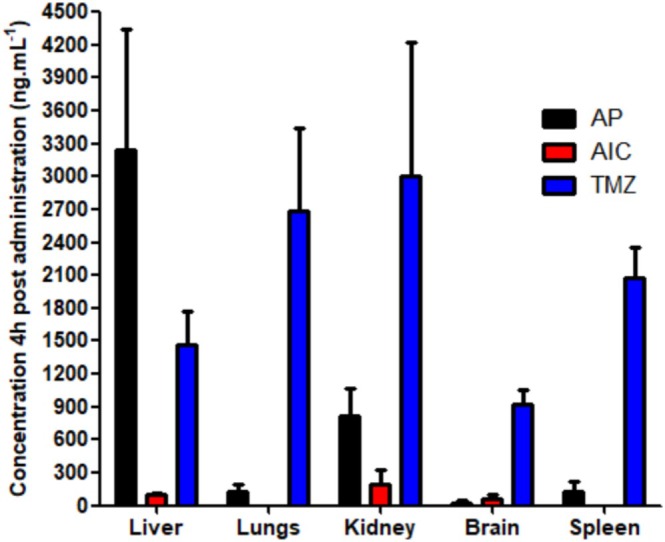 Figure 6
Peer Reviews
No public reviews on file for this paper yet. If you reviewed it on a platform where reviews are public (OpenReview, ICLR, NeurIPS, ICML), you can paste yours below so the community can read it here.
Videos
No videos yet. Explain this paper in a talk, walkthrough, or lecture? Add one.
Taxonomy
TopicsGlioma Diagnosis and Treatment · Chemotherapy-induced organ toxicity mitigation · Eicosanoids and Hypertension Pharmacology