A Prospective Cohort Study on the Usage, Safety, and Efficacy of Delamanid in Patients With Pulmonary Multidrug-Resistant Tuberculosis in South Korea
Jeongha Mok, Haesook Seo, Youngsoo Cho, Taehoon Lee, Sang-Ha Kim, Hye Kyeong Park, Jee Youn Oh, Tae Sun Shim

TL;DR
A study in South Korea found that delamanid is generally safe and effective for treating multidrug-resistant tuberculosis, with most patients adhering to the treatment and achieving positive outcomes.
Contribution
This study provides real-world evidence on delamanid's safety and efficacy in treating MDR-TB under programmatic conditions in South Korea.
Findings
High adherence to delamanid was observed, with 98.6% of patients receiving more than 80% of the prescribed dose.
Delamanid-related adverse events occurred in 44.2% of patients, with serious events in 4.1% and QT interval prolongation in 6.8%.
92.0% of culture-positive patients achieved sputum culture conversion, and the overall treatment success rate was 86.9%.
Abstract
Delamanid has demonstrated potential in the treatment of multidrug-resistant (MDR) or rifampicin-resistant tuberculosis (TB); however, real-world data on its effectiveness and safety remain limited. This prospective cohort study enrolled patients with pulmonary MDR-TB who were treated with a delamanid-containing longer regimen under programmatic conditions in South Korea between 2017 and 2021. Data on delamanid usage, safety, and efficacy were analyzed separately. In total, 147 patients were included in the usage and safety analyses (mean age, 50.7 years; 60.5% male). Adherence to delamanid was high, with a median adherence of 100.0%; 98.6% (n = 145) of the patients received more than 80% of the prescribed dose. Delamanid-related adverse events (AEs) occurred in 44.2% (n = 65) of patients, with the most common AEs being nausea (10.9%), pruritus (6.8%), and QT interval prolongation…
Genes, proteins, chemicals, diseases, species, mutations and cell lines named across the full text — each resolved to its canonical identifier and authoritative record.
Click any figure to enlarge with its caption.
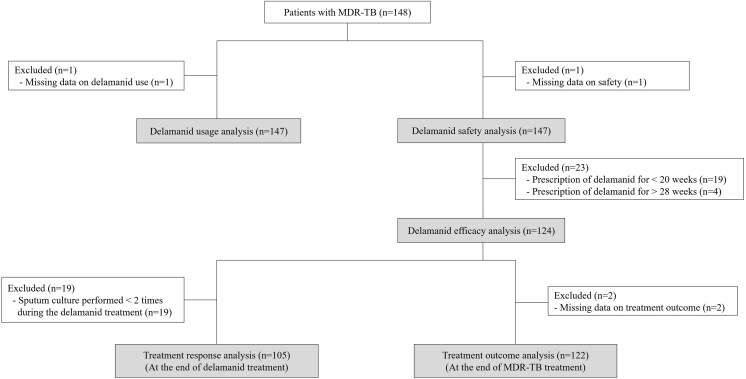 Figure 1
Peer Reviews
No public reviews on file for this paper yet. If you reviewed it on a platform where reviews are public (OpenReview, ICLR, NeurIPS, ICML), you can paste yours below so the community can read it here.
Videos
No videos yet. Explain this paper in a talk, walkthrough, or lecture? Add one.
Taxonomy
TopicsTuberculosis Research and Epidemiology · Andrographolide Research and Applications · Inhalation and Respiratory Drug Delivery