Relational similarity in wild bumblebees: the role of spatial alignment complexity
Gema Martin-Ordas

TL;DR
Wild bumblebees can recognize relational similarity in spatial arrangements, even when the arrays are complex or misaligned.
Contribution
This study shows that wild bumblebees can recognize relational similarity in spatial arrays with varying spatial complexity.
Findings
Bumblebees successfully completed tasks with arrays placed in different spatial configurations.
Results suggest bees can compare arrays and detect common relational features.
The study highlights the cognitive abilities of social insects in spatial tasks.
Abstract
Being able to abstract relations of similarity is considered one of the hallmarks of human cognition. Importantly, previous research has shown that other animals—both vertebrates (e.g., primates) and invertebrates (e.g., bees)— are capable of spontaneously attending to relational similarity in spatial mapping tasks. These tasks require individuals to find a reward in an array of, for example, three objects, after observing a reward being hidden in a different array of three objects. Studies with primates have shown that performance in this type of task is influenced by the distribution of the objects in the arrays. Here I investigated whether wild bumblebees’ relational abilities are also affected by the spatial complexity of the arrays (i.e., three horizontally aligned stimuli). In Experiment 1, bees were presented with two arrays separately: in one condition, the arrays were placed…
Genes, proteins, chemicals, diseases, species, mutations and cell lines named across the full text — each resolved to its canonical identifier and authoritative record.
Click any figure to enlarge with its caption.
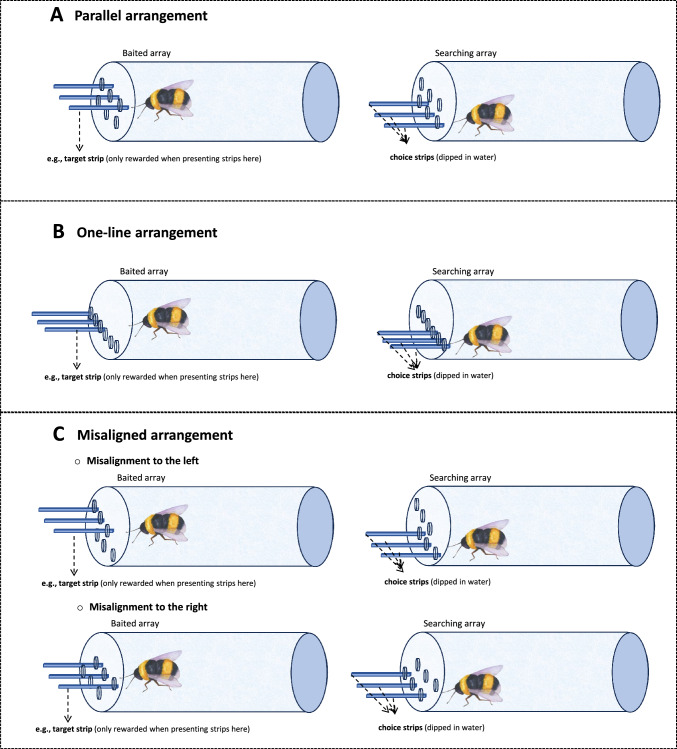 Figure 1
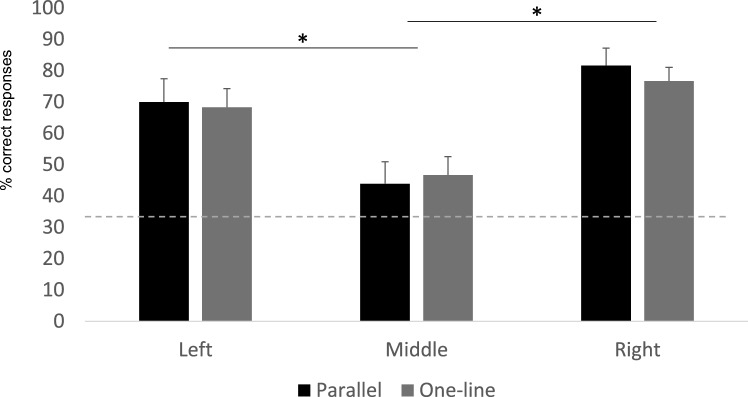 Figure 2
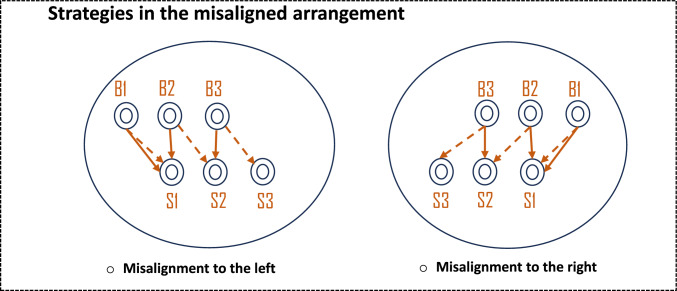 Figure 3
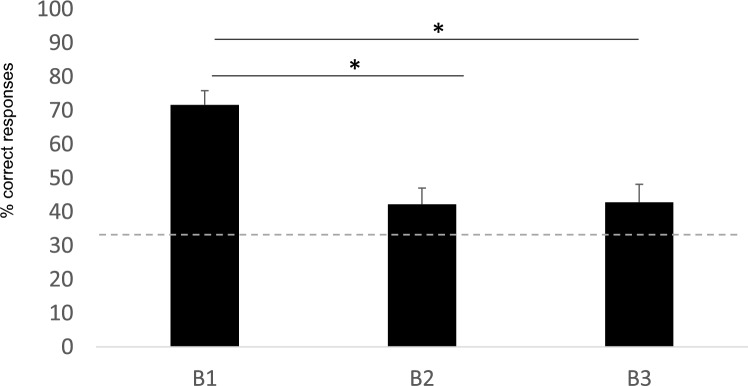 Figure 4
Peer Reviews
No public reviews on file for this paper yet. If you reviewed it on a platform where reviews are public (OpenReview, ICLR, NeurIPS, ICML), you can paste yours below so the community can read it here.
Videos
No videos yet. Explain this paper in a talk, walkthrough, or lecture? Add one.
Taxonomy
TopicsPrimate Behavior and Ecology · Memory and Neural Mechanisms · Hemispheric Asymmetry in Neuroscience