Assessing extensive coronary artery disease using a myocardial jeopardy score based on coronary CT: long-term prognostic value
Andreas A. Giannopoulos, Alexia Rossi, Dimitrios V. Moysidis, Jan A. Schaab, Stjepan Jurisic, Tobia Albertini, Alessandro Candreva, Barbara E. Stähli, Dominik C. Benz, Ronny R. Buechel, Philipp A. Kaufmann, Aju P. Pazhenkottil

TL;DR
This study shows that a CT-based score called CT-BCIS-JS can effectively predict long-term heart risks in patients with coronary artery disease.
Contribution
The study demonstrates the long-term prognostic value of the CT-based British Cardiovascular Intervention Society Jeopardy Score (CT-BCIS-JS) in predicting adverse cardiovascular outcomes.
Findings
Patients with a CT-BCIS-JS score of 6 or higher had an 11-fold higher risk of death or nonfatal MI compared to those with lower scores.
The CT-BCIS-JS score strongly predicted major adverse cardiovascular events, with a nearly 20-fold increased risk in the high-score group.
The CT-BCIS-JS provides excellent risk stratification for patients with known or suspected coronary artery disease.
Abstract
The British Cardiovascular Intervention Society Jeopardy Score (BCIS-JS) is an established, simplified scoring system for assessing coronary artery disease (CAD) extensiveness with excellent agreement between the invasive and the computed tomography (CT) angiography-based scores. Originally developed for use during invasive coronary angiography, it supports procedural planning and risk stratification by estimating the extent of myocardium at risk. The computed tomography (CT)-based version (CT-BCIS-JS) has shown excellent agreement with the invasive score. We aimed to investigate the value of the CT-BCIS-JS in predicting long-term outcomes. This retrospective single-center study included 337 patients referred for coronary CT angiography (CCTA). CT-BCIS-JS was calculated using a purpose-developed online calculator, and patients were divided into extensive and non-extensive CAD (BCIS ≥ 6…
Genes, proteins, chemicals, diseases, species, mutations and cell lines named across the full text — each resolved to its canonical identifier and authoritative record.
Click any figure to enlarge with its caption.
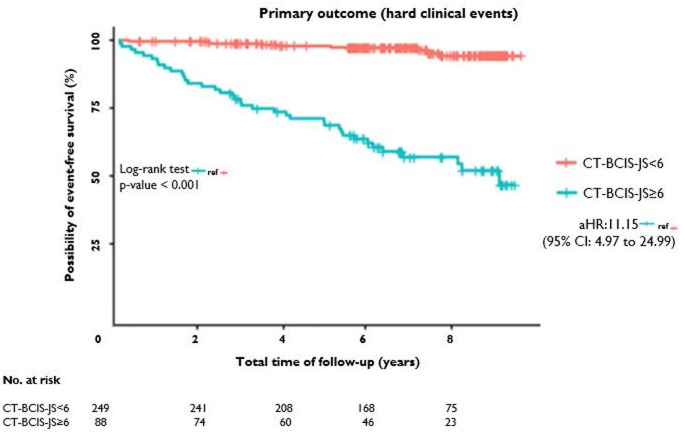 Figure 1
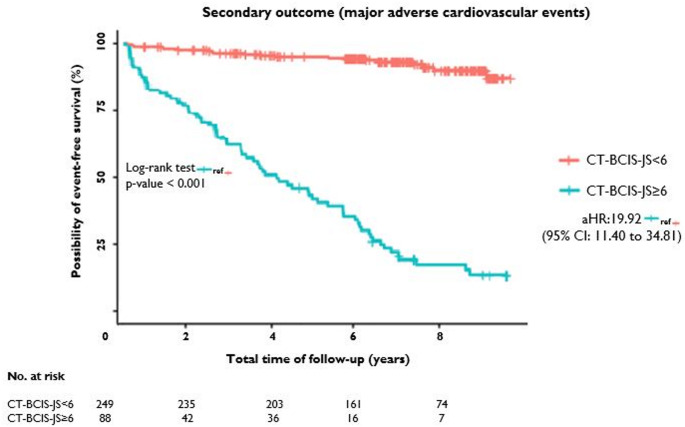 Figure 2
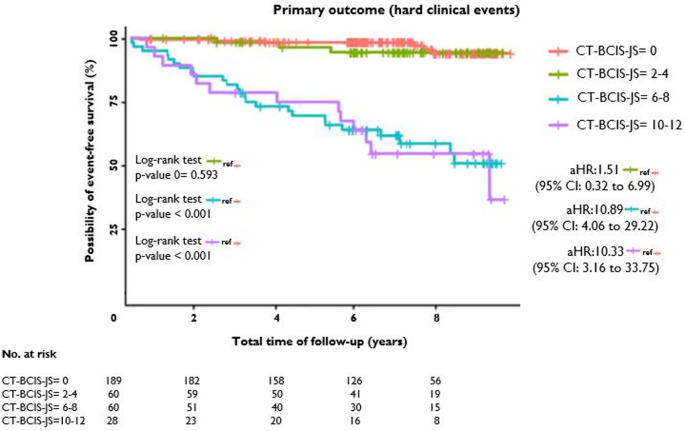 Figure 3
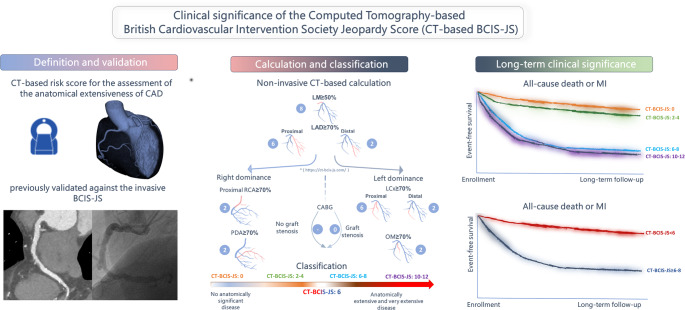 Figure 4
Peer Reviews
No public reviews on file for this paper yet. If you reviewed it on a platform where reviews are public (OpenReview, ICLR, NeurIPS, ICML), you can paste yours below so the community can read it here.
Videos
No videos yet. Explain this paper in a talk, walkthrough, or lecture? Add one.
Taxonomy
TopicsCardiac Imaging and Diagnostics · Acute Myocardial Infarction Research · Coronary Interventions and Diagnostics