Perception-Based Methods and Beyond: A Current Opinion on How to Assess Static Stretching Intensity
Konstantin Warneke, Anthony J. Blazevich, Daniel Jochum, David G. Behm, Ewan Thomas, Masatoshi Nakamura, José Afonso

TL;DR
This paper discusses the lack of a clear definition for stretch intensity and suggests better ways to measure it for consistent results in research and practice.
Contribution
The paper proposes alternative methods to quantify stretch intensity beyond subjective perception, aiming for more objective and reliable assessments.
Findings
Perceived discomfort or pain is an unreliable measure of stretch intensity due to variability and lack of objective definitions.
Using joint angles or stretch distances as a percentage of peak passive torque may better reflect tissue load without subjective measures.
A unified and quantifiable definition of stretch intensity is needed for consistent clinical and scientific applications.
Abstract
Muscle stretching is widely used in clinical, athletic, and otherwise healthy populations, yet a consensual definition of stretch intensity—a key component of stretch load—does not exist. This is important because the effects of stretch intensity on range of motion and strength are controversial but suggested to affect clinical practice and scientific research. Most commonly, stretch intensity is defined in relation to an individual’s perceived level of discomfort or pain; however, these definitions are problematic for several reasons, including that consensual and objective quantifiable definitions of ‘pain’ and ‘discomfort’ do not exist, perceptions vary widely (and may not be sensed in some populations), and their ordinal (interval) nature is problematic from a statistical (research) point of view. The maximal range of motion or stretch distance may instead be useful; however, it can…
Genes, proteins, chemicals, diseases, species, mutations and cell lines named across the full text — each resolved to its canonical identifier and authoritative record.
Click any figure to enlarge with its caption.
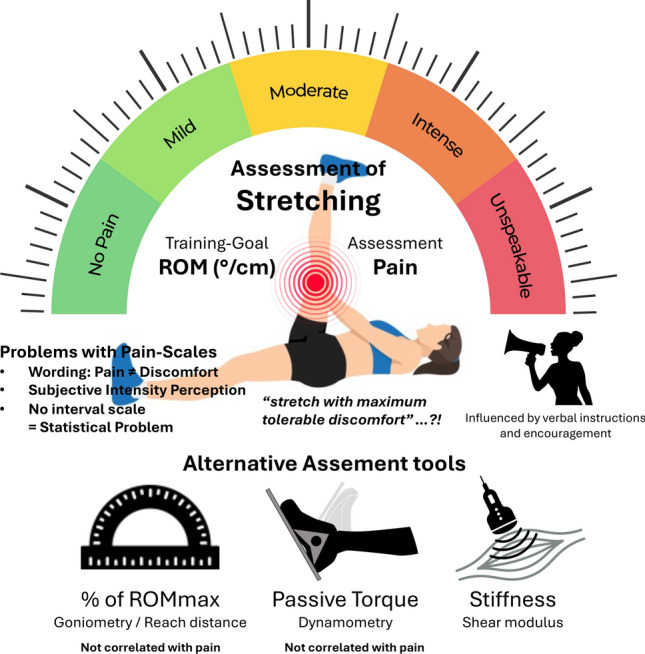 Figure 1
Peer Reviews
No public reviews on file for this paper yet. If you reviewed it on a platform where reviews are public (OpenReview, ICLR, NeurIPS, ICML), you can paste yours below so the community can read it here.
Videos
No videos yet. Explain this paper in a talk, walkthrough, or lecture? Add one.
Taxonomy
TopicsSports injuries and prevention · Sports Performance and Training · Musculoskeletal pain and rehabilitation