Enhanced Visualisation of Colorectal Tumours via Topical Application of EMI-137 in a Methylcellulose-Based Formulation: An ex vivo Feasibility Study
Elham Zonoobi, Daan G. J. Linders, Stefan Harmsen, María Rita Rodríguez Luna, Shadhvi S. Bhairosingh, Dima D. A. Almandawi, Ronald L. P. Van Vlierberghe, Marvin W. J. Nogaitzig, Christophe Portal, Stijn A. L. P. Crobach, Michele Diana, Gilbert Noordam, Davey van den Burg

TL;DR
A new viscous formulation of EMI-137 improves fluorescence imaging of colorectal tumors by enhancing tracer contact with tissue.
Contribution
A novel methylcellulose-based formulation enhances EMI-137's fluorescence for ex vivo tumor visualization.
Findings
Methylcellulose formulation increased EMI-137 fluorescence intensity compared to PBS.
EMI-137 in methylcellulose effectively visualized colon tumors with high tumor-to-background ratio.
Histopathological analysis confirmed c-Met expression in visualized tumors.
Abstract
Fluorescence-guided molecular imaging may improve colorectal cancer (CRC) patient outcomes by enabling early detection and better surgical treatment, relying on developing targeted fluorescent tracers to highlight tumours. This study investigates visualising primary colon tumours by topically applying EMI-137, a targeted fluorescent tracer designed to bind to c-Met receptor. We introduce a novel viscous formulation to enhance the tracer's performance, aiming for a clear, robust fluorescent signal by improving contact with mucosal surface of ex vivo colon specimens. We evaluated fluorescence properties of EMI-137 in phosphate-buffered saline (PBS) and in methylcellulose (m-cellulose) and determined emission spectrum of the tracer in both formulations. Flow cytometry was used to determine EMI-137's specificity for c-Met receptor and its optimal concentration. Live-cell imaging visually…
Genes, proteins, chemicals, diseases, species, mutations and cell lines named across the full text — each resolved to its canonical identifier and authoritative record.
Click any figure to enlarge with its caption.
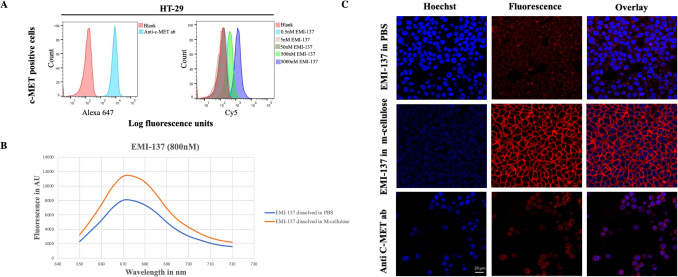 Figure 1
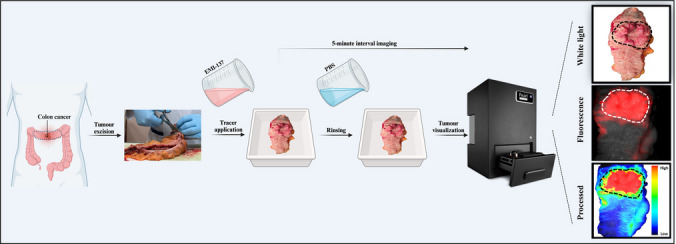 Figure 2
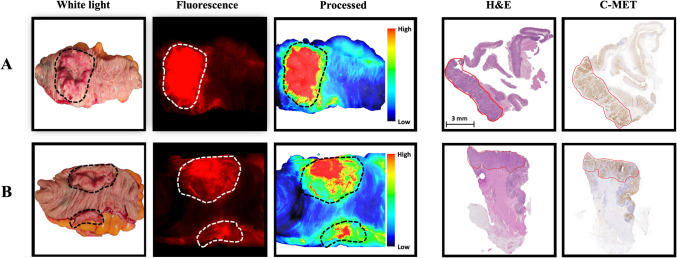 Figure 3
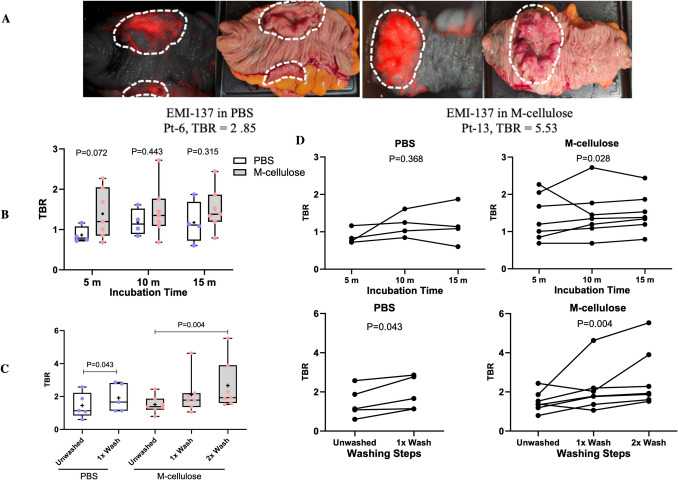 Figure 4
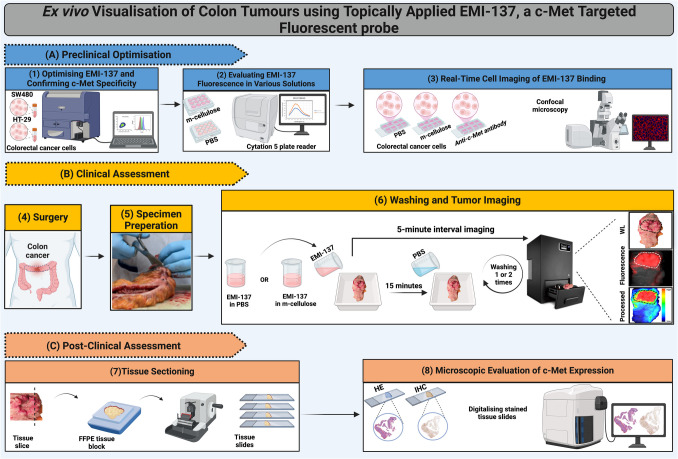 Figure 5
Peer Reviews
No public reviews on file for this paper yet. If you reviewed it on a platform where reviews are public (OpenReview, ICLR, NeurIPS, ICML), you can paste yours below so the community can read it here.
Videos
No videos yet. Explain this paper in a talk, walkthrough, or lecture? Add one.
Taxonomy
TopicsNanoplatforms for cancer theranostics · Photodynamic Therapy Research Studies · Cancer Cells and Metastasis