Relationships between Pre- and Postcopulatory Sexually Selected Traits in Green Frogs (Lithobates clamitans)
M O Girard, C J Clark, A F Kahrl

TL;DR
Green frogs show complex trade-offs between traits used to attract mates and traits related to successful fertilization, suggesting energy limits their ability to invest in all traits equally.
Contribution
The study reveals both positive and negative correlations between pre- and postcopulatory traits in Green Frogs, supporting the trade-off hypothesis.
Findings
Belly saturation and hue were negatively correlated with sperm count and sperm length.
Forearm size was positively correlated with sperm count and velocity but negatively with sperm length.
Results suggest complex energetic trade-offs in male Green Frogs' sexual trait investment.
Abstract
Sexual selection is thought to be a primary driver of trait evolution. The expression of traits that improve mate acquisition or fertilization success may be linked in organisms that experience intense sexual selection as they must invest sufficient energy into many different sexual traits in order to reproduce. Two prevailing models—the phenotype-linked fertility hypothesis and the trade-off hypothesis—describe potential positive or negative correlations, respectively, between pre- and postcopulatory traits. We examined the interaction between precopulatory traits (belly coloration and forearm size) and postcopulatory traits (sperm morphology, sperm velocity, and sperm count) in male Green Frogs (Lithobates clamitans). We found multiple positive and negative correlations between pre- and postcopulatory sexual traits. Interestingly, belly saturation and hue, which are precopulatory…
Genes, proteins, chemicals, diseases, species, mutations and cell lines named across the full text — each resolved to its canonical identifier and authoritative record.
Click any figure to enlarge with its caption.
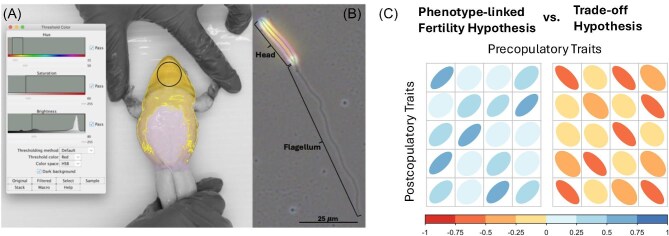 Figure 1
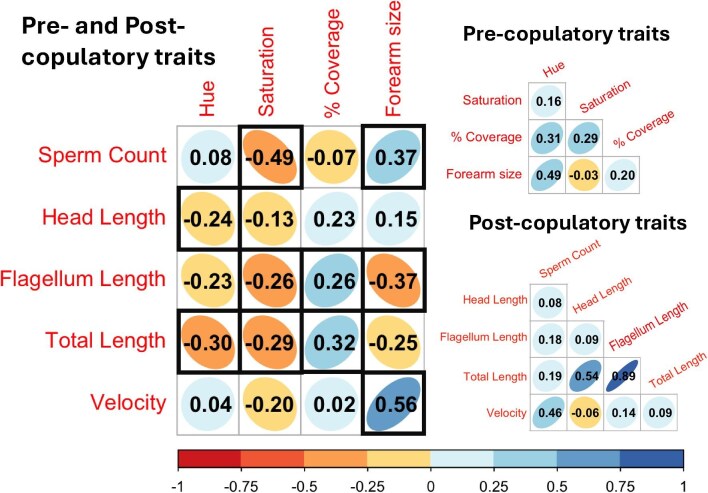 Figure 2
Peer Reviews
No public reviews on file for this paper yet. If you reviewed it on a platform where reviews are public (OpenReview, ICLR, NeurIPS, ICML), you can paste yours below so the community can read it here.
Videos
No videos yet. Explain this paper in a talk, walkthrough, or lecture? Add one.
Taxonomy
TopicsAmphibian and Reptile Biology · Animal Behavior and Reproduction · Evolution and Genetic Dynamics