Estrogen-Functionalized Ru(II) Polypyridyl Complexes Self-Assemble into Aggregates and Exhibit Selective Phototoxicity against Breast Cancer Cells
Sofia Alexandra Tsoni, Timothy Kench, Ramon Vilar, Theodore Lazarides

TL;DR
Researchers developed a new type of light-activated cancer treatment using estrogen-linked Ru(II) complexes that selectively target breast cancer cells.
Contribution
Estrogen-functionalized Ru(II) complexes show selective phototoxicity against ER+ breast cancer cells, offering a new approach for targeted photodynamic therapy.
Findings
Estrogen-functionalized Ru(II) complexes self-assemble into micelle-like structures under biological conditions.
Two complexes exhibit up to 9.6-fold higher light-induced cytotoxicity toward ER+ compared to ER− breast cancer cells.
Aggregation of complexes enhances cellular uptake and phototoxic effects in targeted cancer cells.
Abstract
Photodynamic therapy (PDT) constitutes a promising cancer treatment modality in which an administered photosensitizer is excited with visible light to induce the localized generation of cytotoxic reactive oxygen species (ROS) at the tumor site, thus minimizing damage to healthy tissues and avoiding the use of ionizing radiation. However, most photosensitizers lack inherent selectivity for cancer cells, leading to undesirable accumulation in healthy tissues. The readily formed triplet excited states of Ru(II) polypyridyl complexes, coupled with their kinetic inertness, make them suitable candidates as photosensitizers for PDT. Herein, we report the synthesis of a series of estrogen-functionalized Ru(II) complexes using click chemistry and investigate their photophysical properties and biological activity. Dynamic light scattering studies, supported by time-resolved luminescence…
Genes, proteins, chemicals, diseases, species, mutations and cell lines named across the full text — each resolved to its canonical identifier and authoritative record.
Click any figure to enlarge with its caption.
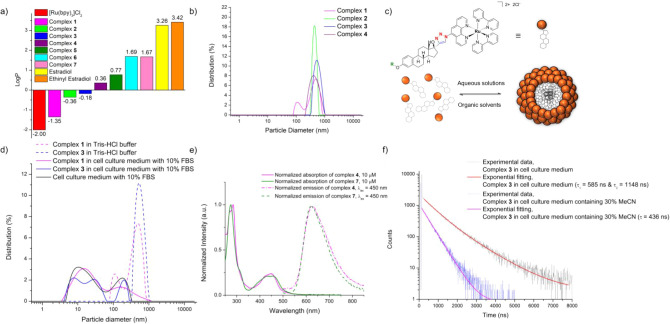 Figure 1
 Figure 2
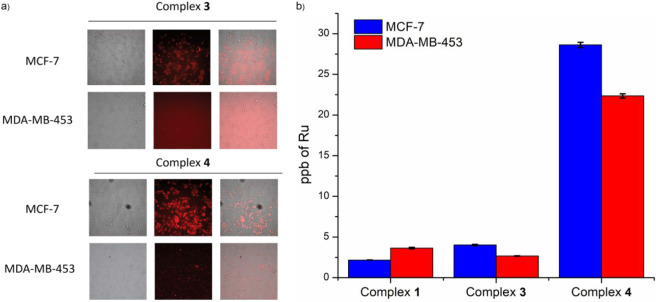 Figure 3
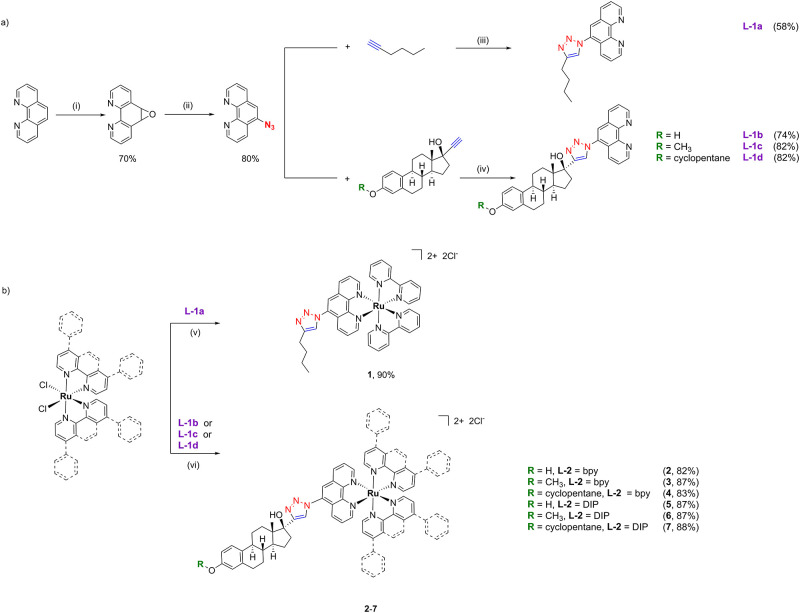 Figure 4
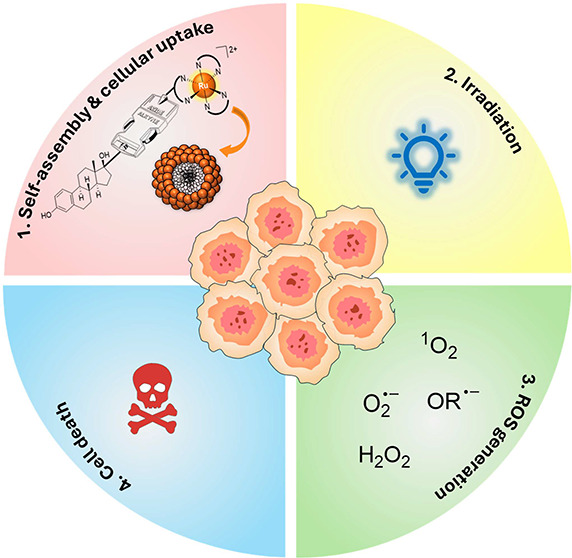 Figure 5
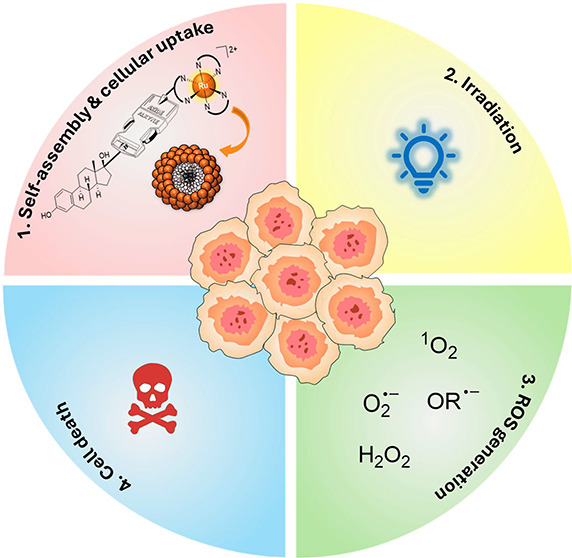 Figure 6
 Figure 7
Peer Reviews
No public reviews on file for this paper yet. If you reviewed it on a platform where reviews are public (OpenReview, ICLR, NeurIPS, ICML), you can paste yours below so the community can read it here.
Videos
No videos yet. Explain this paper in a talk, walkthrough, or lecture? Add one.
Taxonomy
TopicsPhotodynamic Therapy Research Studies · Metal complexes synthesis and properties · Nanoplatforms for cancer theranostics