High-throughput developmental assay of cold tolerance in Caenorhabditis elegans
Amanda L. Peake, Nikita S. Jhaveri, Erik C. Andersen, John R. Stinchcombe

TL;DR
The paper introduces a high-throughput method to study cold tolerance in C. elegans larvae, revealing genetic variation and heritability.
Contribution
A scalable high-throughput assay for measuring cold tolerance in C. elegans during the L1 larval stage.
Findings
Animals exposed to 24-hour cold treatment showed greater variation in cold tolerance.
The assay is suitable for large-scale genetic and evolutionary studies of cold tolerance in nematodes.
Abstract
Temperature can impose strong selection causing thermal tolerance variation between individuals, populations, and species. We developed a high-throughput larval development assay for cold tolerance in the model organism Caenorhabditis elegans . We exposed animals to 4°C cold treatments for either 12 or 24 hours. Animals exposed to the 24-hour cold treatment exhibited greater variation and heritability in cold tolerance during the L1 larval stage. The high-throughput approach that we developed is easily scalable to simultaneously measure a large number of strains, which makes it ideal for studying the genetics and evolution of cold tolerance in Caenorhabditis nematodes.
Genes, proteins, chemicals, diseases, species, mutations and cell lines named across the full text — each resolved to its canonical identifier and authoritative record.
Click any figure to enlarge with its caption.
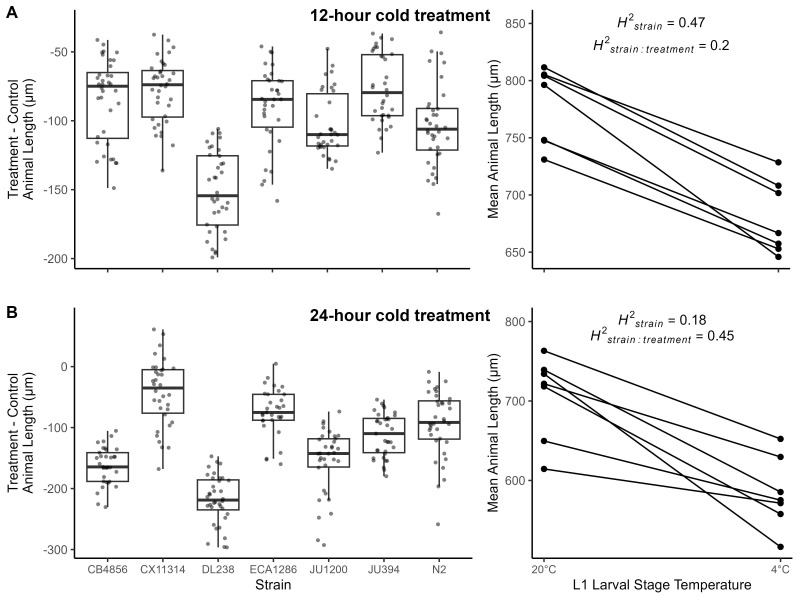 Figure 1
Peer Reviews
No public reviews on file for this paper yet. If you reviewed it on a platform where reviews are public (OpenReview, ICLR, NeurIPS, ICML), you can paste yours below so the community can read it here.
Videos
No videos yet. Explain this paper in a talk, walkthrough, or lecture? Add one.
Taxonomy
TopicsGenetics, Aging, and Longevity in Model Organisms · Physiological and biochemical adaptations · Evolution and Genetic Dynamics