Beyond criterion: cognitive flexibility in wild striated caracaras
Katie J. Harrington, Megan L. Lambert

TL;DR
This study shows that using learning curves instead of a fixed threshold gives a better understanding of how wild striated caracaras adapt to changing tasks.
Contribution
The paper introduces learning curve analysis as a more accurate alternative to trials-to-criterion for assessing cognitive flexibility in wild animals.
Findings
Trials-to-criterion (TTC) can misrepresent learning by over- or underestimating performance.
Learning curves reveal individual variation in learning trajectories and stability.
Slope- and trajectory-based analyses provide a more ecologically valid framework for studying learning in the wild.
Abstract
Cognitive flexibility, the capacity to adapt to changing conditions, is often assessed with reversal learning, in which a learned association must be updated after reward contingencies change. Trials-to-criterion (TTC) is a widely applied learning threshold, but it can misrepresent performance; some individuals improve steadily but fail to reach the criterion due to variability (false negatives), while others meet it through a spike without sustained learning (false positives). We evaluate TTC limitations and demonstrate learning curve analysis as a more nuanced approach to investigate learning dynamics. We tested wild striated caracaras (Phalcoboenus australis) using a two-choice discrimination task followed by a reversal task and compared TTC with trial-level modelling. Although the group showed overall improvement, individual trajectories varied widely. TTC both over- and…
Genes, proteins, chemicals, diseases, species, mutations and cell lines named across the full text — each resolved to its canonical identifier and authoritative record.
Click any figure to enlarge with its caption.
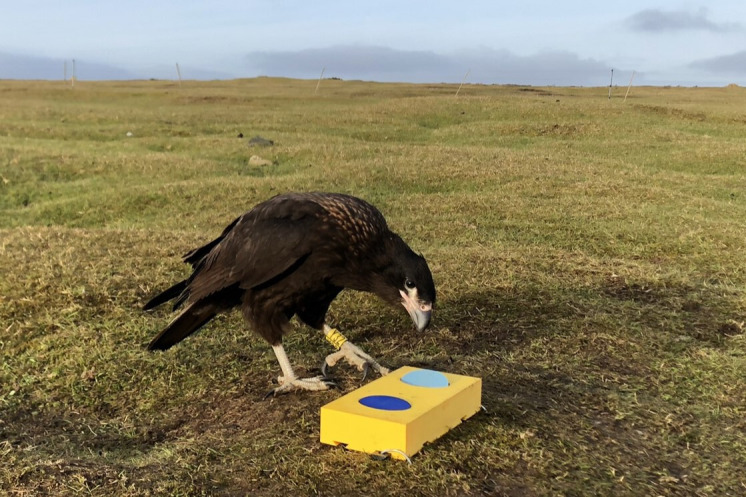 Figure 1
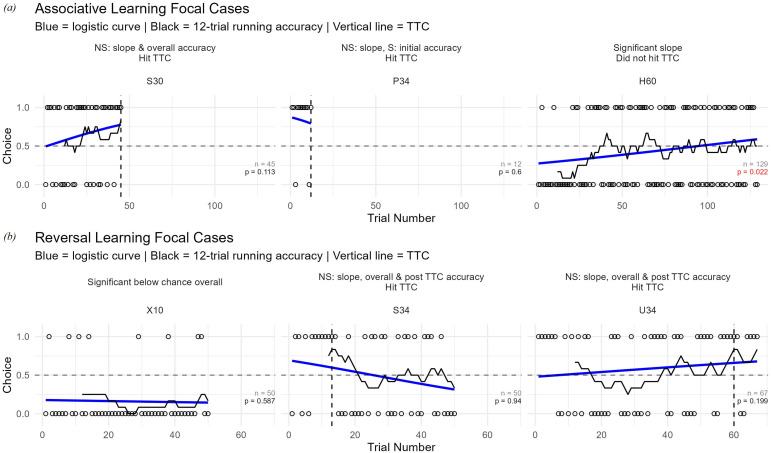 Figure 2
Peer Reviews
No public reviews on file for this paper yet. If you reviewed it on a platform where reviews are public (OpenReview, ICLR, NeurIPS, ICML), you can paste yours below so the community can read it here.
Videos
No videos yet. Explain this paper in a talk, walkthrough, or lecture? Add one.
Taxonomy
TopicsMotor Control and Adaptation · Action Observation and Synchronization · Embodied and Extended Cognition