The effort hypothesis at the heart of the virtuous circle
Michel Audiffren, Nathalie André

TL;DR
This paper updates a model showing how exercise and cognition influence each other in a positive cycle, leading to long-term health benefits.
Contribution
The model now includes the default mode network and emphasizes a bidirectional relationship between exercise and cognitive functions.
Findings
Exercise improves executive functions, which in turn support long-term exercise adherence.
The model integrates multiple mechanisms like the effort hypothesis to explain cognitive and physiological benefits.
Longitudinal studies support the reciprocal links between exercise, cognition, and brain health.
Abstract
This article updates the “virtuous circle” model, which links physical exercise with cognition. This model, which originally focused on connectivity between the salience network (SN) and central executive network (CEN), now also incorporates the default mode network (DMN). It describes a bidirectional dynamic: exercise enhances executive functions (i.e., inhibition, flexibility, updating, planning, and problem-solving), which in turn strengthen long-term exercise adherence. This virtuous circle leads to cognitive, physiological, and motivational benefits through synergistic mechanisms induced by exercise such as the effort hypothesis (effort as an investment), the neurotrophic hypothesis, the cardiovascular hypothesis, the inflammatory hypothesis and the glucocorticoid hypothesis. These mechanisms improve connectivity within large-scale neuronal networks, thereby consolidating…
Genes, proteins, chemicals, diseases, species, mutations and cell lines named across the full text — each resolved to its canonical identifier and authoritative record.
Click any figure to enlarge with its caption.
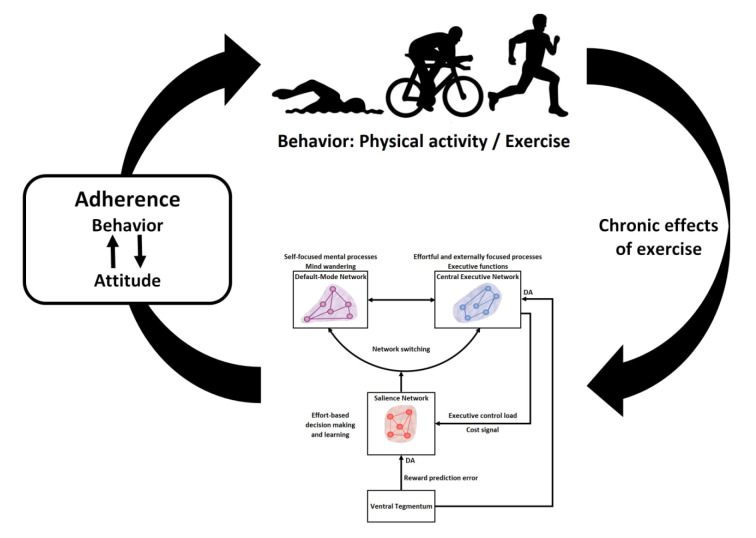 Figure 1
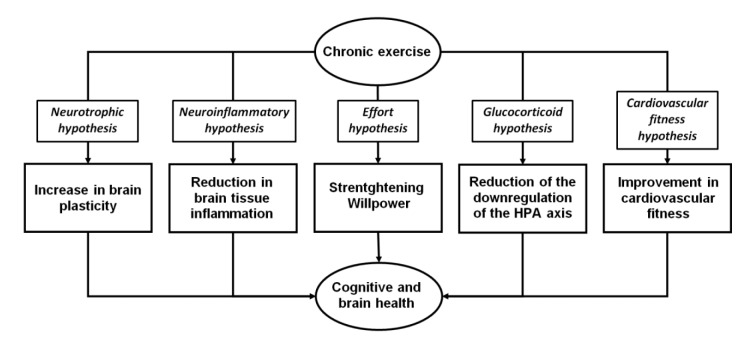 Figure 2
 Figure 3
 Figure 4
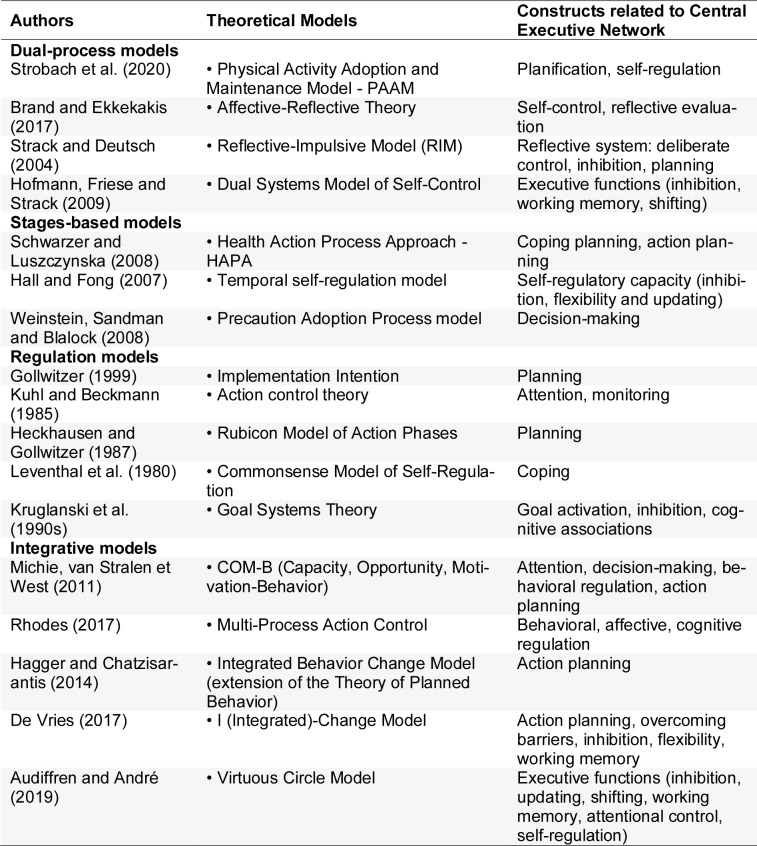 Figure 5
Peer Reviews
No public reviews on file for this paper yet. If you reviewed it on a platform where reviews are public (OpenReview, ICLR, NeurIPS, ICML), you can paste yours below so the community can read it here.
Videos
No videos yet. Explain this paper in a talk, walkthrough, or lecture? Add one.
Taxonomy
TopicsPhysical Activity and Health · Heart Rate Variability and Autonomic Control · Behavioral Health and Interventions