RareLink: scalable REDCap-based framework for rare disease interoperability linking international registries to FHIR and Phenopackets
Adam S. L. Graefe, Filip Rehburg, Samer Alkarkoukly, Daniel Danis, Ana Grönke, Miriam R. Hübner, Alexander Bartschke, Thomas Debertshäuser, Sophie A. I. Klopfenstein, Julian Saß, Julia Fleck, Mirko Rehberg, Jana Zschüntzsch, Elisabeth F. Nyoungui, Tatiana Kalashnikova

TL;DR
RareLink is a new framework that connects REDCap data to global health standards, improving data sharing for rare disease research worldwide.
Contribution
RareLink introduces a scalable, ontology-based framework for REDCap interoperability with FHIR and Phenopackets in rare disease research.
Findings
RareLink was implemented across Germany, Canada, South Africa, and Japan for registry and data analysis.
A simulated Kabuki syndrome cohort demonstrated successful data export to Phenopackets and FHIR.
RareLink supports global applicability and enhances the clinical utility of REDCap data.
Abstract
While Research Electronic Data Capture (REDCap) is widely adopted in rare disease research, its unconstrained data format often lacks native interoperability with global health standards, limiting secondary use. We developed RareLink, an open-source framework implementing our published ontology-based rare disease common data model. It enables standardised data exchange between REDCap, international registries, and downstream analysis tools by linking Global Alliance for Genomics and Health Phenopackets and Health Level 7 Fast Healthcare Interoperability Resources (FHIR) instances conforming to International Patient Summary and Genomics Reporting profiles. RareLink was developed in three phases across Germany, Canada, South Africa, and Japan for registry and data analysis purposes. We defined a simulated Kabuki syndrome cohort and demonstrated data export to Phenopackets and FHIR.…
Genes, proteins, chemicals, diseases, species, mutations and cell lines named across the full text — each resolved to its canonical identifier and authoritative record.
Click any figure to enlarge with its caption.
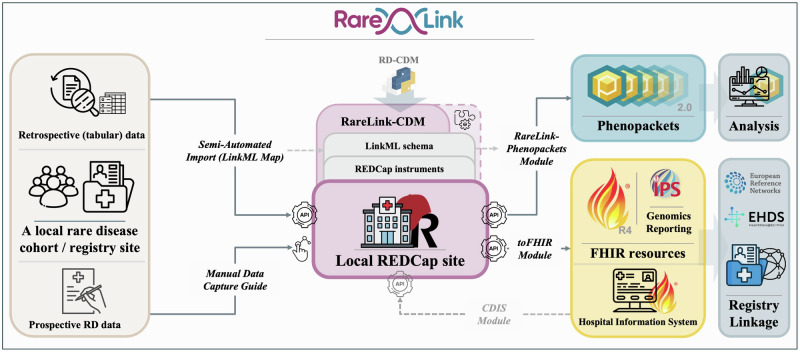 Figure 1
 Figure 2
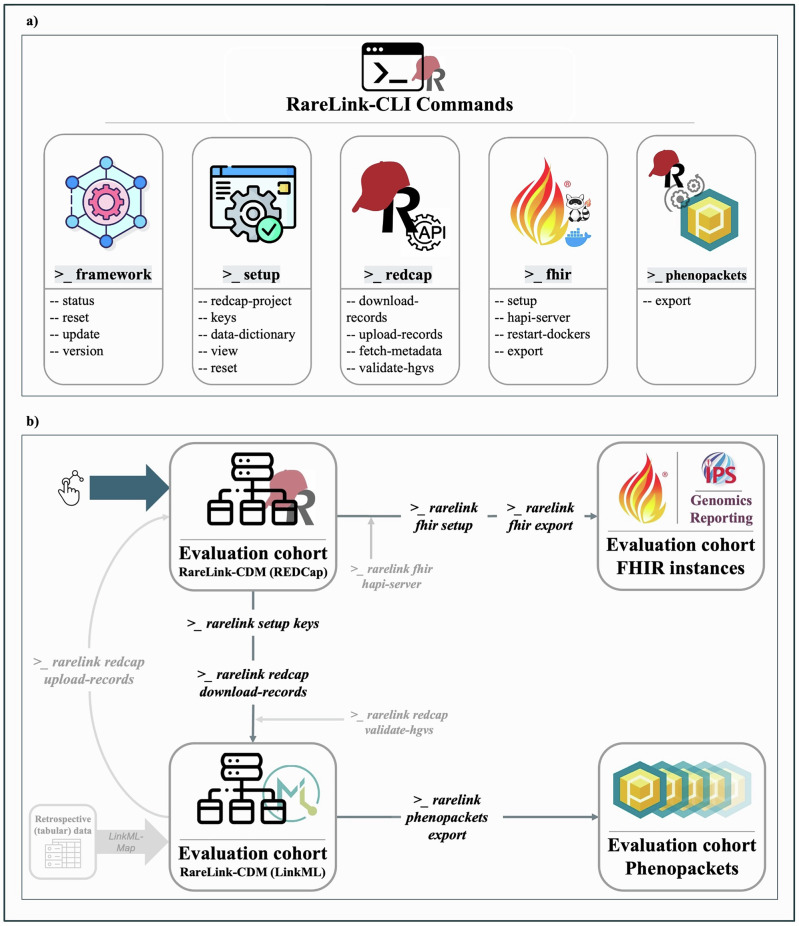 Figure 3
 Figure 4
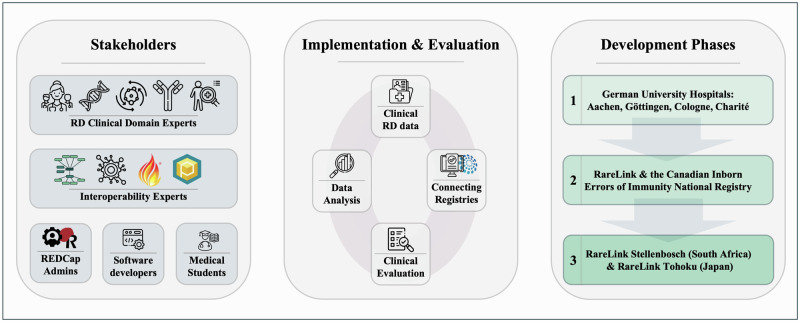 Figure 5
Peer Reviews
No public reviews on file for this paper yet. If you reviewed it on a platform where reviews are public (OpenReview, ICLR, NeurIPS, ICML), you can paste yours below so the community can read it here.
Videos
No videos yet. Explain this paper in a talk, walkthrough, or lecture? Add one.
Taxonomy
TopicsGenomics and Rare Diseases · Biomedical Text Mining and Ontologies · Electronic Health Records Systems