Crystal structures of Ryanodine Receptor reveal dantrolene and azumolene interactions guiding inhibitor development
Hadiatullah Hadiatullah, Lianyun Lin, Zhiyan Wang, Rajamanikandan Sundarraj, Qing Wang, Xinru Lai, Nagomi Kurebayashi, Takuya Kobayashi, Toshiko Yamazawa, Yu Seby Chen, Wenlan Wang, Hongxia Zhao, Yiqing Yin, Takashi Murayama, Filip Van Petegem, Zhiguang Yuchi

TL;DR
Researchers uncovered how dantrolene and azumolene bind to a key receptor, offering insights to develop better inhibitors.
Contribution
High-resolution crystal structures of the RyR Repeat12 domain bound to dantrolene, azumolene, and nucleotides are reported for the first time.
Findings
Dantrolene and azumolene bind cooperatively with nucleotides in a pseudosymmetric cleft involving Trp880 and Trp994.
Binding induces a clamshell-like closure of the R12 domain and allosterically influences RyR gating.
Structure-based screening identified a potent compound with a distinct binding mode targeting the same site.
Abstract
The ryanodine receptor (RyR) is a critical drug target, yet dantrolene (DAN) remains the only FDA-approved inhibitor, limited by hepatotoxicity and unsuitable for chronic use. To guide improved inhibitor development, we determine high-resolution crystal structures of the RyR Repeat12 (R12) domain bound to DAN, its analog azumolene (AZU), and adenine nucleotides (AMP-PCP or ADP). DAN/AZU and nucleotides bind cooperatively to a pseudosymmetric cleft, with key interactions involving Trp880 and Trp994. Binding induces a clamshell-like closure of the R12 domain. Isothermal titration calorimetry (ITC) reveals higher affinity in the presence of nucleotides and lower affinity for RyR2 due to nearby substitutions. Structural comparison with cryo-EM data suggests that DAN/AZU binding allosterically influences RyR gating and functional regulation. Structure-based screening identifies a potent…
Genes, proteins, chemicals, diseases, species, mutations and cell lines named across the full text — each resolved to its canonical identifier and authoritative record.
Click any figure to enlarge with its caption.
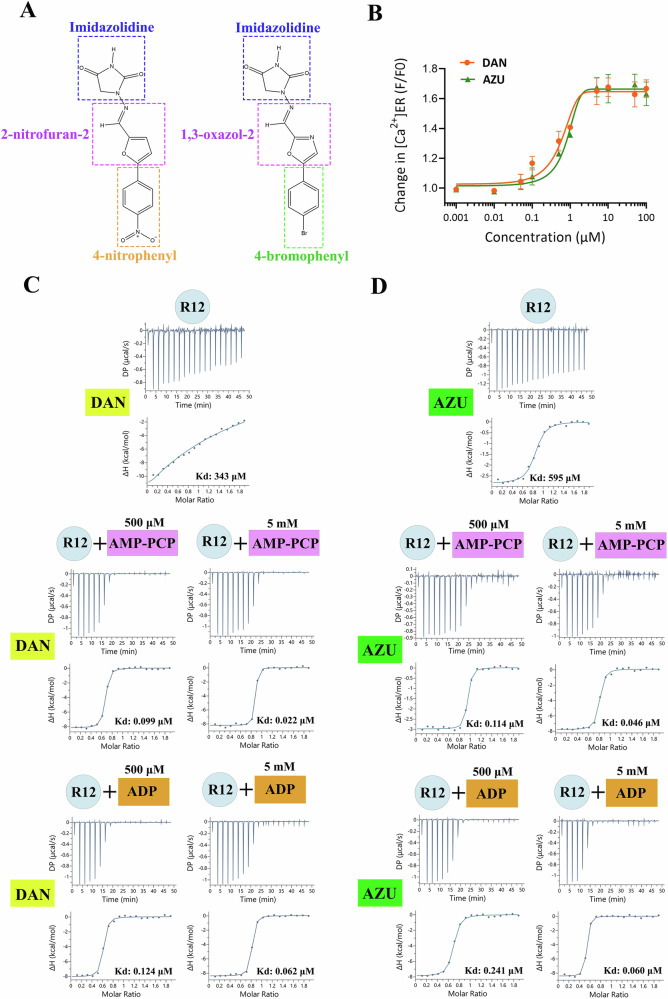 Figure 1
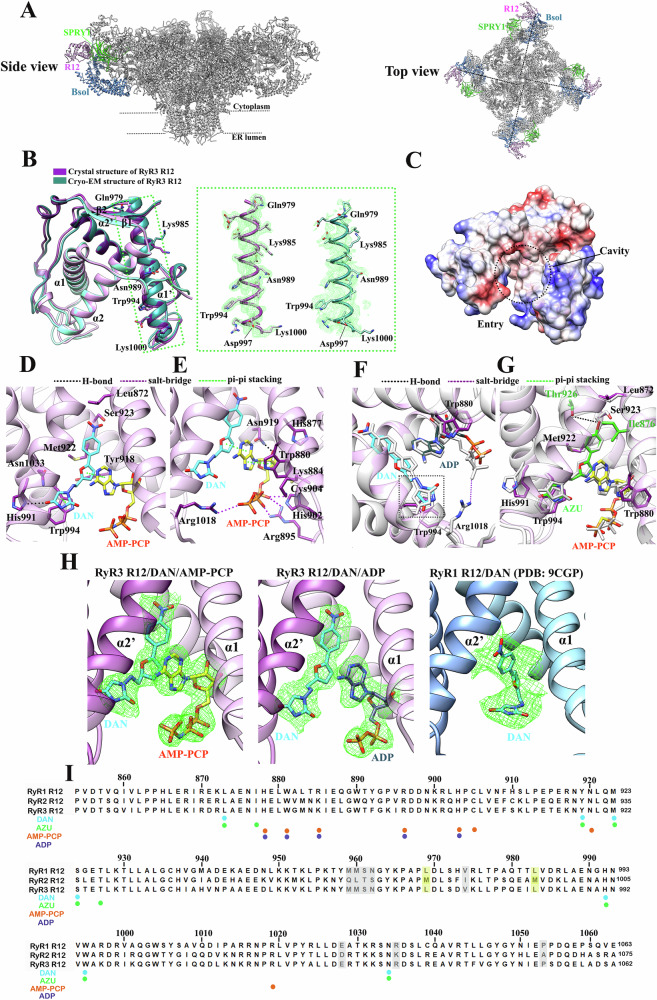 Figure 2
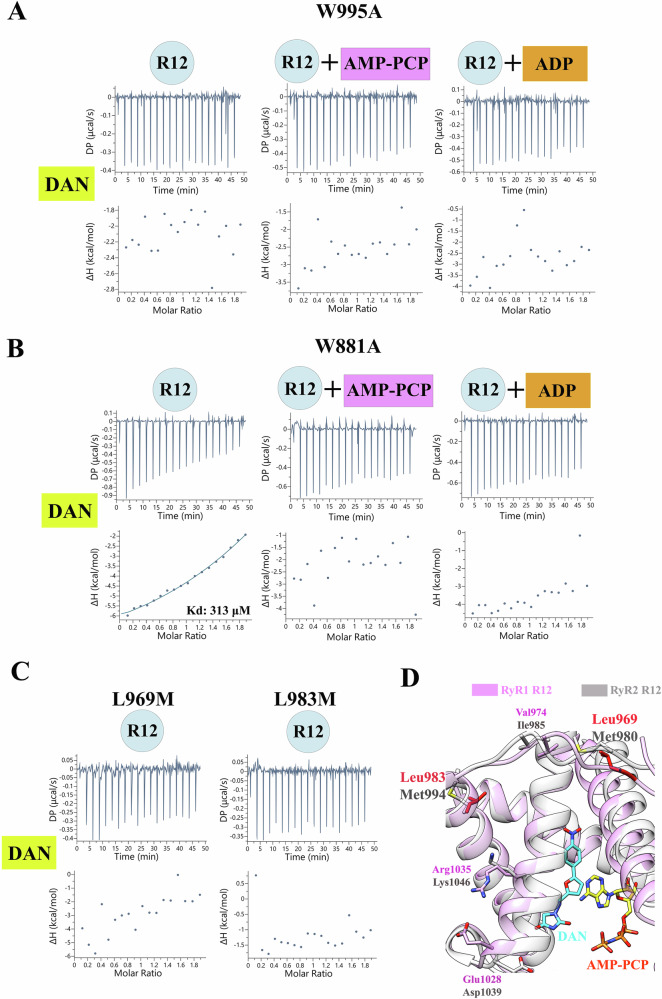 Figure 3
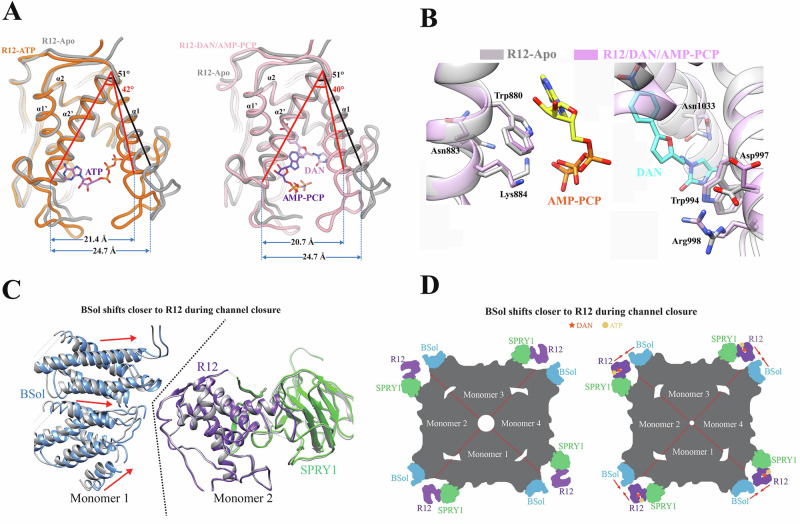 Figure 4
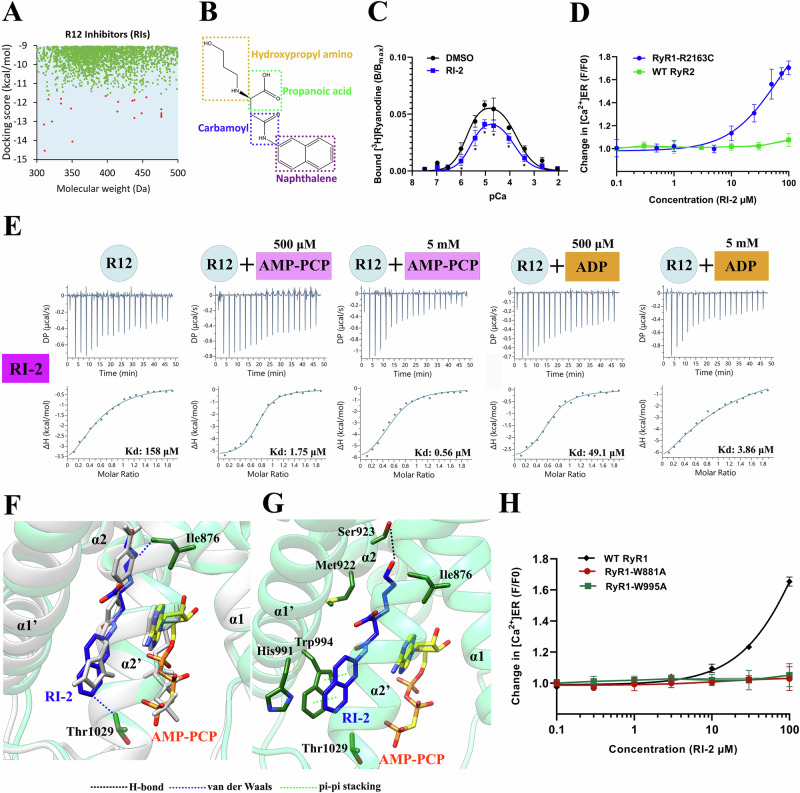 Figure 5
Peer Reviews
No public reviews on file for this paper yet. If you reviewed it on a platform where reviews are public (OpenReview, ICLR, NeurIPS, ICML), you can paste yours below so the community can read it here.
Videos
No videos yet. Explain this paper in a talk, walkthrough, or lecture? Add one.
Taxonomy
TopicsCoordination Chemistry and Organometallics · Crystallography and molecular interactions · Ion channel regulation and function