A dual recurrent neural network model of human-like motion for artificial agents and its evaluation in a VR mirror game turing test
Marius S. Knorr, Jan P. Bremer, Till R. Schneider, Andreas K. Engel, Alexander Maÿe

TL;DR
This paper explores whether artificial agents with human-like motion can be mistaken for humans in a social interaction test.
Contribution
A novel dual recurrent neural network model is proposed and evaluated in a VR Turing test for human-like social interaction.
Findings
Participants correctly identified the interaction partner in 74% of cases.
Subjects were less likely to detect artificial agents when focused on the joint task.
Sensorimotor patterns significantly influence the subjective experience of social interaction.
Abstract
Action-oriented approaches to cognition which emphasize the constitutive role of sensorimotor patterns for perception are gaining importance for the study of cognitive processes in the human brain as well as for endowing artificial agents with cognitive capabilities. It is still debated whether motor-based action-effect contingencies can be extended to social contexts. Here, we investigate the hypothesis that social sensorimotor contingencies (socSMCs) substantially contribute to successful social interaction, and that endowing an artificial agent with socSMCs could make it an interaction partner evaluated like a human. We studied a variant of a Turing test in which human participants had to decide whether they interacted with an artificial agent or another human. To disguise the true nature of the partner, movements were mapped to standardized avatars who interacted in a virtual…
Genes, proteins, chemicals, diseases, species, mutations and cell lines named across the full text — each resolved to its canonical identifier and authoritative record.
Click any figure to enlarge with its caption.
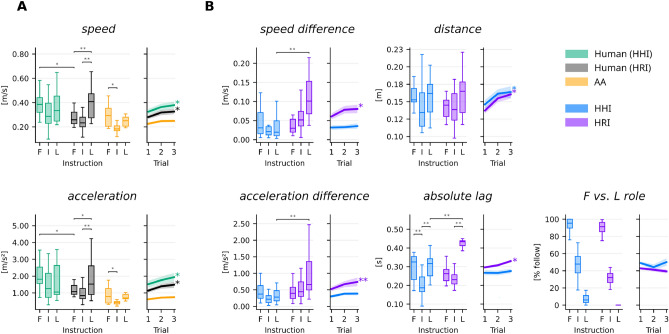 Figure 1
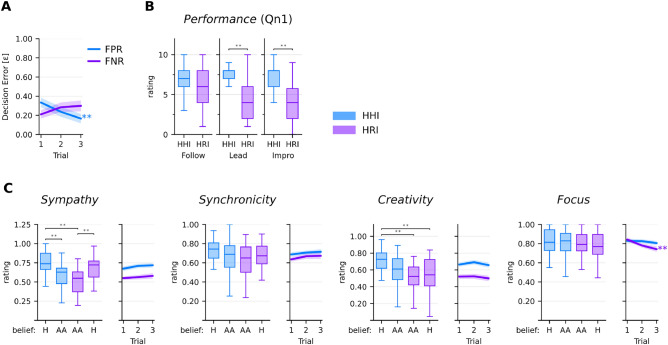 Figure 2
 Figure 3
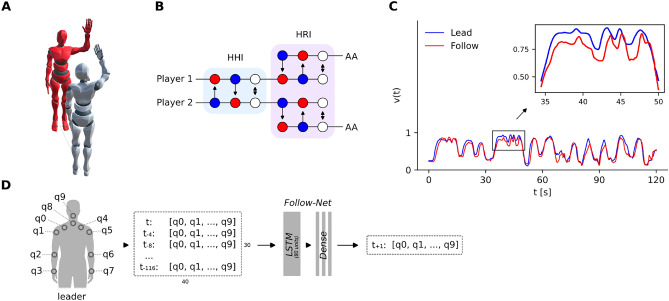 Figure 4
Peer Reviews
No public reviews on file for this paper yet. If you reviewed it on a platform where reviews are public (OpenReview, ICLR, NeurIPS, ICML), you can paste yours below so the community can read it here.
Videos
No videos yet. Explain this paper in a talk, walkthrough, or lecture? Add one.
Taxonomy
TopicsAction Observation and Synchronization · Embodied and Extended Cognition · Social Robot Interaction and HRI