A novel homozygous DST variant causes hereditary sensory and autonomic neuropathy in a Pakistani family
Asad Munir, Helen Nabiryo Frederiksen, Fawad Ali, Sabawoon Shah, Abdur Rashid, Sergey Oreshkov, Kashif Khan, Muhammad Shahzeb, Inam Ullah, Hamid Ur Rahman, Mukhtar Ullah, Muhammad Ansar, Atta Ur Rehman

TL;DR
A new genetic mutation in the DST gene is linked to a rare neurological disorder in two siblings from a Pakistani family.
Contribution
Identifies a novel homozygous DST variant as a cause of hereditary sensory and autonomic neuropathy type 6.
Findings
A homozygous DST variant was found in two affected siblings with HSAN-VI.
The DST mutation is associated with the clinical features of HSAN-VI in this family.
Abstract
Hereditary sensory and autonomic neuropathy type 6 (HSAN-VI) is a rare autosomal recessive neurological disorder that affects fewer than 1 in 1,000,000 individuals worldwide and is characterized by neonatal hypotonia, respiratory and feeding difficulties, impaired motor development and autonomic abnormalities with highly variable age of onset and severity. Here we report a novel homozygous DST variant in association with HSAN-VI in two Pakistani siblings.
Genes, proteins, chemicals, diseases, species, mutations and cell lines named across the full text — each resolved to its canonical identifier and authoritative record.
Click any figure to enlarge with its caption.
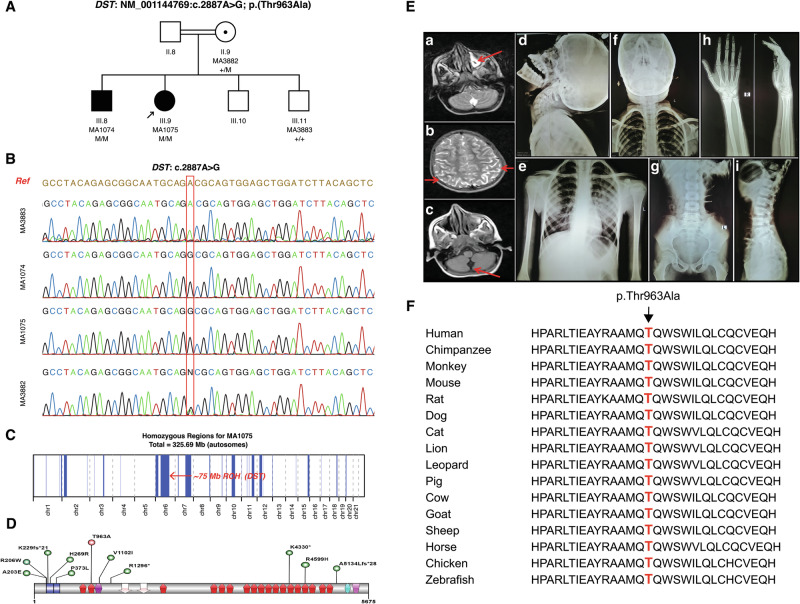 Figure 1
Peer Reviews
No public reviews on file for this paper yet. If you reviewed it on a platform where reviews are public (OpenReview, ICLR, NeurIPS, ICML), you can paste yours below so the community can read it here.
Videos
No videos yet. Explain this paper in a talk, walkthrough, or lecture? Add one.
Taxonomy
TopicsHereditary Neurological Disorders · Genomics and Rare Diseases · Neurological diseases and metabolism