Viral Diseases Explorer: a webtool to identify viral disease information derived from multiple LLMs
Oscar Rojas Labra, Carla M Martinez-Garcia, Nelly Santoyo-Rivera, Daniel Montiel-Garcia, Vijay S Reddy

TL;DR
This paper introduces a webtool that uses AI to identify and explore diseases caused by viruses and their hosts.
Contribution
The novel contribution is a webtool that consolidates viral disease information from multiple AI models.
Findings
Disease information was obtained for 165,363 viruses using AI tools.
The webtool identified 2833 unique diseases affecting 5503 hosts confirmed by three LLMs.
The Viral Diseases Explorer allows users to search for virus-related diseases and hosts.
Abstract
With nearly 266,500 viruses cataloged currently at NCBI and increasing by the day, identifying the diseases they cause, and the affected hosts remains challenging. Hence the motivation for undertaking this study. Utilizing the AI-powered tools, we obtained disease information for 165 363 viruses, identifying 2833 unique diseases affecting 5503 distinct hosts and designated consensus diseases confirmed by three LLMs. Using this information, we developed the Viral Diseases Explorer webtool that enables the searches of diseases linked to specific viruses, viruses causing particular diseases, and viruses infecting specific hosts. Viral Diseases Explorer tool can be accessed from the URL: https://virus-world.org/viral_diseases_explorer.php
Genes, proteins, chemicals, diseases, species, mutations and cell lines named across the full text — each resolved to its canonical identifier and authoritative record.
Click any figure to enlarge with its caption.
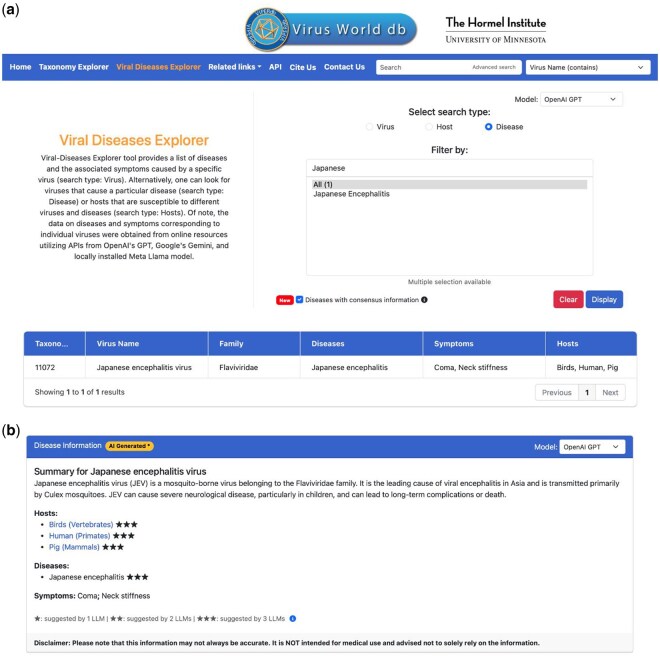 Figure 1
Peer Reviews
No public reviews on file for this paper yet. If you reviewed it on a platform where reviews are public (OpenReview, ICLR, NeurIPS, ICML), you can paste yours below so the community can read it here.
Videos
No videos yet. Explain this paper in a talk, walkthrough, or lecture? Add one.
Taxonomy
TopicsBiomedical Text Mining and Ontologies · Data-Driven Disease Surveillance · vaccines and immunoinformatics approaches